
Ch. 1 The Human Body: An Orientation
Hoehn - Marieb Human Anatomy & Physiology, 12th edition
Hoehn, Haynes, Abbott12th EditionMarieb Human Anatomy & PhysiologyISBN: 9780138242732Not the one you use?Change textbook
Chapter 1, Problem 17

Which of the following relationships is incorrect?
a. Visceral peritoneum/outer surface of small intestine
b. Parietal pericardium/outer surface of heart
c. Parietal pleura/wall of thoracic cavity

Verified step by step guidance
1
Step 1: Understand the definitions of the terms 'visceral' and 'parietal' in the context of serous membranes. 'Visceral' refers to the layer that directly covers an organ, while 'parietal' refers to the layer that lines the body cavity or wall.
Step 2: Analyze option (a): 'Visceral peritoneum/outer surface of small intestine.' Since the visceral peritoneum covers the organs within the abdominal cavity, this relationship is correct.
Step 3: Analyze option (b): 'Parietal pericardium/outer surface of heart.' The parietal pericardium lines the pericardial sac, not the heart itself. The layer covering the heart is the visceral pericardium. Therefore, this relationship is incorrect.
Step 4: Analyze option (c): 'Parietal pleura/wall of thoracic cavity.' The parietal pleura lines the thoracic cavity walls, so this relationship is correct.
Step 5: Conclude that option (b) is the incorrect relationship because the parietal pericardium does not cover the outer surface of the heart; instead, the visceral pericardium does.

Verified video answer for a similar problem:

This video solution was recommended by our tutors as helpful for the problem above.
Video duration:
2m
Was this helpful?

Key Concepts

Here are the essential concepts you must grasp in order to answer the question correctly.

Visceral and Parietal Membranes

Visceral membranes directly cover the organs, while parietal membranes line the walls of body cavities. For example, the visceral peritoneum covers the outer surface of abdominal organs like the small intestine, whereas the parietal peritoneum lines the abdominal cavity walls.
Recommended video:
2:12
Visceral Reflex Arcs

Pericardium Structure and Function

The pericardium is a double-layered membrane surrounding the heart. The visceral pericardium (epicardium) adheres to the heart's surface, while the parietal pericardium lines the fibrous sac enclosing the heart. Understanding this distinction is key to identifying correct relationships.
Recommended video:
06:04
Functional Groups

Pleura and Thoracic Cavity Anatomy

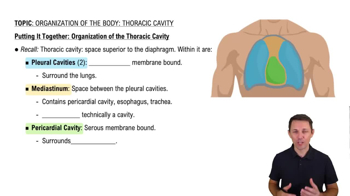
The pleura is a double-layered membrane around the lungs. The visceral pleura covers the lung surface, and the parietal pleura lines the thoracic cavity walls. Recognizing which layer contacts the cavity wall helps determine correct anatomical relationships.
Recommended video:
Guided course
2:51
Organization of the Thoracic Cavity
Related Practice
Textbook Question

a. Make a diagram showing the nine abdominopelvic regions, and name each region. Name two organs (or parts of organs) that could be located in each of the named regions.


b. Make a similar sketch illustrating how the abdominopelvic cavity may be divided into quadrants, and name each quadrant.

2155
views
Textbook Question

Compare and contrast the operation of negative and positive feedback mechanisms in maintaining homeostasis. Provide two examples of variables controlled by negative feedback mechanisms and one example of a process regulated by a positive feedback mechanism.

1981
views
Textbook Question

Relate each of the following conditions or statements to either the dorsal body cavity or the ventral body cavity.

a. Surrounded by the bony skull and the vertebral column

b. Includes the thoracic and abdominopelvic cavities

c. Contains the brain and spinal cord

d. Contains the heart, lungs, and digestive organs

923
views
Textbook Question

Assume that the body has been sectioned along three planes: (1) a median plane, (2) a frontal plane, and (3) a transverse plane made at the level of each of the organs listed below. Which organs would be visible in only one or two of these three cases?

a. Urinary bladder

b. Brain

c. Lungs

d. Kidneys

e. Small intestine

f. Heart

1576
views
Textbook Question

Use as many directional terms as you can to describe the relationship between the elbow's olecranal region and your palm.

1641
views
Textbook Question

Why is an understanding of the anatomical position important?

1651
views