Back

Lipids definitions

Control buttons has been changed to "navigation" mode.
1/15
  • Hydrocarbon

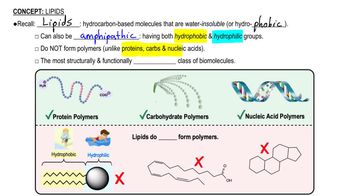
    A structural feature composed of carbon and hydrogen atoms, forming the backbone of molecules that resist mixing with water.
  • Hydrophobic

    A property describing molecules or regions that avoid water, resulting in poor solubility in aqueous environments.
  • Amphipathic

    A characteristic of molecules containing both water-fearing and water-loving regions, enabling unique interactions with membranes.
  • Macromolecule

    A large biomolecule essential for life, distinguished by its size and complexity, such as proteins, carbohydrates, and lipids.
  • Polymer

    A chain-like structure formed by repeating subunits, common in proteins and nucleic acids but absent in lipids.
  • Monomer

    A single molecular unit that can join with others to form polymers, a concept not applicable to lipid structure.
  • Fatty Acid

    A molecule with a hydrocarbon chain and a carboxyl group, serving as a building block for many lipid types.
  • Isoprene

    A five-carbon unit forming the basis of certain lipids, contributing to structural diversity within this biomolecule class.
  • Glycerolipid

    A lipid type built from glycerol and fatty acids, often found in biological membranes and energy storage.
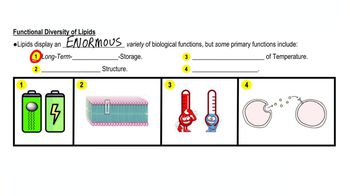
  • Membrane

    A biological structure composed mainly of lipids, providing a barrier and facilitating cellular compartmentalization.
  • Energy Storage

    A function of certain biomolecules, allowing organisms to retain energy for long-term use, especially in hydrocarbon chains.
  • Temperature Regulation

    A biological process influenced by lipids, maintaining optimal conditions for cellular and organismal activity.
  • Cell Signaling

    A communication mechanism between cells, often mediated by specific lipid molecules to coordinate biological responses.
  • Biomolecule

    A molecule produced by living organisms, playing critical roles in structure, function, and regulation of biological systems.
  • Lipid Bilayer

    A double-layered structure formed by amphipathic lipids, fundamental to membrane architecture and function.