Back

Lipids quiz

Control buttons has been changed to "navigation" mode.
1/15
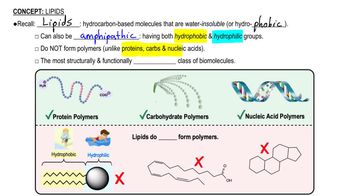
  • What are lipids primarily composed of, and what property does this give them?

    Lipids are primarily composed of hydrocarbons, which makes them hydrophobic or water-insoluble.
  • How do lipids differ from proteins, carbohydrates, and nucleic acids in terms of structure?

    Lipids do not form polymers or long chains of repeating monomer subunits, unlike proteins, carbohydrates, and nucleic acids.
  • What does it mean for a lipid to be amphipathic?

    An amphipathic lipid contains both hydrophobic (water-fearing) and hydrophilic (water-loving) regions.
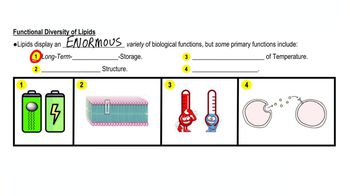
  • List two primary biological functions of lipids.

    Lipids serve as long-term energy storage molecules and as major structural components of biological membranes.
  • How do lipids contribute to temperature regulation?

    Lipids help regulate the temperature of organisms and individual cells, as well as biological activity under different temperatures.
  • What role do lipids play in cell signaling?

    Some lipids act as mediators of cell signaling, allowing cells to communicate with each other.
  • Why are lipids considered structurally and functionally diverse?

    Lipids are diverse because they do not form polymers and have a wide variety of structures and functions.
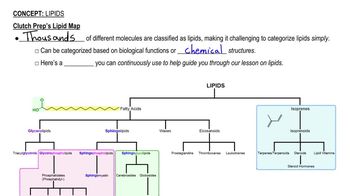
  • How are lipids categorized in the Clutch Prep course?

    Lipids are categorized based on similarities in their chemical structures into fatty acid-based and isoprene-based groups.
  • What are the two main chemical categories of lipids?

    The two main categories are fatty acid-based lipids and isoprene-based lipids.
  • What is the significance of the lipid map introduced in the lesson?

    The lipid map helps organize and predict the order in which different lipid types will be studied based on their chemical structure.
  • Which group of lipids will be studied first according to the lipid map?

    Fatty acid-based lipids will be studied first.
  • What is a common feature found in all lipids?

    All lipids contain hydrocarbon groups that are hydrophobic.
  • Why might textbooks or professors categorize lipids differently?

    Lipids can be categorized based on either their biological functions or their chemical structures, leading to different classification systems.
  • What analogy is used to describe the energy storage function of lipids?

    Lipids are compared to batteries because they can store energy over long periods of time.
  • How does the lipid map reflect the structure of the course?

    The lipid map mirrors the order of topics covered, starting with fatty acid-based lipids and then moving to isoprene-based lipids.