 Back
BackCell Signaling and Membrane Transport: Biochemistry Study Guide
Study Guide - Smart Notes
 Tailored notes based on your materials, expanded with key definitions, examples, and context.
Biosignaling: Types of Cell Communication
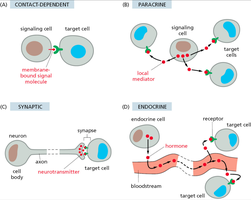
Modes of Cell Signaling
Cells communicate through various mechanisms to regulate physiological processes. The four main types of cell signaling are contact-dependent, paracrine, synaptic, and endocrine signaling.
Contact-Dependent Signaling: Requires direct contact between signaling and target cells via membrane-bound molecules.
Paracrine Signaling: Involves local mediators released by a cell to affect nearby target cells.
Synaptic Signaling: Utilizes neurotransmitters released at synapses between neurons and target cells.
Endocrine Signaling: Uses hormones secreted into the bloodstream to reach distant target cells.
Cellular Responses to Signals
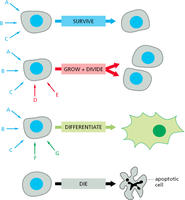
Types of Cellular Outcomes
Cells respond to external signals in diverse ways, including survival, growth, division, differentiation, or apoptosis. The outcome depends on the combination and nature of signals received.
Survive: Signals promote cell survival.
Grow and Divide: Signals stimulate cell proliferation.
Differentiate: Signals induce cell specialization.
Die: Signals trigger programmed cell death (apoptosis).
Signal Transduction Mechanisms
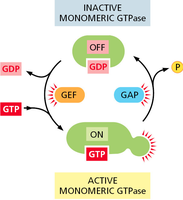
GTPase Switches
Monomeric GTPases act as molecular switches in signal transduction. They cycle between inactive (GDP-bound) and active (GTP-bound) states, regulated by GEFs (guanine nucleotide exchange factors) and GAPs (GTPase-activating proteins).
Inactive State: Bound to GDP.
Activation: GEF promotes exchange of GDP for GTP.
Active State: Bound to GTP, able to transmit signals.
Inactivation: GAP stimulates GTP hydrolysis to GDP.
Receptor Tyrosine Kinases (RTKs)
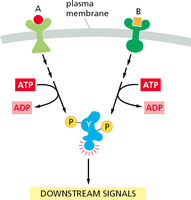
RTKs are membrane receptors that, upon ligand binding, phosphorylate tyrosine residues using ATP, initiating downstream signaling cascades.
Ligand Binding: Activates receptor.
Autophosphorylation: Tyrosine residues are phosphorylated.
Signal Transmission: Phosphorylated sites recruit signaling proteins.
Cellular Effects of Signaling
Fast vs. Slow Responses
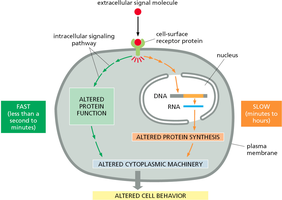
Cell signaling can result in rapid changes in protein function or slower changes in gene expression and protein synthesis.
Fast Responses: Altered protein function (seconds to minutes).
Slow Responses: Altered gene expression and protein synthesis (minutes to hours).
Signal Response Curves
Types of Response Curves
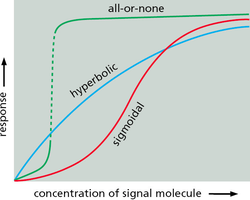
The cellular response to signal concentration can be hyperbolic, sigmoidal, or all-or-none, reflecting different regulatory mechanisms.
Hyperbolic: Gradual increase in response.
Sigmoidal: Cooperative response, often seen in multi-subunit systems.
All-or-None: Threshold effect, response is either fully on or off.
G-Protein Coupled Receptors (GPCRs)
Activation Mechanism
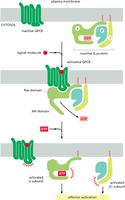
GPCRs are membrane proteins that activate G-proteins upon ligand binding, leading to effector activation and downstream signaling.
Inactive State: GPCR and G-protein are unbound.
Activation: Ligand binding causes conformational change, G-protein exchanges GDP for GTP.
Effector Activation: G-protein subunits activate downstream effectors.
Membrane Transport
Permeability of Molecules
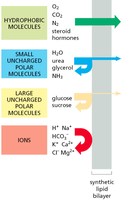
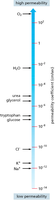
The lipid bilayer selectively allows passage of molecules based on size, polarity, and charge. Hydrophobic molecules pass easily, while ions and large polar molecules require transport proteins.
Hydrophobic Molecules: Easily cross the membrane.
Small Uncharged Polar Molecules: Cross with moderate ease.
Large Uncharged Polar Molecules: Cross with difficulty.
Ions: Require transport proteins.
Transport Proteins
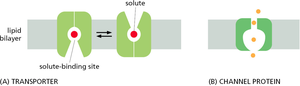
Transport proteins facilitate movement of solutes across membranes. They are classified as transporters (bind and move solutes) or channel proteins (form pores for solute passage).
Transporters: Bind solute and undergo conformational change.
Channel Proteins: Form open channels for rapid solute movement.
Passive and Active Transport
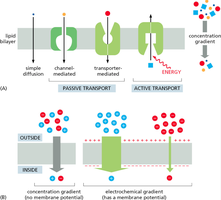
Transport across membranes can be passive (down concentration gradient) or active (against gradient, requiring energy).
Passive Transport: Includes simple diffusion, channel-mediated, and transporter-mediated diffusion.
Active Transport: Requires energy input, often from ATP.
Electrochemical Gradients and Membrane Potential
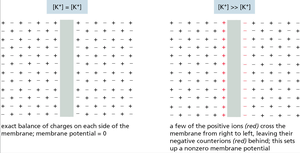
Ion movement across membranes creates electrochemical gradients and membrane potentials, essential for cellular function.
Electrochemical Gradient: Combination of concentration and electrical gradients.
Membrane Potential: Difference in charge across the membrane.
Transport Kinetics
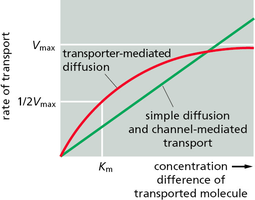
Transporter-mediated diffusion exhibits saturation kinetics similar to enzyme-catalyzed reactions, characterized by and .
Simple Diffusion: Linear relationship with concentration.
Transporter-Mediated Diffusion: Saturates at high solute concentrations.
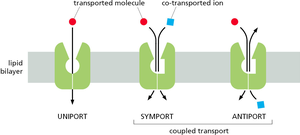
Types of Transport: Uniport, Symport, Antiport
Transporters can move solutes singly (uniport), together (symport), or in opposite directions (antiport).
Uniport: Single solute transported.
Symport: Two solutes transported in same direction.
Antiport: Two solutes transported in opposite directions.
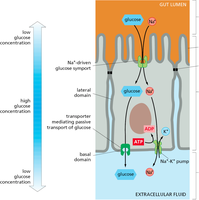
Glucose Transport in Epithelial Cells
Glucose transport across epithelial cells involves coordinated action of Na+-driven symporters, passive transporters, and Na+/K+ pumps.
Na+-Driven Glucose Symport: Moves glucose into cell against gradient.
Passive Transporter: Facilitates glucose exit into extracellular fluid.
Na+/K+ Pump: Maintains ion gradients using ATP.
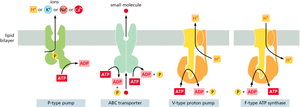
Types of ATP-Driven Pumps
ATP-driven pumps transport ions and small molecules across membranes, maintaining cellular homeostasis.
P-type Pump: Transports ions using ATP.
ABC Transporter: Moves small molecules using ATP.
V-type Proton Pump: Transports protons into organelles.
F-type ATP Synthase: Synthesizes ATP using proton gradient.
Additional info:
These topics are directly relevant to biochemistry chapters on biosignaling, membrane transport, and cellular communication.
Key equations for transporter kinetics:
