 Back
BackDNA: Structure, Properties, and Biological Significance
Study Guide - Smart Notes
 Tailored notes based on your materials, expanded with key definitions, examples, and context.
DNA: Structure and Chemical Properties
Physical and Chemical Structure of DNA
Deoxyribonucleic acid (DNA) is the hereditary material in almost all living organisms. Its structure and chemical properties are fundamental to its function in storing and transmitting genetic information.
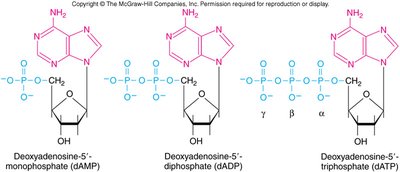
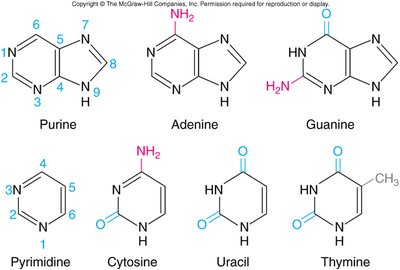
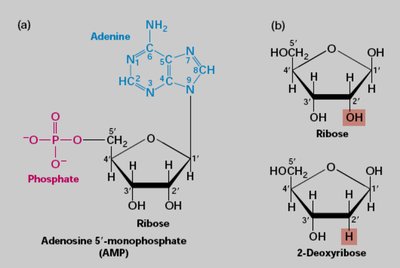
DNA is a polymer of nucleotides, each consisting of a nitrogenous base, a deoxyribose sugar, and a phosphate group.
The four nitrogenous bases in DNA are adenine (A), cytosine (C), guanine (G), and thymine (T).
Nucleotides can have one, two, or three phosphate groups (monophosphate, diphosphate, triphosphate).
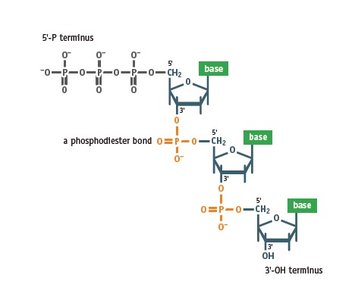
The backbone of DNA is formed by phosphodiester bonds between the 5' phosphate and 3' hydroxyl groups of adjacent sugars.
Hydrophilic Backbone and Hydrophobic Bases
The sugar-phosphate backbone is hydrophilic, allowing DNA to interact with water and proteins.
Nitrogenous bases are hydrophobic and stack inside the helix, away from water.
At neutral pH, phosphate groups are negatively charged, stabilized by interactions with proteins and metal ions.
Light Absorption by Nucleotide Bases
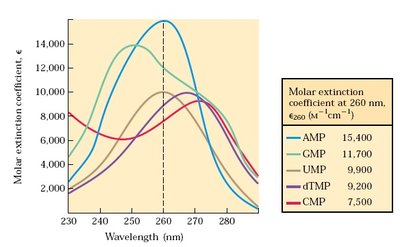
Purines and pyrimidines absorb ultraviolet (UV) light, with a strong absorption peak near 260 nm.
This property is used to quantify DNA and RNA in solution.
Double Helix and Higher-Order Structure
The Double Helix Model
The double helix structure of DNA was elucidated by Watson and Crick, based on X-ray diffraction data from Rosalind Franklin. The model describes two antiparallel strands wound around each other, with base pairs forming the rungs of the helical ladder.
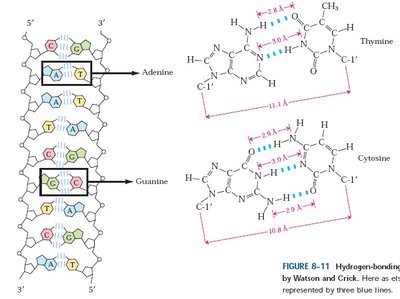
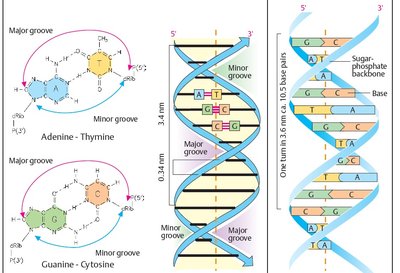
Base pairing: Adenine pairs with thymine (A-T) via two hydrogen bonds; guanine pairs with cytosine (G-C) via three hydrogen bonds.
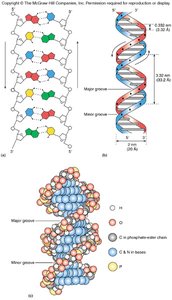
There are about 10 base pairs per turn in B-form DNA.
The two strands are antiparallel (one runs 5'→3', the other 3'→5').
Major and Minor Grooves
The double helix has two grooves: a major groove and a minor groove.
These grooves are important for protein binding and regulation of gene expression.
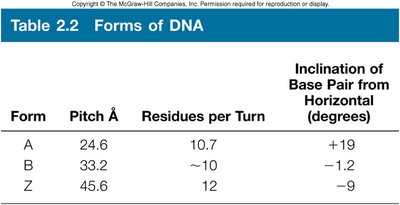
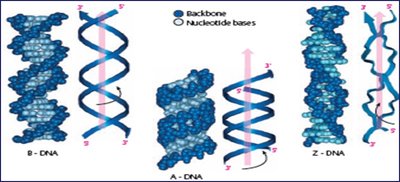
Forms of DNA: A, B, and Z
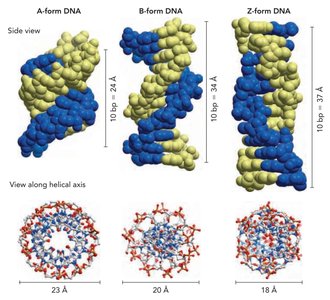
DNA can adopt several conformations depending on environmental conditions and sequence.
B-DNA: The most common form in cells; right-handed helix, 10 bp per turn, 20 Å diameter.
A-DNA: Forms under low humidity; right-handed, 11 bp per turn, 23 Å diameter.
Z-DNA: Left-handed helix, 12 bp per turn, 18 Å diameter; occurs in regions with alternating purine-pyrimidine sequences.
Form | Pitch (Å) | Residues per Turn | Inclination (degrees) |
|---|---|---|---|
A | 24.6 | 10.7 | +19 |
B | 33.2 | ~10 | -1.2 |
Z | 45.6 | 12 | -9 |
DNA Supercoiling
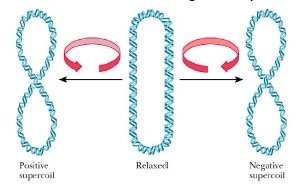
Supercoiling relieves helical stress and compacts DNA.
Topoisomerases are enzymes that introduce or remove supercoils by cutting and rejoining DNA strands.
DNA Denaturation and Renaturation
Denaturation (Melting)
Denaturation refers to the separation of the two DNA strands, usually by heat, high pH, or organic solvents. The temperature at which half of the DNA is denatured is called the melting temperature (Tm).
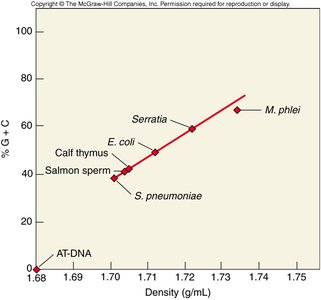
GC content increases Tm due to stronger hydrogen bonding (three bonds in G-C vs. two in A-T).
Denaturation is monitored by increased absorbance at 260 nm (hyperchromic effect).
Renaturation (Annealing) and Hybridization
Separated DNA strands can reassociate under suitable conditions (temperature, concentration, time).
Hybridization refers to the pairing of complementary nucleic acid strands, including DNA-DNA, DNA-RNA, or RNA-RNA.
DNA Sequence, Size, and Genetic Capacity
Base Sequence and Consensus
The sequence of bases encodes genetic information.
Consensus sequences are common motifs found in related DNA regions, important for regulatory functions.
Measuring DNA Size
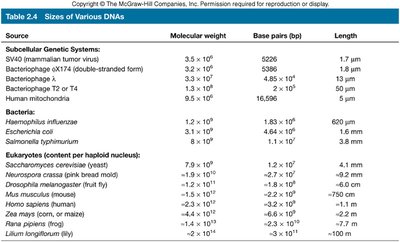
DNA size can be expressed as number of base pairs, molecular weight, or physical length.
Techniques: electron microscopy, gel electrophoresis.
Source | Molecular Weight | Base Pairs (bp) | Length |
|---|---|---|---|
Escherichia coli | 2.8 × 10⁹ | 4.6 × 10⁶ | 1.6 mm |
Human (haploid) | 1.9 × 10¹² | 3.2 × 10⁹ | ~1 m |
Phage λ | 3.2 × 10⁷ | 4.85 × 10⁴ | 16 μm |
Genetic Capacity and the C-Value Paradox
The number of genes is not always proportional to DNA content (C-value paradox).
Much of the extra DNA in some organisms is noncoding.
Chromosome Structure and Specialized DNA Elements
Chromosome Components
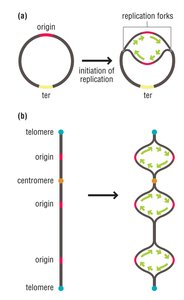
Bacterial chromosomes are typically circular with a single origin of replication.
Eukaryotic chromosomes are linear, with multiple origins, centromeres, and telomeres.
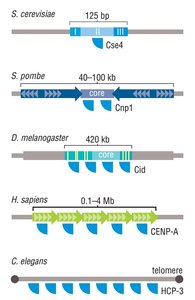
Centromeres
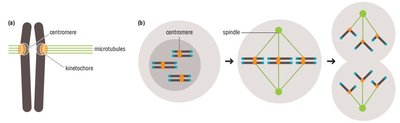
Centromeres are essential for proper chromosome segregation during cell division.
They bind specific proteins to form the kinetochore.
Centromere size and sequence vary among species.
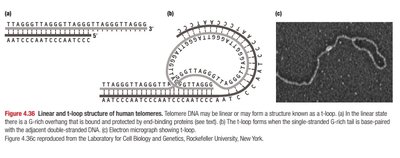
Telomeres
Telomeres are repetitive DNA sequences at chromosome ends, protecting them from degradation.
They play a role in cellular aging and stability.
Mitochondrial and Chloroplast DNA
Both organelles contain their own circular DNA, which is AT-rich, lacks histones, and is present in multiple copies.
These genomes are inherited maternally and encode essential genes for organelle function.
Histones and DNA Packaging
Histones are proteins essential for DNA packaging in eukaryotes, forming nucleosomes and higher-order chromatin structures.
Summary Table: Key Properties of DNA
Property | Description |
|---|---|
Polymer type | Double-stranded helix of nucleotides |
Backbone | Sugar-phosphate, hydrophilic |
Bases | A, T, G, C (hydrophobic, UV-absorbing) |
Base pairing | A-T (2 H-bonds), G-C (3 H-bonds) |
Forms | A, B, Z (differ in pitch, handedness, diameter) |
Supercoiling | Relieves helical stress, compacting DNA |
Denaturation | Separation of strands by heat, pH, solvents |
Renaturation | Reassociation of complementary strands |
Genetic capacity | Not always proportional to DNA amount (C-value paradox) |
Special elements | Origins, centromeres, telomeres |
