 Back
BackGluconeogenesis: Pathways, Regulation, and Physiological Cycles
Study Guide - Smart Notes
 Tailored notes based on your materials, expanded with key definitions, examples, and context.
Gluconeogenesis
Overview of Gluconeogenesis
Gluconeogenesis is the metabolic pathway by which the liver synthesizes glucose from non-carbohydrate precursors, such as pyruvate, lactate, glycerol, and certain amino acids. This process is essential for maintaining blood glucose levels during fasting or intense exercise, especially when dietary glucose and glycogen stores are depleted.
Location: Primarily occurs in the liver (and to a lesser extent, the kidney).
Precursors: Any metabolite that can be converted to pyruvate (e.g., lactate, most amino acids, glycerol) can enter gluconeogenesis.
Energetics: Gluconeogenesis is energetically costly, requiring input of ATP and GTP.
Reversal of Glycolysis: Seven near-equilibrium reactions of glycolysis are reversed, but three metabolically irreversible steps are bypassed using unique enzymes and intermediates.
Net Reaction of Gluconeogenesis
The overall stoichiometry of gluconeogenesis from pyruvate is as follows:
Key Steps and Enzymes in Gluconeogenesis
Bypassing Irreversible Steps of Glycolysis
Three glycolytic reactions are essentially irreversible and must be bypassed in gluconeogenesis:
Pyruvate to Phosphoenolpyruvate (PEP):
Step 1: Pyruvate carboxylase converts pyruvate to oxaloacetate (OAA) in the mitochondria. This reaction is activated by acetyl-CoA and consumes 1 ATP per pyruvate.
Step 2: Phosphoenolpyruvate carboxykinase (PEPCK) converts OAA to PEP, consuming 1 GTP per pyruvate.
Fructose-1,6-bisphosphate to Fructose-6-phosphate:
Fructose-1,6-bisphosphatase catalyzes this hydrolysis, which is metabolically irreversible due to a large negative ΔG.
Inhibited by AMP and fructose-2,6-bisphosphate (F2,6-BP).
Glucose-6-phosphate to Glucose:
Glucose-6-phosphatase hydrolyzes glucose-6-phosphate to free glucose, which is then exported from the liver to the bloodstream.
This reaction occurs in the lumen of the endoplasmic reticulum (ER), requiring transport by GLUT 7.
Regulation of Gluconeogenesis
Hormonal Regulation
Glucagon: Activates gluconeogenesis during fasting by increasing cAMP and upregulating PEPCK gene transcription.
Insulin: Inhibits gluconeogenesis by decreasing PEPCK gene transcription, favoring glycolysis.
Allosteric Regulation
Fructose-1,6-bisphosphatase: Inhibited by AMP and F2,6-BP, which signal low energy and high glucose availability, respectively.
Substrate Availability: Increased concentrations of alanine or lactate stimulate gluconeogenesis.
Gluconeogenesis is tightly coordinated with glycogen metabolism to maintain stable blood glucose levels.
Entry of Non-Carbohydrate Precursors
Glycerol Entry
Glycerol, derived from triglyceride or phospholipid breakdown, enters gluconeogenesis via two enzymatic steps:
Glycerol kinase: Converts glycerol to glycerol-3-phosphate.
Glycerol-3-phosphate dehydrogenase: Converts glycerol-3-phosphate to dihydroxyacetone phosphate (DHAP), an intermediate in gluconeogenesis.
Physiological Cycles Involving Gluconeogenesis
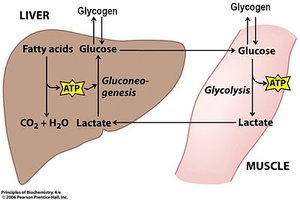
The Cori Cycle
The Cori cycle describes the metabolic cooperation between muscle and liver during anaerobic exercise. Lactate produced by glycolysis in muscle is transported to the liver, where it is converted back to glucose via gluconeogenesis. This glucose can then be returned to muscle for energy production.
Muscle: Glycolysis produces lactate from glucose.
Liver: Lactate is converted to glucose, using ATP derived from fatty acid oxidation.
The Glucose-Alanine Cycle
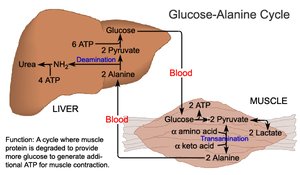
The glucose-alanine cycle is another mechanism for transporting amino acid-derived carbon from muscle to liver. During fasting or prolonged exercise, muscle protein is degraded, and alanine is formed from pyruvate and released into the bloodstream. In the liver, alanine is converted back to pyruvate for gluconeogenesis, while the amino group is excreted as urea.
Muscle: Amino acids are transaminated to form alanine, which is exported to the liver.
Liver: Alanine is deaminated to pyruvate, which enters gluconeogenesis; the amino group enters the urea cycle.
Summary Table: Key Enzymes and Regulation in Gluconeogenesis
Step | Enzyme | Regulation |
|---|---|---|
Pyruvate → Oxaloacetate | Pyruvate carboxylase | Activated by acetyl-CoA |
Oxaloacetate → PEP | PEP carboxykinase (PEPCK) | Upregulated by glucagon, downregulated by insulin |
Fructose-1,6-bisphosphate → Fructose-6-phosphate | Fructose-1,6-bisphosphatase | Inhibited by AMP, F2,6-BP |
Glucose-6-phosphate → Glucose | Glucose-6-phosphatase | Occurs in ER; regulated by substrate availability |
Additional info: The Cori and glucose-alanine cycles are critical for metabolic integration between tissues, allowing the liver to support muscle energy needs during fasting or intense activity. Regulation of gluconeogenesis ensures that glucose is produced only when necessary, preventing wasteful energy expenditure.
