 Back
BackIdentifying Organic Compound Families from Structural Formulas
Study Guide - Smart Notes
 Tailored notes based on your materials, expanded with key definitions, examples, and context.
Q1. To which family of organic compounds do the following compounds belong? Explain.
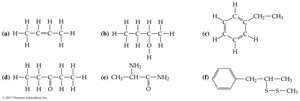
Background
Topic: Functional Groups in Organic Chemistry
This question tests your ability to recognize and classify organic compounds based on their structural formulas. Understanding functional groups is essential in biochemistry, as they determine the chemical properties and reactivity of molecules.
Key Terms and Concepts:
Hydrocarbon: Compound containing only carbon and hydrogen.
Alkene: Hydrocarbon with at least one carbon-carbon double bond.
Alcohol: Compound with an –OH (hydroxyl) group attached to a carbon.
Aromatic Hydrocarbon: Compound with a ring structure containing alternating double bonds (e.g., benzene).
Ketone: Compound with a carbonyl group (C=O) bonded to two carbons.
Amide: Compound with a carbonyl group bonded to a nitrogen atom.
Amine: Compound with a nitrogen atom bonded to carbon(s) and/or hydrogen(s).
Disulfide: Compound containing an S–S bond.
Step-by-Step Guidance
Examine each compound for the elements present (carbon, hydrogen, oxygen, nitrogen, sulfur).
Identify any multiple bonds (double or triple bonds) or ring structures in the molecule.
Look for characteristic functional groups, such as –OH (alcohol), C=O (carbonyl), NH2 (amine), or S–S (disulfide).
Determine if the compound fits into more than one family (e.g., a molecule with both an amide and an amine group).
Use a functional group table or your knowledge to match the structure to the correct family.
Try solving on your own before revealing the answer!
Final Answer:
(a) Hydrocarbon (alkene) – contains only C and H, with a C=C double bond.
(b) Alcohol – contains an –OH group attached to a carbon.
(c) Aromatic hydrocarbon – six-membered ring with alternating double bonds.
(d) Ketone – carbonyl group (C=O) bonded to two carbons.
(e) Amide and amine – contains both a carbonyl group bonded to NH2 (amide) and a separate NH2 (amine).
(f) Aromatic hydrocarbon and disulfide – benzene ring and S–S group.
Each compound is classified based on its functional groups and structural features.
