 Back
BackMonosaccharides and Carbohydrates: Structure, Classification, and Biological Roles
Study Guide - Smart Notes
 Tailored notes based on your materials, expanded with key definitions, examples, and context.
Carbohydrates: Structure and Biological Importance
Overview of Carbohydrates
Carbohydrates are the most abundant biomolecules on Earth, playing critical roles in energy storage, structural integrity, and cellular communication. Their complexity arises from the many ways simple carbohydrate units can combine with each other and with proteins or lipids.
Energy Source: Carbohydrates are oxidized to yield energy for cellular processes.
Energy Storage: Polysaccharides such as starch and glycogen serve as energy reserves.
Structural Role: They form cell walls (e.g., cellulose in plants) and protective coatings in various organisms.
Component of Nucleic Acids: Ribose and deoxyribose sugars are integral to RNA and DNA structure.
Monosaccharides: The Simplest Carbohydrates
Definition and General Structure
Monosaccharides are the simplest units of carbohydrates, with the general formula (CH2O)n, where n typically ranges from 3 to 9 (most commonly 5 or 6). Each monosaccharide contains one carbonyl group (either an aldehyde or a ketone) and multiple hydroxyl (–OH) groups.
Classification by Carbonyl Group:
Aldoses: Monosaccharides with an aldehyde group (e.g., glucose).
Ketoses: Monosaccharides with a ketone group (e.g., fructose).
Classification by Number of Carbons:
Triose: 3 carbons
Tetrose: 4 carbons
Pentose: 5 carbons
Hexose: 6 carbons (e.g., glucose)
Example: Glucose is an aldohexose (an aldehyde monosaccharide with 6 carbons).
Nomenclature and Numbering
The most oxidized carbon in a monosaccharide receives the lowest possible number. Monosaccharides are derivatives of either glyceraldehyde (aldoses) or dihydroxyacetone (ketoses).
Stereochemistry of Monosaccharides
D- and L- Stereoisomers
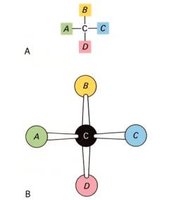
Monosaccharides exhibit stereoisomerism due to the presence of chiral carbons. Each chiral center can give rise to different spatial arrangements, leading to a diversity of isomers. The D- and L- notation refers to the configuration around the chiral carbon furthest from the carbonyl group.
D-Sugars: Most biological sugars are D stereoisomers.
Chirality: The presence of multiple chiral centers increases the number of possible stereoisomers.
Cyclic Structure of Monosaccharides
Cyclization in Aqueous Solution
Monosaccharides predominantly exist in cyclic forms in aqueous solution. The cyclization process creates a new chiral center at the anomeric carbon, resulting in two possible anomers: alpha (α) and beta (β).
Fischer Projections: Used to represent the open-chain form.
Haworth Projections: Used to represent the cyclic form.
Cyclization Mechanism:
Hemiacetal Formation: For aldoses (reaction between an aldehyde and an alcohol group).
Hemiketal Formation: For ketoses (reaction between a ketone and an alcohol group).
Derivatives of Monosaccharides
Common Modifications
Monosaccharides can undergo various chemical modifications, leading to a wide range of derivatives with important biological functions.
Phosphorylation: Addition of phosphate groups to any alcohol group, important in metabolism (e.g., glucose-6-phosphate).
Deoxygenation: Removal of an oxygen atom (e.g., deoxyribose in DNA).
Amino Sugars: Replacement of an –OH group with an amino group (e.g., glucosamine).
Reduction: Reduction of the parent carbonyl group to produce polyhydroxy alcohols (e.g., sorbitol).
Summary Table: Classification of Monosaccharides
Type | Functional Group | Number of Carbons | Example |
|---|---|---|---|
Aldose | Aldehyde | 3 (Triose) | Glyceraldehyde |
Aldose | Aldehyde | 6 (Hexose) | Glucose |
Ketose | Ketone | 3 (Triose) | Dihydroxyacetone |
Ketose | Ketone | 6 (Hexose) | Fructose |
