 Back
BackPhotosynthesis: Light Reactions, Electron Transport, and Energy Conversion
Study Guide - Smart Notes
 Tailored notes based on your materials, expanded with key definitions, examples, and context.
Photosynthesis: Overview and Significance
Introduction to Photosynthesis
Photosynthesis is the process by which light energy is converted into chemical energy, enabling autotrophic organisms to synthesize carbohydrates from carbon dioxide and water. This process is fundamental to life on Earth, as it provides both the organic molecules and oxygen required by most living organisms.
Autotrophs are organisms that produce their own food using light or chemical energy, while heterotrophs rely on consuming organic molecules produced by autotrophs.
Photosynthesis is the reverse of cellular respiration in terms of overall reactants and products.
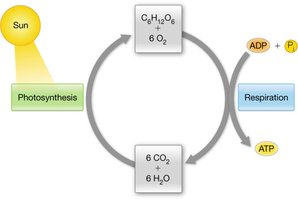
Example: If photosynthesis ceased, higher life forms would become extinct within decades due to the loss of oxygen and organic carbon sources.
The Role of Photosynthesis in Metabolism
Photosynthesis is the ultimate source of energy for nearly all life forms. It provides the starting materials for major biosynthetic pathways, leading from CO2 and H2O to polysaccharides and other biomolecules.
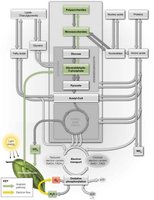
Molecular oxygen (O2) is derived from water and released as a by-product.
Photosynthesis fixes atmospheric CO2, maintaining the carbon and oxygen cycles.
The Basic Processes of Photosynthesis
General Photosynthetic Reaction
The general equation for photosynthesis can be written as:

Where H2A is a general reductant and A is the oxidized product. In oxygenic photosynthesis (plants, algae, cyanobacteria), water is the reductant:

Light and Dark Reactions
Photosynthesis consists of two main subprocesses:
Light reactions: Use sunlight to oxidize H2O to O2, producing ATP and NADPH.
Dark reactions (Calvin Cycle): Utilize ATP and NADPH to fix CO2 into carbohydrates. These reactions do not require light directly.
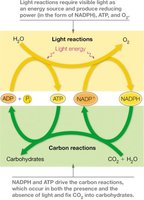
Example: The light reactions generate the reducing power and energy currency (NADPH and ATP) needed for the synthesis of carbohydrates in the Calvin cycle.
Chloroplast Structure and Localization of Photosynthetic Processes
Chloroplast Organization
Photosynthesis takes place in chloroplasts, which are double-membrane organelles containing their own DNA. The inner membrane encloses the stroma, the site of the dark reactions, while the thylakoid membranes house the light reactions.
Thylakoids: Flat, sac-like structures stacked into grana, connected by stroma lamellae.
Stroma: Fluid-filled space where carbohydrate synthesis and starch storage occur.
Thylakoid Membranes
The thylakoid membranes contain all components required for the light reactions:
Light-harvesting proteins
Reaction centers
Electron-transport chains
ATP synthase
Light Absorption and Electron Transfer
Chlorophyll and Accessory Pigments
Photosynthesis begins with the absorption of light by pigments, primarily chlorophyll a. When a photon is absorbed, an electron is excited to a higher energy state.
Chlorophyll a: Cyclic tetrapyrrole with a central magnesium ion, absorbs visible light efficiently.
Accessory pigments: Chlorophyll b, β-carotene, lutein, and others broaden the absorption spectrum.
Energy Transfer Mechanisms
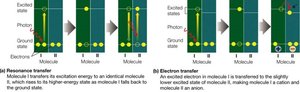
Excited electrons in pigments can transfer energy in two main ways:
Resonance transfer: Excitation energy is transferred to a neighboring pigment molecule.
Electron transfer: The excited electron is transferred to a nearby molecule, resulting in charge separation.
Photosystems and Electron Transport
Photosystems I and II
Plants use two distinct photosystems, each with a reaction center and associated light-harvesting complexes:
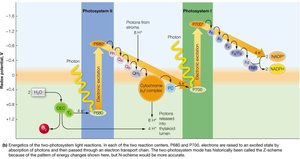
Photosystem II (PSII): Absorbs light at 680 nm (P680), oxidizes water, and transfers electrons to plastoquinone.
Photosystem I (PSI): Absorbs light at 700 nm (P700), generates NADPH by transferring electrons to ferredoxin and then to NADP+.
Electron Flow and the Z Scheme
Electron flow from water to NADP+ involves both photosystems and is known as the Z scheme due to the pattern of energy changes:
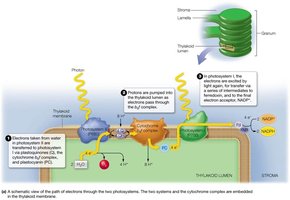
PSII oxidizes water at the manganese center, releasing O2 and protons into the thylakoid lumen.
Electrons are transferred via plastoquinone, cytochrome bf complex, and plastocyanin to PSI.
PSI reduces ferredoxin, which then reduces NADP+ to NADPH.
Proton Gradient and ATP Synthesis
The electron transport chain generates a proton gradient across the thylakoid membrane, with a higher proton concentration (lower pH) in the lumen. This gradient drives ATP synthesis via ATP synthase.
Cytochrome bf complex and water oxidation both contribute to the proton gradient.
ATP and NADPH produced are used in the Calvin cycle for carbon fixation.
Specialized Structures and Molecules
Plastoquinone and Plastoquinol
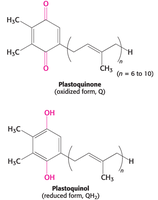
Plastoquinone (Q) is an electron carrier in the thylakoid membrane. Upon reduction, it forms plastoquinol (QH2), which shuttles electrons and protons between PSII and the cytochrome bf complex.
Oxygen-Evolving Complex (OEC)
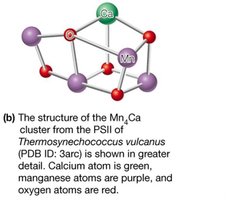
The OEC, also known as the manganese center, is responsible for water oxidation in PSII. It contains a cluster of four manganese ions and one calcium ion bridged by oxygen atoms.
Light-Harvesting Complex II (LHCII)
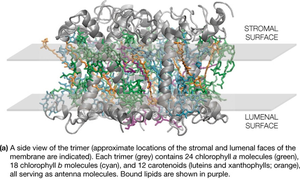
LHCII is the major antenna complex in plants, capturing and transferring light energy to the reaction centers. Each trimer contains multiple chlorophyll a, chlorophyll b, and carotenoid molecules, as well as bound lipids.
Summary Table: Key Steps and Components in Photosynthesis
Step/Component | Function | Location |
|---|---|---|
Light Absorption | Excitation of electrons in pigments | Thylakoid membrane |
Photosystem II | Oxidizes water, generates O2, initiates electron flow | Thylakoid membrane |
Plastoquinone | Electron and proton carrier | Thylakoid membrane |
Cytochrome bf Complex | Transfers electrons, pumps protons | Thylakoid membrane |
Photosystem I | Reduces ferredoxin, generates NADPH | Thylakoid membrane |
ATP Synthase | Synthesizes ATP using proton gradient | Thylakoid membrane |
Calvin Cycle | Fixes CO2 into carbohydrates | Stroma |
Practice Questions
What is the ultimate source of electrons for the synthesis of carbohydrates in plants?
Where do the light reactions of photosynthesis occur within the chloroplast?
What is the main function of the oxygen-evolving complex in PSII?
How is ATP synthesized during photosynthesis?
