 Back
BackPhotosynthesis: The Calvin–Benson Cycle, Photorespiration, and Regulation
Study Guide - Smart Notes
 Tailored notes based on your materials, expanded with key definitions, examples, and context.
Photosynthesis: Overview and Key Processes
Introduction to Photosynthesis
Photosynthesis is the fundamental process by which plants, algae, and some bacteria convert light energy into chemical energy, producing organic compounds and oxygen from carbon dioxide and water. This process is essential for life on Earth, as it forms the basis of the food chain and maintains atmospheric oxygen levels.
Light Reactions: Capture light energy to produce ATP and NADPH, and release O2 by splitting water.
Dark (Carbon) Reactions: Use ATP and NADPH to fix CO2 into carbohydrates via the Calvin–Benson cycle.
Photorespiration and the C4 Cycle
Photorespiration: Low CO2 and High O2 Conditions
Under conditions of low CO2 and high O2, plants undergo photorespiration, a process in which O2 is consumed and CO2 is released. This occurs because the enzyme Rubisco acts as an oxygenase, incorporating O2 into ribulose-1,5-bisphosphate (RuBP) to form 2-phosphoglycolate.
Consequences: Loss of RuBP, consumption of O2, release of CO2, and expenditure of ATP.
Only about 75% of the carbon is recovered; the rest is lost as CO2.
C4 Plants: Conserving CO2
Some plants have evolved the C4 pathway to minimize photorespiratory losses. In this pathway, CO2 is initially fixed into a four-carbon compound (oxaloacetate) in mesophyll cells, which is then converted to malate and transported to bundle sheath cells. There, malate is decarboxylated to release CO2 for the Calvin–Benson cycle, effectively concentrating CO2 around Rubisco and reducing photorespiration.
Key Steps: CO2 + phosphoenolpyruvate (PEP) → oxaloacetate → malate → CO2 (in bundle sheath cells).
Advantage: Enhanced efficiency of photosynthesis in hot, dry environments.
The Calvin–Benson Cycle
Overview and Stages
The Calvin–Benson cycle operates in the chloroplast stroma and is responsible for fixing atmospheric CO2 into carbohydrates. The cycle can be divided into three main phases: carboxylation, reduction, and regeneration.
Carboxylation: CO2 is added to RuBP by Rubisco, forming 3-phosphoglycerate (3-PGA).
Reduction: 3-PGA is phosphorylated and reduced to glyceraldehyde-3-phosphate (GAP) using ATP and NADPH.
Regeneration: Most GAP is recycled to regenerate RuBP, while some is used for starch and sucrose synthesis.
Key Enzymes: Rubisco, 3-phosphoglycerate kinase (PGK), glyceraldehyde-3-phosphate dehydrogenase (GAPDH), fructose-1,6-bisphosphatase (FBPase), transketolase (TK), sedoheptulose-1,7-bisphosphatase (SBPase), ribulose-5-phosphate kinase (PRK), and others.
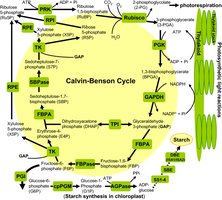
Fates of Glyceraldehyde-3-Phosphate (GAP)
Starch Synthesis: Some GAP remains in the chloroplast and is converted to starch via intermediates such as fructose-6-phosphate (F6P).
Sucrose Synthesis: GAP exported to the cytosol is used for sucrose production.
Regeneration: GAP is recycled to regenerate RuBP, ensuring the cycle continues.
Starch Biosynthesis Pathway
Within the chloroplast, the Calvin–Benson intermediate F6P is redirected into starch production. Key enzymes include phosphoglucose isomerase (PGI), chloroplast phosphoglucomutase (cpPGM), ADP-glucose pyrophosphorylase (AGPase), starch synthases (SS1–SS4), starch-branching enzyme (SBE), and debranching enzymes (DBE, including ISA1 and ISA2).
Key Reactions and Enzymes in Photosynthesis
Rubisco Activase (RCA): Uses ATP to remove inhibitory sugar phosphates from Rubisco, activating it.
Fructose 1,6-bisphosphatase (FBPase): Hydrolyzes fructose 1,6-bisphosphate to fructose 6-phosphate in the Calvin cycle's regeneration phase.
Glyceraldehyde 3-phosphate dehydrogenase (GAPDH): Reduces 1,3-bisphosphoglycerate to GAP using NADPH.
Ribulose 5-phosphate kinase (PRK): Phosphorylates ribulose 5-phosphate to RuBP using ATP.
ATP Synthesis in Chloroplasts
Jagendorf’s Demonstration
Jagendorf’s experiment demonstrated that chloroplasts can synthesize ATP when a pH gradient is imposed across the thylakoid membrane, supporting the chemiosmotic theory.
Chloroplast ATP Synthase
The ATP synthase of chloroplasts (CF1–CF0 complex) closely resembles the mitochondrial F1–F0 complex. Newly synthesized ATP is released into the stroma for carbohydrate synthesis. The orientation of the complex is reversed compared to mitochondria.
Regulation of ATP Synthase
Activated by reduction of a disulfide bond in the γ subunit by reduced thioredoxin (from ferredoxin via ferredoxin–thioredoxin reductase).
Proton-motive force induces conformational changes in the ε subunit, enhancing activity.
Ensures ATP synthesis is coordinated with light reactions and reducing power availability.
Electron Flow and Photophosphorylation
Cyclic Electron Flow
When NADPH needs are met, electrons from photosystem I can cycle back through cytochrome bf and plastocyanin, generating ATP without producing NADPH or O2. This is called cyclic photophosphorylation.
Photon Requirements
Eight photons yield one O2, two NADPH, and three ATP molecules (non-cyclic).
Two photons yield one ATP (cyclic), but no NADPH.
Protective Mechanisms and Organization
Accessory Pigments and Nonphotochemical Quenching (NPQ)
Accessory pigments transfer energy to reaction centers and protect against photodamage by dissipating excess energy as heat (NPQ), preventing formation of reactive oxygen species (ROS). Carotenoids are essential for this protection.
Thylakoid Membrane Organization
Stacked (appressed) regions: Contain photosystem II.
Unstacked (nonappressed) regions: Contain photosystem I and ATP synthase, facilitating access to stroma enzymes.
Regulation of Photosynthesis
Rubisco Regulation
Stimulated by high pH, CO2, and Mg2+ in the stroma (resulting from light-driven proton pumping).
Activated by Rubisco activase, which is itself regulated by a ferredoxin/thioredoxin-dependent disulfide reduction pathway.
Inhibited by transition-state analogs such as 2-carboxy-D-arabinitol-1-phosphate (CA1P).
Light-Dependent Activation of Carbon-Reaction Enzymes
Rubisco activase, FBPase, GAPDH, and PRK are activated by reduction of disulfide bonds via the ferredoxin/thioredoxin pathway.
This ensures that carbon fixation enzymes are active only when light is available.
Applications and Crop Improvement
Artificial Photosynthesis and Crop Yield Enhancement
Artificial systems aim to mimic photosynthesis for clean energy production (e.g., perovskite-based photovoltaic cells).
Improving NPQ shutdown rates can increase crop yields, as demonstrated in tobacco plants with faster NPQ deactivation.
Herbicides and Photosynthesis Inhibition
Herbicides such as diuron and atrazine inhibit photosystem II, blocking electron flow.
Paraquat inhibits photosystem I and generates ROS, damaging cellular components.
Summary Table: Key Enzymes of the Calvin–Benson Cycle
Enzyme | Function |
|---|---|
Rubisco | Carboxylates RuBP, initiating CO2 fixation |
PGK | Phosphorylates 3-phosphoglycerate to 1,3-bisphosphoglycerate |
GAPDH | Reduces 1,3-bisphosphoglycerate to GAP |
FBPase | Hydrolyzes fructose 1,6-bisphosphate to fructose 6-phosphate |
PRK | Phosphorylates ribulose 5-phosphate to RuBP |
SBPase | Hydrolyzes sedoheptulose 1,7-bisphosphate |
TK | Transfers two-carbon units between sugars |
Key Equations
Overall Calvin–Benson Cycle (for 3 CO2):
Photorespiration (simplified):
