 Back
BackRNA and Protein Synthesis: Structure, Function, and Regulation
Study Guide - Smart Notes
 Tailored notes based on your materials, expanded with key definitions, examples, and context.
RNA and Protein Synthesis
Overview of the Central Dogma
The central dogma of molecular biology describes the flow of genetic information from DNA to RNA to protein. This process is fundamental to all living organisms and underlies the mechanisms of gene expression and regulation.
DNA serves as the template for RNA synthesis (transcription).
RNA carries genetic information and is translated into proteins (translation).
Proteins are the functional molecules responsible for cellular structure and activity.

Types and Functions of RNA
Ribosomal RNA (rRNA)
rRNA is a structural and functional component of ribosomes, facilitating protein synthesis by providing a platform for mRNA and tRNA interaction.
Prokaryotic ribosomes contain 5S, 16S, and 23S rRNA.
Eukaryotic ribosomes contain 5S, 5.8S, 18S, and 28S rRNA.
rRNA sequences are complementary to regions of mRNA, aiding in translation.
Transfer RNA (tRNA)
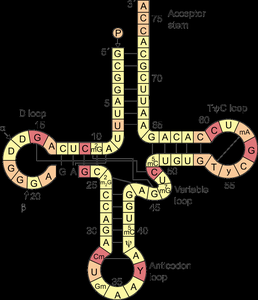
tRNA acts as an adaptor molecule, carrying amino acids to the ribosome and matching them to the appropriate codons in mRNA during translation.
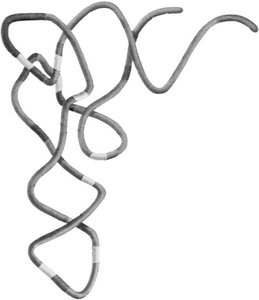
Has a cloverleaf secondary structure and a complex 3D tertiary structure.
Contains modified bases such as dihydrouridine (DHU), ribosylthymine (rT), pseudouridine (Ψ), and inosine (I).
3'-end (acceptor stem) is the site of amino acid attachment.
Other Non-coding RNAs
Non-coding RNAs do not encode proteins but play essential roles in gene regulation and RNA processing.
snRNA: Involved in splicing.
snoRNA: rRNA processing.
miRNA & siRNA: Inhibit gene expression by binding to target mRNA sequences.
piRNA: Repression of transposons and chromatin modification.
lncRNA: Regulates gene expression.
Messenger RNA (mRNA)
mRNA carries genetic information from DNA to the ribosome for protein synthesis.
Prokaryotic mRNAs are polycistronic (carry information for several polypeptides).
Eukaryotic mRNAs are monocistronic (one polypeptide per mRNA), contain introns and exons, and undergo post-transcriptional modifications.
Initiation codon: AUG; Termination codons: UAG, UGA, UAA.
Enzymatic Synthesis of RNA (Transcription)
RNA Synthesis Mechanism
RNA is synthesized from ribosyl-NTPs (A, G, C, U) by RNA polymerase, which does not require a primer. The RNA chain grows in the 5' to 3' direction, and the RNA strand is antiparallel to the DNA template strand.
Phosphodiester bond formation between 3'-OH and 5'-P.
5'-end of RNA has a triphosphate group.
Transcription in Eukaryotes
Eukaryotic transcription involves three RNA polymerases, each responsible for different types of RNA.
Pol I: rRNA (nucleolus), insensitive to amanitin.
Pol II: mRNA and snRNA, strongly inhibited by amanitin.
Pol III: tRNA, 5S rRNA, inhibited by high amanitin concentration.
Promoters include TATA box and CAAT box.
Many non-polymerase factors are required for enzyme binding to DNA.
Post-Transcriptional Modifications of mRNA
Eukaryotic mRNA Processing
Newly synthesized mRNA undergoes several modifications to become mature and functional.
5' capping: Addition of 7-methylguanosine to protect mRNA from degradation.
Polyadenylation: Addition of a poly(A) tail at the 3' end, signaled by AAUAAA sequence.
Splicing: Removal of introns and joining of exons by the spliceosome (complex of snRNAs and proteins).
Alternative splicing and RNA editing allow for the production of modified proteins.
RNA Editing Example: Apolipoprotein B
RNA editing can change the protein product by modifying specific nucleotides in the mRNA.
Human APO-B gene: Codon 2153 (CAA) encodes glutamine (Gln).
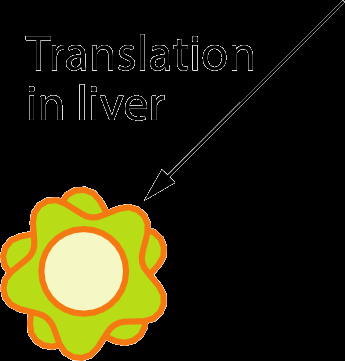
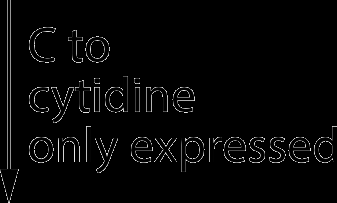
In the intestine, cytidine deaminase converts CAA to UAA (stop codon), producing a truncated protein.
Translation: Protein Synthesis
The Genetic Code
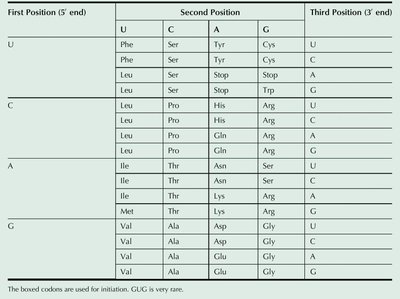
The genetic code consists of 64 codons, each specifying an amino acid or a start/stop signal. It is nearly universal among organisms.
Sixty-one codons correspond to 20 amino acids (degeneracy).
AUG: Start codon (Met); GUG: Rarely used as start.
UAA, UAG, UGA: Stop codons.
Exceptions exist in mitochondrial genetic code.
Initiation of Translation in Prokaryotes and Eukaryotes
Translation initiation involves the assembly of the ribosome, mRNA, and initiator tRNA. Differences exist between prokaryotic and eukaryotic systems.
Prokaryotes: Coupled transcription and translation; polycistronic mRNA.
Eukaryotes: Monocistronic mRNA; transcription and translation are separated.
Post-Translational Modifications of Proteins
Types of Modifications
Proteins undergo various modifications after translation to become fully functional.
Deformylation and removal of N-terminal amino acids.
Acylation, methylation, hydroxylation, carboxylation, phosphorylation.
Attachment of prosthetic groups (e.g., heme, biotin).
Glycosylation and disulfide bond formation.
Clinical Disorders Related to Post-Translational Modifications
Mucolipidosis II (I-cell disease): Mislocalization of lysosomal enzymes due to lack of mannose-6-phosphate.
α1-antitrypsin deficiency: Defects in secretion, leading to lung and liver damage.
Inhibitors of Protein Synthesis: Antibiotics
Mechanisms of Inhibition
Various antibiotics inhibit protein synthesis by targeting different steps in translation.
Aminoglycosides: Prevent correct initiation by interfering with formyl-tRNA binding.
Puromycin: Causes premature chain termination.
Tetracyclines: Inhibit aminoacyl-tRNA binding to the 30S subunit.
Macrolides: Inhibit peptide bond formation and translocation.
Lincosamides: Interfere with aminoacyl end binding and destabilize ribosomes.
Chloramphenicol: Inhibits peptidyl transferase activity.
Inhibitors of Protein Synthesis in Eukaryotes
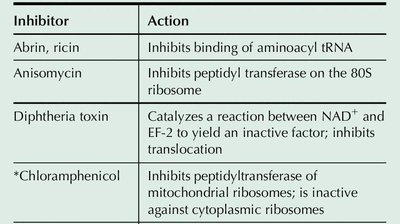
Some inhibitors specifically target eukaryotic ribosomes or mitochondrial ribosomes.
Inhibitor | Action |
|---|---|
Abrin, ricin | Inhibits binding of aminoacyl tRNA |
Anisomycin | Inhibits peptidyl transferase on the 80S ribosome |
Diphtheria toxin | Catalyzes a reaction between NAD+ and EF-2 to yield an inactive factor; inhibits translocation |
Chloramphenicol | Inhibits peptidyltransferase of mitochondrial ribosomes; inactive against cytoplasmic ribosomes |
Inhibitor | Action |
|---|---|
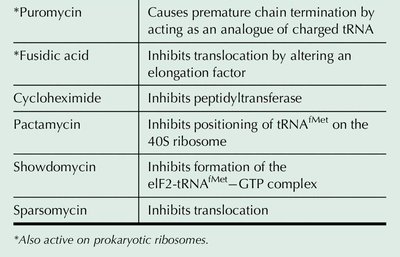
Puromycin | Causes premature chain termination by acting as an analogue of charged tRNA |
Fusidic acid | Inhibits translocation by altering an elongation factor |
Cycloheximide | Inhibits peptidyltransferase |
Pactamycin | Inhibits positioning of tRNAfMet on the 40S ribosome |
Showdomycin | Inhibits formation of the eIF2-tRNAfMet-GTP complex |
Sparsomycin | Inhibits translocation |
Collagen Biosynthesis and Disorders
Collagen Structure and Biosynthesis
Collagen is the primary structural protein in animal extracellular matrices, providing strength and elasticity.
Basic unit: Tropocollagen, composed of three polypeptide chains (Gly-X-Y repeats).
Post-translational modifications: Hydroxylation, glycosylation, folding, conversion to collagen, self-assembly, oxidative deamination.
Intracellular steps: Synthesis and assembly of procollagen.
Extracellular steps: Transformation to collagen and incorporation into fibrils.
Collagen Disorders
Ehlers-Danlos Syndrome (EDS): Connective tissue disorder with multiple types, caused by defects in collagen synthesis or processing.
Scurvy: Vitamin C deficiency leading to defective collagen and blood vessels.
Epidermolysis bullosa simplex: Glycosylation defect in collagen.
Osteogenesis Imperfecta: Disorder of type I collagen, caused by mutations in COL1A1 or COL1A2.
Lathyrism: Inactivation of lysyl oxidase, affecting collagen and elastin tissues.
Marfan syndrome: Mutation in fibrillin-1 gene, affecting collagen crosslinking.
Menkes’ syndrome: Deficiency in copper-containing enzymes, affecting collagen and other tissues.
