 Back
BackRNA Structure, Function, and Types in Biochemistry
Study Guide - Smart Notes
 Tailored notes based on your materials, expanded with key definitions, examples, and context.
RNA Structure and Function
Overview of RNA
Ribonucleic acid (RNA) is a fundamental biomolecule involved in various cellular processes, including protein synthesis and gene regulation. Unlike DNA, RNA is typically single-stranded and can fold into complex secondary and tertiary structures due to intramolecular base pairing.
Single-stranded nature: RNA does not form a regular double helix like DNA but can create secondary structures such as hairpins and loops.
Base pairing: Hydrogen bonds between complementary bases allow RNA to form intricate shapes essential for its function.
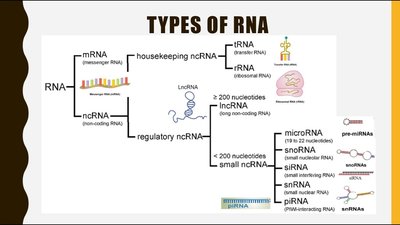
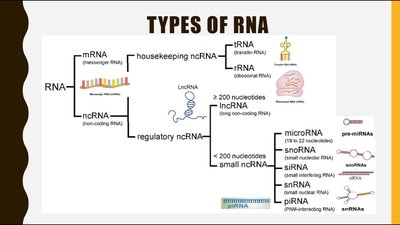
Types of RNA: There are three main types of RNA involved in protein synthesis: messenger RNA (mRNA), transfer RNA (tRNA), and ribosomal RNA (rRNA). Additionally, various non-coding RNAs (ncRNAs) play regulatory roles.
RNA Structure
Chemical and Structural Features
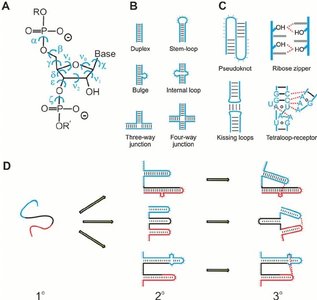
RNA molecules are composed of ribonucleotides linked by phosphodiester bonds. The presence of a 2'-hydroxyl group on the ribose sugar distinguishes RNA from DNA and contributes to its structural diversity.
Primary structure: Linear sequence of nucleotides (A, U, G, C).
Secondary structure: Includes stem-loops, bulges, and junctions formed by base pairing.
Tertiary structure: Complex three-dimensional folding stabilized by additional interactions.
Types of RNA Involved in Protein Synthesis
Messenger RNA (mRNA)
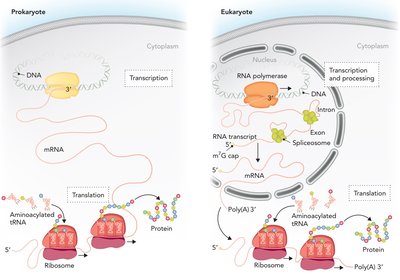
mRNA serves as the blueprint for protein synthesis, carrying genetic information from DNA to ribosomes. In prokaryotes, mRNA can be translated immediately after transcription, while in eukaryotes, it undergoes additional processing such as capping, splicing, and polyadenylation.
Monogenic mRNA: Encodes a single polypeptide.
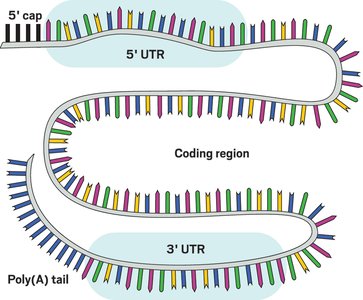
5' Cap: A 7-methylguanosine cap protects mRNA from degradation and assists in ribosome binding.
3' Poly(A) tail: A stretch of adenine residues enhances mRNA stability and export from the nucleus.
UTRs: Untranslated regions at both ends regulate translation and mRNA stability.
Transfer RNA (tRNA)
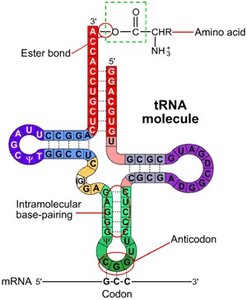
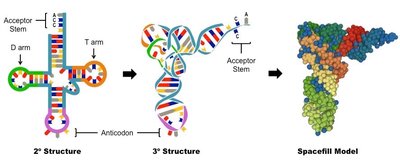
tRNA molecules function as adaptors, bringing specific amino acids to the ribosome during translation. Each tRNA has an anticodon that pairs with the corresponding mRNA codon and an acceptor stem for amino acid attachment.
Cloverleaf structure: tRNA folds into a characteristic secondary structure with several arms and loops.
Anticodon loop: Contains a triplet sequence complementary to the mRNA codon.
3' CCA end: The site of amino acid attachment, essential for protein synthesis.
Aminoacyl-tRNA: tRNA charged with its specific amino acid.
Ribosomal RNA (rRNA)
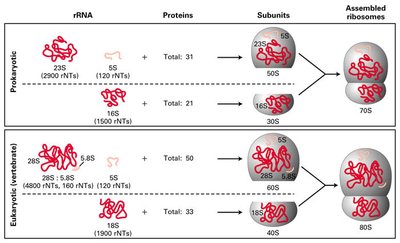
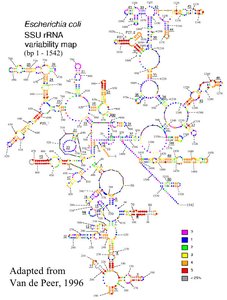
rRNA molecules are structural and catalytic components of ribosomes, the cellular machinery for protein synthesis. rRNA interacts with ribosomal proteins to form the small and large subunits of ribosomes.
Prokaryotic rRNA: 5S, 16S, and 23S rRNAs form the 30S and 50S subunits, assembling into the 70S ribosome.
Eukaryotic rRNA: 5S, 5.8S, 18S, and 28S rRNAs form the 40S and 60S subunits, assembling into the 80S ribosome.
Function: rRNA catalyzes peptide bond formation and ensures proper alignment of mRNA and tRNAs.
Regulatory Non-Coding RNAs
Overview of Non-Coding RNAs (ncRNAs)
Non-coding RNAs are RNA molecules that do not encode proteins but play crucial roles in gene regulation, RNA processing, and genome stability. They are classified by size and function into small and long ncRNAs.
Small ncRNAs: Include microRNA (miRNA), small interfering RNA (siRNA), small nuclear RNA (snRNA), and small nucleolar RNA (snoRNA).
Long ncRNAs (lncRNA): Typically longer than 200 nucleotides, involved in chromatin remodeling, transcriptional regulation, and other processes.
MicroRNA (miRNA) and Short Interfering RNA (siRNA)
miRNAs and siRNAs are small regulatory RNAs that mediate gene silencing through mRNA degradation or translational repression. They are processed from longer precursors and incorporated into the RNA-induced silencing complex (RISC).
miRNA: Endogenously encoded, regulates gene expression post-transcriptionally.
siRNA: Often derived from exogenous or endogenous double-stranded RNA, triggers mRNA cleavage.
RISC: Protein complex that mediates RNA silencing.
Small Nuclear RNA (snRNA) and Small Nucleolar RNA (snoRNA)
snRNAs are essential for pre-mRNA splicing, forming the core of the spliceosome. snoRNAs guide chemical modifications of rRNA, tRNA, and snRNA.
snRNA: Involved in splicing of pre-mRNA in the nucleus.
snoRNA: Directs methylation and pseudouridylation of other RNAs.
Long Non-Coding RNA (lncRNA)
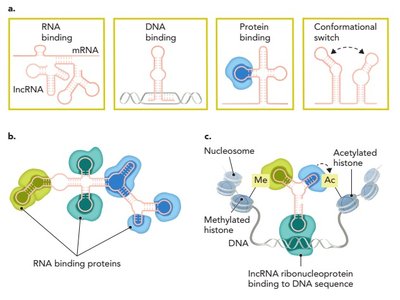
lncRNAs are involved in diverse regulatory functions, including chromatin modification, transcriptional regulation, and scaffolding of protein complexes. They can interact with DNA, RNA, and proteins to modulate gene expression.
Modes of action: RNA binding, DNA binding, protein binding, and conformational switching.
Examples: XIST (X-chromosome inactivation), HOTAIR (chromatin remodeling).
Other Regulatory RNAs
PIWI-interacting RNA (piRNA): Regulates gene expression at the transcriptional and translational levels, especially in germ cells.
TERC RNA: Telomerase RNA component, essential for telomere maintenance.
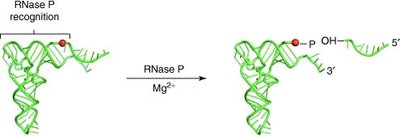
Ribonuclease P (RNase P): A ribozyme involved in tRNA processing.
Summary Table: Abundant RNA Species in Cells
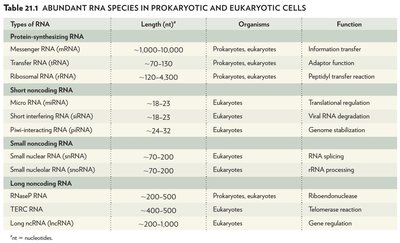
The following table summarizes the main types of RNA, their lengths, organisms in which they are found, and their primary functions.
Types of RNA | Length (nt) | Organisms | Function |
|---|---|---|---|
Messenger RNA (mRNA) | ~1,000–10,000 | Prokaryotes, eukaryotes | Information transfer |
Transfer RNA (tRNA) | ~70–130 | Prokaryotes, eukaryotes | Adaptor function |
Ribosomal RNA (rRNA) | ~120–4,300 | Prokaryotes, eukaryotes | Peptidyl transferase reaction |
Micro RNA (miRNA) | ~18–25 | Eukaryotes | Translational regulation |
Short interfering RNA (siRNA) | ~21–23 | Eukaryotes | Viral RNA degradation |
Small nucleolar RNA (snoRNA) | ~24–132 | Eukaryotes | Genome stabilization |
Small nuclear RNA (snRNA) | ~70–200 | Eukaryotes | RNA splicing |
TERC RNA | ~200–500 | Prokaryotes, eukaryotes | Ribonuclease |
Long non-coding RNA (lncRNA) | ~200–100,000 | Eukaryotes | Gene regulation |
Key Equations and Concepts
Central Dogma of Molecular Biology:
Base pairing in RNA: Adenine (A) pairs with Uracil (U), and Guanine (G) pairs with Cytosine (C).
Conclusion
RNA molecules are essential for the flow of genetic information and regulation of gene expression in all living cells. Understanding their structure, types, and functions is fundamental to biochemistry and molecular biology.
