 Back
BackBiology Unit 1 Study Guide: Chemistry & Molecules of Cells
Study Guide - Smart Notes
 Tailored notes based on your materials, expanded with key definitions, examples, and context.
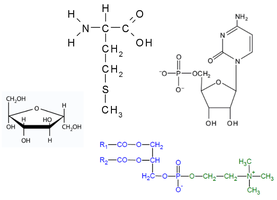
Q1. Which structure below represents a carbohydrate? How did you recognize it?
Background
Topic: Macromolecules – Carbohydrates
This question tests your ability to identify carbohydrates based on their chemical structure and understand the distinguishing features of carbohydrates compared to other biological macromolecules.
Key Terms and Concepts:
Carbohydrate: Organic molecule composed of carbon, hydrogen, and oxygen, typically in a ratio of 1:2:1.
Monosaccharide: Simple sugar, basic unit of carbohydrates (e.g., glucose).
Structural formula: Diagram showing the arrangement of atoms in a molecule.
Step-by-Step Guidance
Examine each structure for the presence of multiple hydroxyl groups () and a ring or chain of carbon atoms, which are typical features of carbohydrates.
Look for a formula close to , which is characteristic of carbohydrates.
Compare the structures to see which one matches the typical monosaccharide or polysaccharide arrangement.
Identify the structure that contains only carbon, hydrogen, and oxygen in the correct ratio and arrangement.
Try solving on your own before revealing the answer!
Final Answer: The structure in the lower left corner represents a carbohydrate.
This structure is a monosaccharide (glucose), recognizable by its ring form and the presence of multiple hydroxyl groups. Carbohydrates typically have a ring structure with , , and atoms in a 1:2:1 ratio.
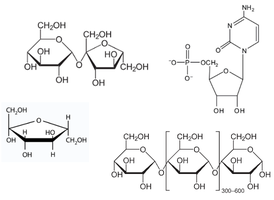
Q2. Which structure below represents a monosaccharide? Which represents a disaccharide? Which is the polysaccharide?
Background
Topic: Carbohydrate Classification
This question tests your ability to distinguish between monosaccharides, disaccharides, and polysaccharides based on their chemical structure.
Key Terms and Concepts:
Monosaccharide: Single sugar unit (e.g., glucose).
Disaccharide: Two monosaccharides joined together (e.g., sucrose).
Polysaccharide: Long chain of monosaccharide units (e.g., cellulose, starch).
Glycosidic bond: Covalent bond joining monosaccharides.
Step-by-Step Guidance
Identify the structure with a single ring – this is likely the monosaccharide.
Find the structure with two rings joined by a bond – this is the disaccharide.
Look for the structure with multiple repeating units (rings) – this is the polysaccharide.
Check for brackets or notation indicating repetition, which is typical for polysaccharides.
Try solving on your own before revealing the answer!
Final Answer: The lower left structure is a monosaccharide, the upper left is a disaccharide, and the lower right is a polysaccharide.
The monosaccharide is a single ring (glucose), the disaccharide is two rings joined (sucrose or lactose), and the polysaccharide is a chain of repeating rings (cellulose or starch).
Q3. Which structure represents a phospholipid? How did you recognize it?
Background
Topic: Lipid Structure – Phospholipids
This question tests your ability to identify phospholipids based on their unique structural features, which are essential for cell membrane formation.
Key Terms and Concepts:
Phospholipid: Lipid molecule with a hydrophilic phosphate head and two hydrophobic fatty acid tails.
Hydrophilic: Water-attracting.
Hydrophobic: Water-repelling.
Phosphate group: Contains phosphorus and oxygen atoms.
Step-by-Step Guidance
Look for a structure with a phosphate group attached to a glycerol backbone.
Identify two fatty acid chains (hydrophobic tails) connected to the glycerol.
Check for a polar head (phosphate) and nonpolar tails (fatty acids), which is characteristic of phospholipids.
Compare the structures to see which one fits this description.
Try solving on your own before revealing the answer!
Final Answer: The structure in the lower right corner represents a phospholipid.
This structure has a phosphate group (blue), a glycerol backbone, and two fatty acid tails (green), which are the defining features of a phospholipid.
Q4. Which structure represents an amino acid? How did you recognize it?
Background
Topic: Protein Structure – Amino Acids
This question tests your ability to identify amino acids based on their chemical structure and understand their role as the building blocks of proteins.
Key Terms and Concepts:
Amino acid: Organic molecule with an amino group (), a carboxyl group (), a hydrogen atom, and a variable R group attached to a central carbon.
Carboxyl group: functional group.
Amino group: functional group.
Step-by-Step Guidance
Look for a structure with a central carbon atom bonded to an amino group (), a carboxyl group (), a hydrogen atom, and a side chain (R group).
Check for the presence of both the amino and carboxyl groups, which are unique to amino acids.
Compare the structures to see which one matches this description.
Identify the structure that fits the general formula for amino acids.
Try solving on your own before revealing the answer!
Final Answer: The structure in the upper left corner represents an amino acid.
This structure has a central carbon, an amino group, a carboxyl group, a hydrogen atom, and a variable side chain (R group), which are the defining features of an amino acid.
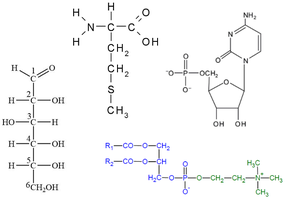
Q5. Which structure contains a carboxyl group? What kind of macromolecule below contains a carboxyl group?
Background
Topic: Functional Groups in Macromolecules
This question tests your ability to identify the carboxyl group in chemical structures and understand which macromolecules contain this functional group.
Key Terms and Concepts:
Carboxyl group: Functional group with the formula .
Amino acid: Contains a carboxyl group.
Fatty acid: Also contains a carboxyl group.
Step-by-Step Guidance
Look for the group in the chemical structures provided.
Identify which macromolecule (amino acid, fatty acid, etc.) contains this group.
Compare the structures to see which one has the carboxyl group.
Determine the type of macromolecule based on the presence of the carboxyl group.
Try solving on your own before revealing the answer!
Final Answer: The amino acid and fatty acid structures contain a carboxyl group.
Amino acids and fatty acids are macromolecules that include the carboxyl group () in their structure.
