 Back
BackChapter 8: Metabolism—Energy & Enzymes
Study Guide - Smart Notes
 Tailored notes based on your materials, expanded with key definitions, examples, and context.
Metabolism—Energy & Enzymes
What is Metabolism?
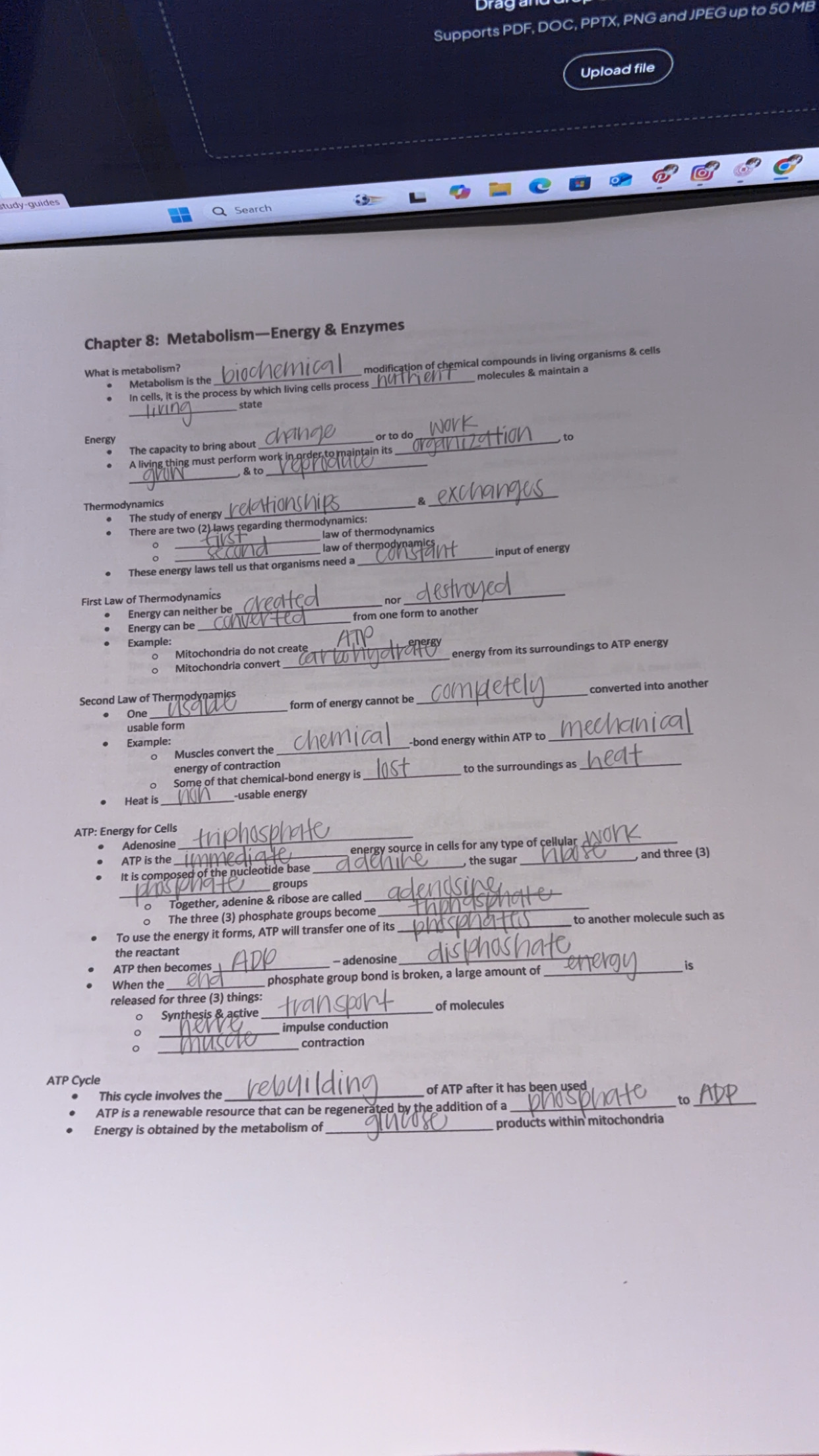
Metabolism refers to the biochemical modification of chemical compounds in living organisms and cells. In cells, metabolism is the process by which living cells process nutrient molecules and maintain a living state.
Metabolism includes all chemical reactions that occur within an organism to sustain life.
These reactions are organized into metabolic pathways, which are sequences of enzymatically catalyzed steps.
Energy in Biological Systems
Energy is the capacity to bring about change or to do work. Living things must perform work to maintain their organization, grow, reproduce, and carry out exchanges with their environment.
Examples of biological work include synthesis of molecules, transport of substances, and mechanical work such as muscle contraction.
Thermodynamics in Biology
The study of energy relationships and exchanges is called thermodynamics. There are two main laws of thermodynamics that govern energy transformations in biological systems:
First Law of Thermodynamics: Energy can neither be created nor destroyed; it can only be converted from one form to another.
Second Law of Thermodynamics: One usable form of energy cannot be completely converted into another usable form; some energy is always lost as heat.
First Law of Thermodynamics
Energy is conserved in all processes.
Example: Mitochondria do not create ATP energy; instead, they convert carbohydrate energy from their surroundings into ATP energy.
Second Law of Thermodynamics
Energy transformations are never 100% efficient; some energy is always lost as heat.
Example: Muscles convert chemical-bond energy within ATP to mechanical energy for contraction. Some of this energy is lost as heat.
ATP: Energy for Cells
Adenosine triphosphate (ATP) is the immediate energy source in cells for any type of cellular work.
ATP is composed of the nucleotide base adenine, the sugar ribose, and three phosphate groups.
Together, adenine and ribose are called adenosine.
The three phosphate groups are linked in a chain and can be transferred to other molecules.
To use the energy it forms, ATP will transfer one of its phosphate groups to another molecule (the reactant), becoming ADP (adenosine diphosphate) and releasing energy.
When the end phosphate group bond is broken, a large amount of energy is released for three main cellular processes:
Synthesis & active transport of molecules
Nerve impulse conduction
Muscle contraction
The ATP Cycle
The ATP cycle involves the rebuilding of ATP after it has been used. ATP is a renewable resource that can be regenerated by the addition of a phosphate group to ADP.
Energy is obtained by the metabolism of glucose and other products within mitochondria.
Key Equations
ATP Hydrolysis:
ATP Synthesis:
Summary Table: Laws of Thermodynamics in Biology
Law | Description | Biological Example |
|---|---|---|
First Law | Energy cannot be created or destroyed; only converted | Carbohydrate energy converted to ATP in mitochondria |
Second Law | Energy conversions are inefficient; some energy lost as heat | Muscle contraction releases heat |
