 Back
BackGenetics: Patterns of Inheritance – Study Guide
Study Guide - Smart Notes
 Tailored notes based on your materials, expanded with key definitions, examples, and context.
Patterns of Inheritance
Introduction to Mendelian Genetics
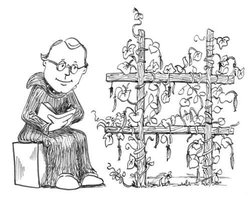
Mendelian genetics forms the foundation of classical inheritance, describing how traits are passed from parents to offspring. Gregor Mendel’s experiments with pea plants led to the discovery of fundamental principles governing heredity.
Mendel’s Experiments: Mendel cross-fertilized pea plants and observed seven distinct characteristics, each with two contrasting traits.
Heritable Factors: Mendel concluded that inheritable factors (now known as genes) retain their individuality across generations.
Importance: Mendel’s work established the basis for understanding genetic inheritance and variation.
Example: Pea plant experiments showing inheritance of flower color, seed shape, etc.
Seven Pea Characteristics Studied by Mendel
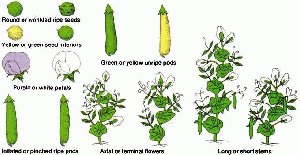
Mendel selected pea plants for their clear, contrasting traits, which allowed him to track inheritance patterns.
Traits Studied: Seed shape, seed color, pod shape, pod color, flower color, flower position, and stem height.
Application: These traits provided a model for understanding monogenic inheritance.
Genes and Alleles
Genes are units of heredity, and alleles are alternative versions of a gene that account for variations in inherited traits.
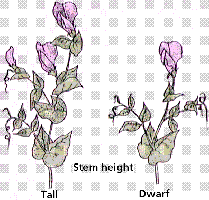
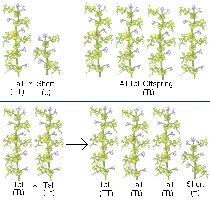
Gene Example: Stem height
Alleles: Tall (dominant) or dwarf (recessive)
Genotype and Phenotype
Genotype: The genetic makeup of an organism (e.g., TT, Tt, tt).
Phenotype: The observable physical trait (e.g., tall or short plants).
Homozygous: Two identical alleles for a gene (e.g., TT or tt).
Heterozygous: Two different alleles for a gene (e.g., Tt).
Dominant and Recessive Alleles
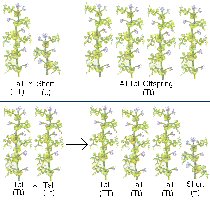
Dominant Allele: Expressed in the phenotype even if only one copy is present (e.g., T for tall).
Recessive Allele: Only expressed when two copies are present (e.g., t for short).
Mendel’s Law of Segregation
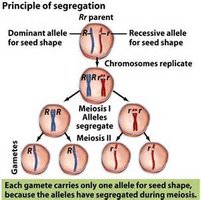
Mendel’s Law of Segregation states that allele pairs separate during gamete formation, so each gamete carries only one allele for each gene.
Meiosis: The process by which alleles segregate into gametes.
Result: Offspring inherit one allele from each parent.
Hybridization and Terminology
Hybridization: Cross-fertilization between different varieties produces hybrids.
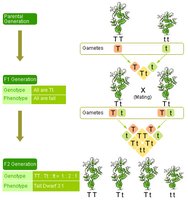
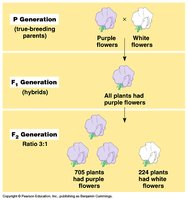
P Generation: Parental generation.
F1 Generation: First filial generation, offspring of P generation.
F2 Generation: Second filial generation, offspring of F1 generation.
Monogenic vs. Polygenic Traits
Monogenic Trait: Controlled by a single gene (e.g., pea flower color).
Polygenic Trait: Controlled by multiple genes (e.g., human skin color).
Punnett Square and Monohybrid Cross
The Punnett square is a diagram used to predict the outcome of a genetic cross.
Monohybrid Cross: Cross between parents differing in one trait.
F2 Generation Ratio: 3:1 ratio of dominant to recessive phenotype.
Example: Tt x Tt produces TT, Tt, tt offspring.
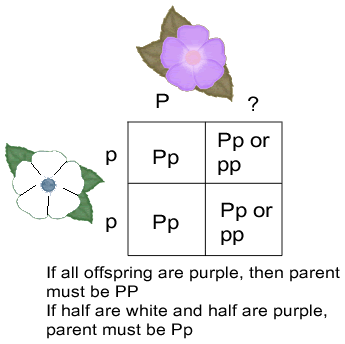
Test Cross
A test cross is used to determine the genotype of an individual with a dominant phenotype by crossing it with a homozygous recessive individual.
Purpose: Reveals whether the dominant phenotype is homozygous or heterozygous.
Principle of Independent Assortment
Mendel’s Principle of Independent Assortment states that alleles of different genes segregate independently during gamete formation.
Result: Traits are inherited independently of each other.
Example: Inheritance of flower color is independent of pea shape.
Rules of Probability in Genetics
Probability rules help predict genetic outcomes.
Rule of Multiplication: Probability of two independent events occurring together is the product of their probabilities.
Rule of Addition: Probability of either of two mutually exclusive events occurring is the sum of their probabilities.
Example: Probability of aabbcc offspring from AaBbCc x AaBbCc cross:
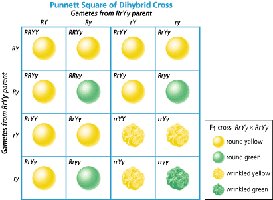
Dihybrid Cross
A dihybrid cross involves parents differing in two traits, demonstrating independent assortment.
F2 Generation Ratio: 9:3:3:1 ratio of phenotypes.
Incomplete Dominance
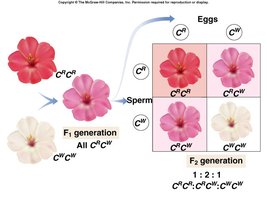
In incomplete dominance, the heterozygote displays a phenotype intermediate between the two parents.
Example: Red and white flowers produce pink offspring.
F2 Generation Ratio: 1:2:1 for phenotypes.
Codominance
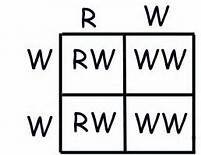
In codominance, both alleles are fully expressed in the heterozygote.
Example: Blood type AB in humans.

Pedigrees
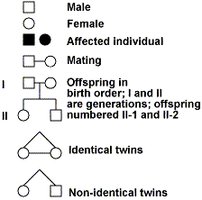
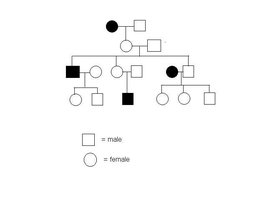
Pedigrees are diagrams used to track inheritance of traits across generations in families.
Symbols: Squares represent males, circles represent females, shaded shapes indicate affected individuals.
Application: Used to determine genotypes and inheritance patterns.
Genetic Disorders
Autosomal Recessive Disorders: Require two copies of the mutant allele (e.g., cystic fibrosis).
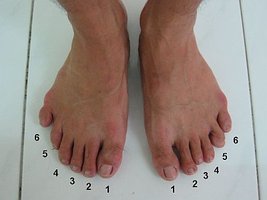
Autosomal Dominant Disorders: Require only one copy of the mutant allele (e.g., achondroplasia, Huntington’s disease, polydactyly).
Carrier: Heterozygous individuals who carry the allele but do not express the disorder.
Inbreeding: Increases the probability of inheriting recessive disorders.

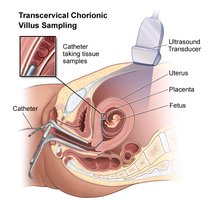
Amniocentesis and Chorionic Villus Sampling
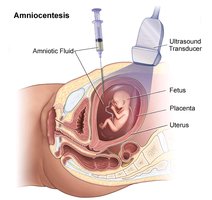
These are prenatal diagnostic techniques used to detect genetic disorders and chromosomal abnormalities.
Amniocentesis: Performed between weeks 14-20; involves extracting amniotic fluid for testing.
Chorionic Villus Sampling: Performed as early as week 8; involves sampling placental tissue.
Risks: Both procedures carry a risk of bleeding, miscarriage, or premature birth.
Summary Table: Types of Genetic Inheritance
Type | Definition | Example |
|---|---|---|
Monogenic | Trait controlled by one gene | Pea flower color |
Polygenic | Trait controlled by multiple genes | Human skin color |
Incomplete Dominance | Heterozygote shows intermediate phenotype | Pink flowers from red and white parents |
Codominance | Both alleles fully expressed | Blood type AB |
Additional info:
Pedigrees are essential for tracking inheritance of genetic disorders in families.
Probability calculations are fundamental for predicting genetic outcomes in crosses.
Chromosome theory of inheritance links Mendel’s principles to the behavior of chromosomes during meiosis.
