 Back
BackMolecular Structure and Intermolecular Forces: Determining Properties of Molecules
Study Guide - Smart Notes
 Tailored notes based on your materials, expanded with key definitions, examples, and context.
Molecular Structure and Properties
Basic Concepts of Molecular Structure
Understanding the structure of molecules is fundamental to predicting their properties and behavior. Molecules are composed of atoms, which are the smallest units of chemical elements. The way these atoms are arranged and bonded determines the physical and chemical properties of the substance.
Molecular Formula: Indicates the number and type of atoms in a molecule (e.g., CH3OH for methanol).
Structural Formula: Shows how atoms are connected within the molecule.
Lewis Structure: Visualizes the arrangement of electrons and bonds between atoms.
Substances can be classified as pure (composed of one type of molecule or atom) or mixtures (composed of two or more substances). Pure substances include metals, salts, and molecular compounds, while mixtures can be separated into their components by physical methods.
Types of Chemical Bonds
The type of bond between atoms in a molecule affects its polarity and interactions with other molecules.
Nonpolar Covalent Bond (Apolaire atoombinding): Electrons are shared equally between atoms, usually between identical atoms or those with similar electronegativity (e.g., H2, O2).
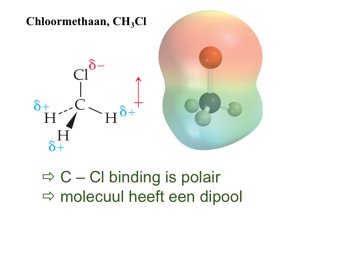
Polar Covalent Bond (Polaire atoombinding): Electrons are shared unequally due to a difference in electronegativity, resulting in partial charges (e.g., HCl, H2O, CH3Cl).
Polarity leads to the formation of dipoles, which are regions of partial positive (δ+) and negative (δ−) charge within a molecule.
Intermolecular Forces
Overview of Intermolecular Forces
Intermolecular forces are attractions between molecules that influence physical properties such as boiling point, melting point, and solubility. The main types are:
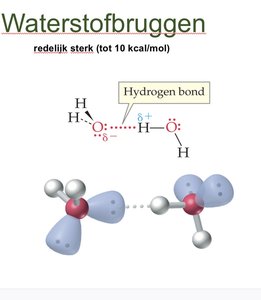
Hydrogen Bonds (Waterstofbruggen): Strong attractions between a hydrogen atom bonded to a highly electronegative atom (O, N, or F) and a lone pair on another electronegative atom.
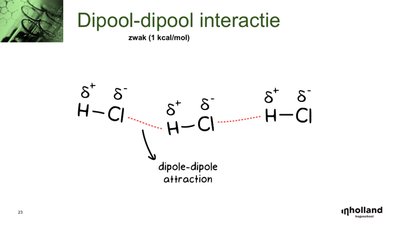
Dipole-Dipole Interactions: Attractions between the positive end of one polar molecule and the negative end of another.
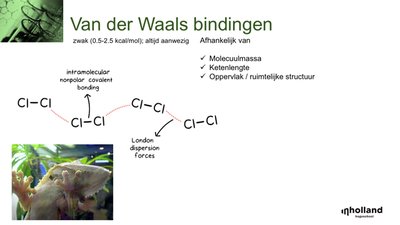
Van der Waals Forces (London Dispersion Forces): Weak, temporary attractions due to momentary shifts in electron density, present in all molecules but especially important in nonpolar molecules.
Hydrogen Bonds
Hydrogen bonds are relatively strong intermolecular forces (up to 10 kcal/mol) that occur when hydrogen is covalently bonded to O, N, or F and interacts with a lone pair on another electronegative atom. This is crucial in water and many biological molecules.
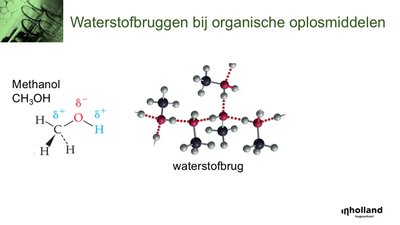
Hydrogen bonds are also important in organic solvents such as methanol, where they influence solubility and boiling points.
Dipole-Dipole Interactions
Dipole-dipole interactions occur between polar molecules. The strength of these interactions depends on the magnitude of the dipole moment and the orientation of the molecules. For example, in HCl, the positive hydrogen of one molecule is attracted to the negative chlorine of another.
Van der Waals Forces (London Dispersion Forces)
Van der Waals forces are weak attractions present in all molecules, arising from temporary dipoles created by shifting electron clouds. They are especially significant in large, nonpolar molecules and increase with molecular size and surface area.
Polarity and Molecular Geometry
Determining Molecular Properties from Structure
The properties of a molecule can be predicted by analyzing:
Type of atoms: Which elements are present (e.g., O, H, N, C).
Geometry: The spatial arrangement of atoms (linear, bent, tetrahedral, etc.).
Polarity: Whether the molecule has a net dipole moment, determined by both bond polarity and molecular geometry.
Ability to form hydrogen bonds: Presence of O-H, N-H, or F-H groups and lone pairs.
Partial charges: Regions of δ+ and δ− within the molecule.
Functional groups: Specific groups such as -OH, -NH2, -COOH, which influence reactivity and interactions.
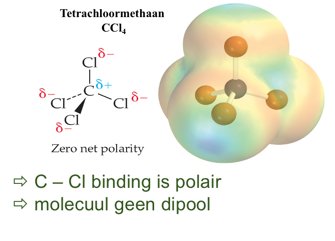
For example, chloormethaan (CH3Cl) has a polar C–Cl bond and a net dipole, while tetrachloormethaan (CCl4) has polar C–Cl bonds but is overall nonpolar due to its symmetrical geometry.
Classification of Substances
Pure Substances vs. Mixtures
Substances can be classified as:
Pure Substances: Composed of only one type of particle (element or compound), e.g., water (H2O), sodium chloride (NaCl).
Mixtures: Composed of two or more substances physically combined, e.g., salt water.
Mixtures can be separated into pure substances by physical methods such as filtration.
Examples and Applications
Water (H2O): Pure molecular substance, forms hydrogen bonds, high boiling point.
Sodium chloride (NaCl): Pure ionic compound, does not form molecules in the same sense as covalent compounds.
Copper (Cu): Pure metallic element.
Salt water: Mixture of water and sodium chloride.
Summary Table: Types of Intermolecular Forces
Type of Force | Strength | Occurs Between | Example |
|---|---|---|---|
Hydrogen Bond | Strong (up to 10 kcal/mol) | H bonded to O, N, or F | H2O, CH3OH |
Dipole-Dipole | Moderate (≈1 kcal/mol) | Polar molecules | HCl, CH3Cl |
Van der Waals (London Dispersion) | Weak (0.5–2.5 kcal/mol) | All molecules, especially nonpolar | Cl2, CCl4 |
Practice Questions
Which of the following is a pure molecular substance? Answer: D. Water (H2O)
What is the main difference between a pure substance and a mixture? Answer: D. A pure substance consists of one type of substance, a mixture consists of multiple types.
Which method is used to separate a mixture into pure substances? Answer: Filtration
What is the main difference between a nonpolar and a polar covalent bond? Answer: In a nonpolar bond, electrons are shared equally; in a polar bond, they are shared unequally.
Additional info: The concepts covered here are foundational for understanding the chemical context of life (Ch. 2), water and life (Ch. 3), and the molecular diversity of life (Ch. 4) in introductory biology courses. Mastery of these topics is essential for further study in biochemistry, cell biology, and physiology.
