 Back
BackNervous and Immune System Study Guide – Step-by-Step Guidance
Study Guide - Smart Notes
 Tailored notes based on your materials, expanded with key definitions, examples, and context.
Q1. Describe the 3 functions of a nervous system (sensory input, integration, motor output).
Background
Topic: Nervous System Functions
This question tests your understanding of the basic roles the nervous system plays in an organism, specifically how it processes information and responds to stimuli.
Key Terms:
Sensory Input: Gathering information from the environment.
Integration: Processing and interpreting sensory input.
Motor Output: Responding to information by activating muscles or glands.
Step-by-Step Guidance
Start by defining each function: What does sensory input mean in the context of the nervous system?
Explain how integration occurs—what happens to the information once it is received?
Describe motor output and how the nervous system translates processed information into action.
Try solving on your own before revealing the answer!
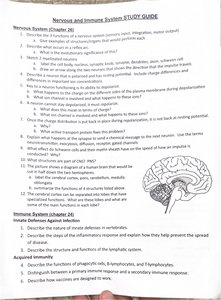
Q2. Give 4 examples of effector organs/tissues that could perform each function.
Background
Topic: Effector Organs and Tissues
This question is about identifying organs or tissues that respond to nervous system signals.
Key Terms:
Effector: An organ or cell that acts in response to a stimulus.
Examples: Muscles, glands, etc.
Step-by-Step Guidance
Recall what types of organs or tissues are controlled by the nervous system.
List examples for each function (e.g., muscles for movement, glands for secretion).
Think about how each effector responds to nervous system signals.
Try solving on your own before revealing the answer!
Q3. What are the two main nervous system divisions, and what are their main functions?
Background
Topic: Nervous System Structure
This question tests your knowledge of the central and peripheral nervous systems and their roles.
Key Terms:
Central Nervous System (CNS): Brain and spinal cord.
Peripheral Nervous System (PNS): Nerves outside the CNS.
Step-by-Step Guidance
Identify the two main divisions: CNS and PNS.
Describe the primary function of the CNS.
Describe the primary function of the PNS.
Try solving on your own before revealing the answer!
Q4. What are the main cell types in nervous tissue, and what are their functions?
Background
Topic: Nervous Tissue Cell Types
This question is about the cellular composition of nervous tissue and the roles of each cell type.
Key Terms:
Neuron: Transmits electrical signals.
Glial Cells: Support and protect neurons.
Step-by-Step Guidance
List the main cell types found in nervous tissue.
Describe the function of neurons.
Describe the function of glial cells.
Try solving on your own before revealing the answer!
Q5. What is the main function of a neuron?
Background
Topic: Neuron Function
This question focuses on the primary role of neurons in the nervous system.
Key Terms:
Neuron: Specialized cell for transmitting electrical impulses.
Step-by-Step Guidance
Define what a neuron is.
Explain how neurons transmit information.
Discuss the importance of this function in the nervous system.
Try solving on your own before revealing the answer!
Q6. What are the main parts of a neuron, and what does each part do?
Background
Topic: Neuron Structure
This question tests your knowledge of neuron anatomy and the function of each part.
Key Terms:
Dendrite: Receives signals.
Axon: Transmits signals.
Cell Body: Contains nucleus and organelles.
Step-by-Step Guidance
Identify the main structural parts of a neuron.
Describe the function of dendrites.
Describe the function of the axon.
Describe the function of the cell body.
Try solving on your own before revealing the answer!
Q7. What is the difference between a neuron and a nerve?
Background
Topic: Neuron vs. Nerve
This question asks you to distinguish between individual cells and bundles of cells in the nervous system.
Key Terms:
Neuron: Single nerve cell.
Nerve: Bundle of axons.
Step-by-Step Guidance
Define what a neuron is.
Define what a nerve is.
Explain how nerves are composed of many neurons.
Try solving on your own before revealing the answer!
Q8. What is the difference between a sensory neuron and a motor neuron?
Background
Topic: Types of Neurons
This question tests your understanding of the functional differences between sensory and motor neurons.
Key Terms:
Sensory Neuron: Carries information to the CNS.
Motor Neuron: Carries information from the CNS to effectors.
Step-by-Step Guidance
Define sensory neuron and its function.
Define motor neuron and its function.
Compare the direction of information flow for each type.
Try solving on your own before revealing the answer!
Q9. What is the difference between a nerve and a tract?
Background
Topic: Nerve vs. Tract
This question is about distinguishing between structures in the peripheral and central nervous systems.
Key Terms:
Nerve: Bundle of axons in the PNS.
Tract: Bundle of axons in the CNS.
Step-by-Step Guidance
Define what a nerve is and where it is found.
Define what a tract is and where it is found.
Explain the functional significance of each.
Try solving on your own before revealing the answer!
Q10. What is the difference between white matter and gray matter?
Background
Topic: Nervous Tissue Types
This question tests your knowledge of the structural and functional differences between white and gray matter.
Key Terms:
White Matter: Myelinated axons.
Gray Matter: Neuron cell bodies and unmyelinated axons.
Step-by-Step Guidance
Define white matter and its composition.
Define gray matter and its composition.
Discuss the functional roles of each in the nervous system.
Try solving on your own before revealing the answer!
Q11. What is the resting membrane potential?
Background
Topic: Membrane Potential
This question is about the electrical charge difference across the membrane of a resting neuron.
Key Terms and Formula:
Resting Membrane Potential: The voltage across the membrane when the neuron is not transmitting signals.
Typical value: -70 mV (millivolts).
Step-by-Step Guidance
Define what is meant by resting membrane potential.
Explain how ion distribution (Na+, K+) contributes to this potential.
Discuss the role of the sodium-potassium pump.
Try solving on your own before revealing the answer!
Q12. What is an action potential?
Background
Topic: Action Potential
This question tests your understanding of how neurons transmit electrical signals.
Key Terms:
Action Potential: Rapid change in membrane potential that propagates along the axon.
Step-by-Step Guidance
Define what an action potential is.
Describe the sequence of events (depolarization, repolarization).
Explain how the action potential moves along the neuron.
Try solving on your own before revealing the answer!
Q13. What is the role of the sodium-potassium pump?
Background
Topic: Ion Transport
This question is about the mechanism that maintains the resting membrane potential.
Key Terms and Formula:
Sodium-Potassium Pump: Transports Na+ out and K+ into the cell.
ATP: Energy source for the pump.
Step-by-Step Guidance
Describe the function of the sodium-potassium pump.
Explain how it uses ATP to move ions against their concentration gradients.
Discuss its importance in maintaining membrane potential.
Try solving on your own before revealing the answer!
Q14. What is the difference between depolarization and repolarization?
Background
Topic: Membrane Potential Changes
This question tests your understanding of the changes in membrane potential during an action potential.
Key Terms:
Depolarization: Membrane potential becomes less negative.
Repolarization: Membrane potential returns to resting value.
Step-by-Step Guidance
Define depolarization and what causes it.
Define repolarization and what causes it.
Explain the sequence of these events during an action potential.
Try solving on your own before revealing the answer!
Q15. What is the difference between a graded potential and an action potential?
Background
Topic: Types of Electrical Signals
This question is about distinguishing between local and propagated electrical changes in neurons.
Key Terms:
Graded Potential: Local change in membrane potential.
Action Potential: All-or-none propagated signal.
Step-by-Step Guidance
Define graded potential and its characteristics.
Define action potential and its characteristics.
Compare how each signal travels and its effect on the neuron.
Try solving on your own before revealing the answer!
Q16. What is the difference between a synapse and a neurotransmitter?
Background
Topic: Neural Communication
This question tests your understanding of how neurons communicate with each other or with effectors.
Key Terms:
Synapse: Junction between two neurons.
Neurotransmitter: Chemical messenger released at the synapse.
Step-by-Step Guidance
Define what a synapse is.
Define what a neurotransmitter is.
Explain how neurotransmitters are released at synapses.
Try solving on your own before revealing the answer!
Q17. What is the difference between an excitatory and an inhibitory neurotransmitter?
Background
Topic: Neurotransmitter Types
This question is about how neurotransmitters affect the postsynaptic neuron.
Key Terms:
Excitatory Neurotransmitter: Promotes action potential.
Inhibitory Neurotransmitter: Prevents action potential.
Step-by-Step Guidance
Define excitatory neurotransmitter and its effect.
Define inhibitory neurotransmitter and its effect.
Explain how these neurotransmitters influence neuron activity.
Try solving on your own before revealing the answer!
Q18. What is the difference between a presynaptic and postsynaptic neuron?
Background
Topic: Synaptic Transmission
This question tests your understanding of the roles of neurons at a synapse.
Key Terms:
Presynaptic Neuron: Sends the signal.
Postsynaptic Neuron: Receives the signal.
Step-by-Step Guidance
Define presynaptic neuron and its function.
Define postsynaptic neuron and its function.
Explain the direction of signal transmission at the synapse.
Try solving on your own before revealing the answer!
Q19. What is the difference between a chemical and an electrical synapse?
Background
Topic: Types of Synapses
This question is about the mechanisms by which neurons communicate.
Key Terms:
Chemical Synapse: Uses neurotransmitters.
Electrical Synapse: Direct electrical connection.
Step-by-Step Guidance
Define chemical synapse and its mechanism.
Define electrical synapse and its mechanism.
Compare the speed and flexibility of each type.
Try solving on your own before revealing the answer!
Q20. What is the difference between a receptor and an effector?
Background
Topic: Nervous System Components
This question tests your understanding of the roles of receptors and effectors in the nervous system.
Key Terms:
Receptor: Detects stimuli.
Effector: Responds to stimuli.
Step-by-Step Guidance
Define what a receptor is and its function.
Define what an effector is and its function.
Explain how information flows from receptor to effector.
Try solving on your own before revealing the answer!
Q21. What is the difference between a reflex and a voluntary response?
Background
Topic: Types of Responses
This question is about distinguishing between automatic and conscious responses.
Key Terms:
Reflex: Automatic, involuntary response.
Voluntary Response: Conscious, controlled response.
Step-by-Step Guidance
Define reflex and its characteristics.
Define voluntary response and its characteristics.
Compare the neural pathways involved in each.
Try solving on your own before revealing the answer!
Q22. What is the difference between a primary and secondary immune response?
Background
Topic: Immune Response
This question tests your understanding of how the immune system reacts to pathogens over time.
Key Terms:
Primary Response: First exposure to antigen.
Secondary Response: Subsequent exposure, faster and stronger.
Step-by-Step Guidance
Define primary immune response and its features.
Define secondary immune response and its features.
Compare the speed and strength of each response.
Try solving on your own before revealing the answer!
Q23. Describe the functions of phagocytic cells, B lymphocytes, and T lymphocytes.
Background
Topic: Immune Cell Functions
This question is about the roles of different immune cells in defending the body.
Key Terms:
Phagocytic Cells: Engulf and digest pathogens.
B Lymphocytes: Produce antibodies.
T Lymphocytes: Destroy infected cells.
Step-by-Step Guidance
Describe the function of phagocytic cells.
Describe the function of B lymphocytes.
Describe the function of T lymphocytes.
Try solving on your own before revealing the answer!
Q24. Distinguish between innate and acquired immunity.
Background
Topic: Types of Immunity
This question tests your understanding of the differences between immunity you are born with and immunity you develop.
Key Terms:
Innate Immunity: Non-specific, immediate defense.
Acquired Immunity: Specific, develops after exposure.
Step-by-Step Guidance
Define innate immunity and its characteristics.
Define acquired immunity and its characteristics.
Compare the mechanisms and effectiveness of each.
Try solving on your own before revealing the answer!
Q25. Describe how vaccines are designed to work.
Background
Topic: Vaccines
This question is about the principles behind vaccine development and their role in immunity.
Key Terms:
Vaccine: Stimulates immune response without causing disease.
Antigen: Substance that triggers immune response.
Step-by-Step Guidance
Explain what a vaccine is and how it is administered.
Describe how vaccines stimulate the immune system.
Discuss the role of memory cells in vaccine effectiveness.
Try solving on your own before revealing the answer!
