 Back
Backch 40
Study Guide - Smart Notes
 Tailored notes based on your materials, expanded with key definitions, examples, and context.
Chapter 40: The Senses
Overview of Sensory Systems
Sensory systems allow animals to detect and interpret a wide variety of environmental and internal stimuli. Sensory perception begins with specialized cells called sensory receptors, which convert stimuli into electrical signals that the nervous system can process. These receptors are organized into five principal categories based on the type of stimulus they detect.
Category of Receptor | Stimuli | Sensory Cell Type | Location |
|---|---|---|---|
Thermoreceptor | Heat, cold | Free nerve ending | Skin, brain |
Mechanoreceptor | Vibration, motion, gravity, pressure, touch, stretch | Hair cell, free nerve endings, specialized endings | Inner ear, skin, muscles, tendons |
Photoreceptor | Light | Rod, cone | Retina of the eye |
Chemoreceptor | Odor, taste | Olfactory receptor, taste receptor | Nasal cavity, taste buds |
Pain receptor | Chemicals from injury, extreme heat/cold, stretch, acid | Free nerve ending | Widespread in body |
How Sensory Receptors Work
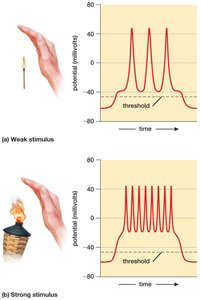
Sensory receptors generate receptor potentials—graded electrical signals whose size depends on stimulus intensity.
If the receptor potential reaches threshold, it triggers action potentials (APs) that travel to the brain.
The brain interprets the location and intensity of the stimulus based on which neurons are activated and the frequency of APs.
Major Sensory Modalities
Temperature Sensing (Thermoreception)
Thermoreceptors detect changes in temperature. They are found in the skin and brain, and help maintain homeostasis by triggering responses to temperature changes.
Cold receptors fire more rapidly below 77°F (25°C).
Warm receptors fire more rapidly above 91°F (33°C).
Thermoreceptors in the brain monitor core body temperature.
Detection of Mechanical Stimuli (Mechanoreception)
Mechanoreceptors respond to physical deformation such as stretching, pressure, vibration, or bending. They are found in the skin, muscles, tendons, and internal organs.
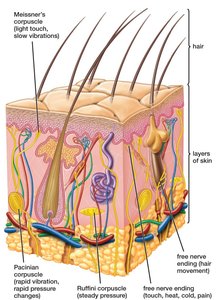
Free nerve endings in the skin detect touch, itching, and tickling.
Specialized structures (e.g., Pacinian corpuscles, Meissner’s corpuscles, Ruffini corpuscles) detect different types of pressure and vibration.
Stretch receptors in muscles and organs signal fullness or position.
Sound Detection (Hearing)
The mammalian ear detects sound, gravity, and head movement. It consists of three main parts: the outer, middle, and inner ear.
Outer ear: Pinna and auditory canal collect and direct sound waves.
Middle ear: Tympanic membrane (eardrum) and three bones (malleus, incus, stapes) transmit vibrations to the inner ear.
Inner ear: Cochlea (for hearing) and vestibular apparatus (for balance).
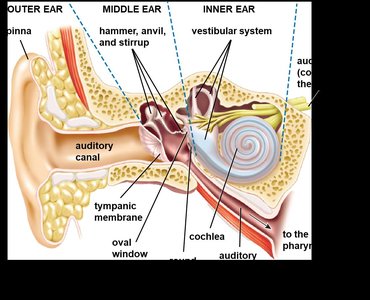
Sound waves cause the basilar membrane in the cochlea to vibrate, bending hair cells and generating receptor potentials. These are converted to action potentials in the auditory nerve, which the brain interprets as sound.
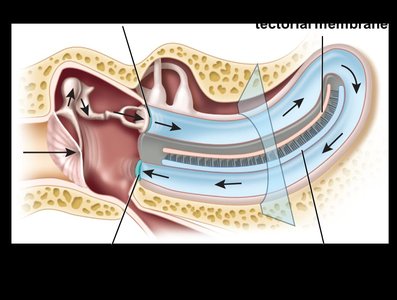
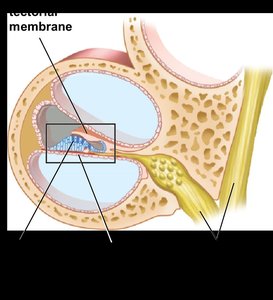
Loudness is encoded by the amplitude of vibrations and the frequency of action potentials.
Pitch is determined by which part of the basilar membrane vibrates most strongly (high notes near the oval window, low notes near the tip).
Gravity and Movement Detection (Vestibular System)
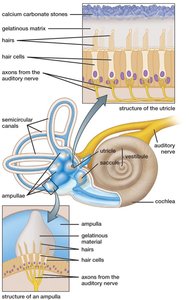
The vestibular apparatus in the inner ear detects gravity, orientation, and movement of the head. It consists of the vestibule (utricle and saccule) and three semicircular canals.
Utricle and saccule detect head position and linear acceleration using hair cells embedded in a gelatinous matrix with calcium carbonate stones.
Semicircular canals detect rotational movement; hair cells in the ampullae respond to fluid movement during head rotation.
Light Perception (Vision)
Vision begins with photoreceptors that contain photopigments. These cells convert light into electrical signals. Eyes vary in complexity from simple eyespots to image-forming eyes.
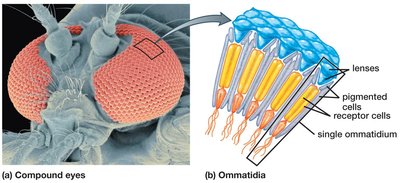
Arthropods have compound eyes made of ommatidia, each functioning as a light detector.
Mammalian eyes are camera-like, with accessory structures for focusing and a retina containing photoreceptors.
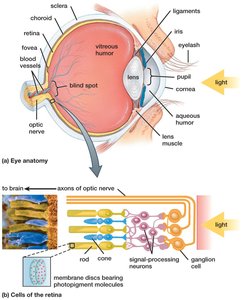
Light passes through the cornea, aqueous humor, pupil, lens, and vitreous humor before reaching the retina.
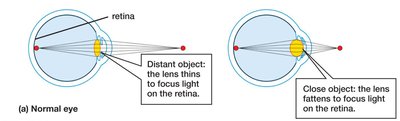
The lens focuses light on the fovea of the retina. The shape of the lens is adjusted by surrounding muscles.
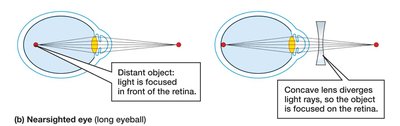
Nearsightedness (myopia): Eyeball too long or cornea too curved; distant objects focus in front of retina.
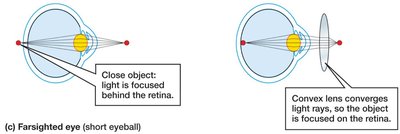
Farsightedness (hyperopia): Eyeball too short or cornea too flat; close objects focus behind retina.
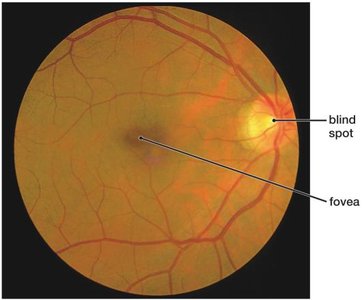
The retina contains rods (sensitive to low light, no color) and cones (color vision, high light intensity). Cones are concentrated in the fovea.
Signals from photoreceptors are processed by layers of neurons and sent to the brain via the optic nerve.
Human eyes have three types of cones (red, green, blue). Color vision results from the relative stimulation of these cones.
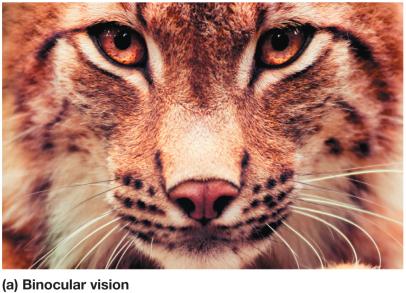
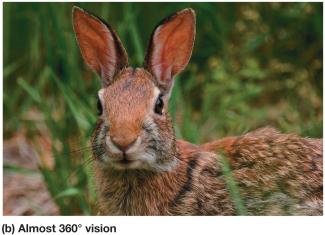
Binocular vision (eyes facing forward) allows depth perception; eyes on the sides (herbivores) provide a wide field of view.
Chemical Sensing (Olfaction and Gustation)
Chemoreceptors detect chemicals in the environment. In vertebrates, olfaction (smell) and gustation (taste) are the main chemical senses.
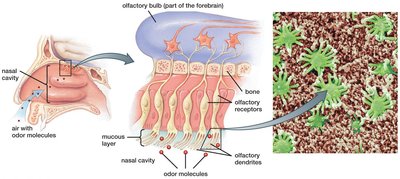
Olfactory receptors are neurons in the nasal cavity that detect airborne molecules. Each neuron expresses one type of receptor protein, specialized for certain odor molecules.
Taste receptors are found in taste buds on the tongue and other areas. Each taste bud contains supporting cells, stem cells, and taste receptor cells.
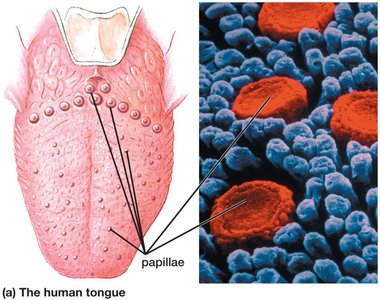
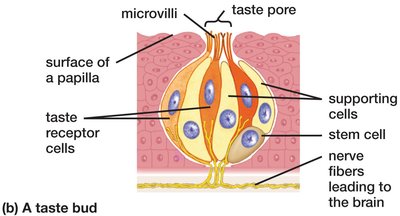
There are five basic tastes: sour, salty, sweet, bitter, and umami.
Sour and salty are detected by ions entering receptor cells; sweet, bitter, and umami are detected by organic molecules binding to receptor proteins.
Flavor perception is a combination of taste and olfaction.
Pain Perception (Nociception)
Pain receptors (nociceptors) are free nerve endings that respond to damaging stimuli such as extreme temperatures, chemicals, or mechanical injury. Pain perception is essential for survival, as it signals potential harm and promotes avoidance behaviors.
Some pain receptors respond to multiple types of damaging stimuli.
Chemicals released during injury (e.g., bradykinin) activate pain receptors.
Summary Table: Principal Categories of Vertebrate Sensory Receptors
Category | Stimulus | Location |
|---|---|---|
Thermoreceptor | Heat, cold | Skin, brain |
Mechanoreceptor | Touch, pressure, vibration, stretch | Skin, muscles, inner ear |
Photoreceptor | Light | Retina |
Chemoreceptor | Odor, taste | Nasal cavity, taste buds |
Pain receptor | Injury, extreme stimuli | Throughout body |
