 Back
BackChapter 3: Water and Life: Properties, Structure, and Biological Importance
Study Guide - Smart Notes
 Tailored notes based on your materials, expanded with key definitions, examples, and context.
Water and Life
Polar Covalent Bonds and Hydrogen Bonding
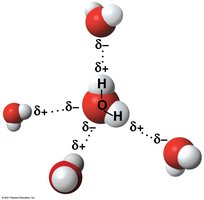
Water molecules exhibit polar covalent bonds, where electrons are shared unequally between oxygen and hydrogen atoms. This results in a partial negative charge near the oxygen atom and a partial positive charge near the hydrogen atoms, making water a polar molecule. The polarity enables water molecules to form hydrogen bonds with each other, which are critical for many of water’s unique properties.
Emergent Properties of Water
Water’s structure and hydrogen bonding give rise to four emergent properties that are essential for life:
Cohesive behavior
Ability to moderate temperature
Expansion upon freezing
Versatility as a solvent
Cohesion and Surface Tension
Cohesion refers to the attraction between water molecules due to hydrogen bonding. This property results in high surface tension, making it difficult to break the surface of water. Surface tension allows certain organisms, such as insects, to walk on water.

Adhesion and Water Transport in Plants
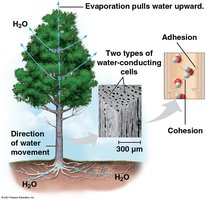
Adhesion is the attraction between water molecules and other substances, such as plant cell walls. Both cohesion and adhesion are vital for the transport of water and nutrients against gravity in plants, enabling water to move upward from roots to leaves.
Moderation of Temperature
Water moderates temperature by absorbing heat from warmer air and releasing it to cooler air. It can absorb or release large amounts of heat with only slight changes in its own temperature, due to its high specific heat. This property is crucial for stabilizing environmental and organismal temperatures.
Kinetic energy: Energy of motion
Thermal energy: Kinetic energy associated with random motion of atoms/molecules
Heat: Transfer of thermal energy
Specific heat: Amount of heat required to change the temperature of 1 g of a substance by 1ºC
For water, the specific heat is 1 cal/(g·ºC). Hydrogen bonding is responsible for water’s high specific heat: heat is absorbed to break bonds and released when bonds form.
Temperature Moderation in Coastal Areas
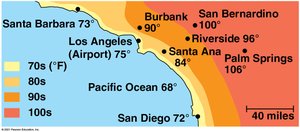
Large bodies of water, such as oceans, absorb and store heat during the day and release it at night, moderating air temperatures in coastal regions.
Evaporative Cooling
Evaporation is the transformation from liquid to gas. The heat of vaporization is the heat required for 1 g of liquid to become gas. As water evaporates, the surface cools, stabilizing temperatures in organisms and bodies of water.
Expansion Upon Freezing
Water is less dense as a solid than as a liquid. At 0ºC, water molecules form a crystalline lattice, making ice about 10% less dense than liquid water. This property ensures that ice floats, preventing bodies of water from freezing solid and supporting aquatic life.
Water: The Solvent of Life
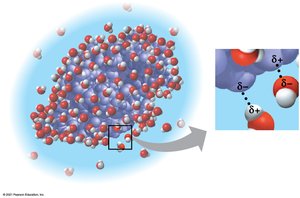
Water is a versatile solvent due to its polarity. It dissolves ionic compounds by surrounding ions with hydration shells and can also dissolve polar molecules, including large proteins with ionic and polar regions.
Solution: Homogeneous mixture of substances
Solvent: Dissolving agent
Solute: Substance dissolved
Aqueous solution: Water is the solvent
Hydrophilic and Hydrophobic Substances
Hydrophilic substances have an affinity for water, while hydrophobic substances do not. Oils are hydrophobic due to nonpolar bonds, and hydrophobic molecules are major components of cell membranes.
Solute Concentration in Aqueous Solutions
Chemical reactions in organisms often occur in aqueous solutions. Molecular mass is the sum of atomic masses in a molecule. Mole is a unit for measuring molecules: 1 mol = molecules (Avogadro’s number). Molarity (M) is the number of moles of solute per liter of solution.
Possible Evolution of Life on Other Planets
Biologists search for life on planets with evidence of water. Mars, for example, has been found to have water, and some exoplanets show signs of water vapor.

Acidic and Basic Conditions Affect Living Organisms
Dissociation of Water
A hydrogen atom in a hydrogen bond between two water molecules can shift, forming a hydronium ion (H3O+) and a hydroxide ion (OH–). Water is in dynamic equilibrium, with dissociation and reformation occurring at equal rates.
Acids, Bases, and the pH Scale
Acid: Increases H+ concentration
Base: Reduces H+ concentration
Strong acids/bases: Dissociate completely
Weak acids/bases: Reversibly release/accept H+
The pH scale describes acidity/basicity:
In aqueous solution at 25ºC:
pH is defined as:
Neutral solution: , so
Acidic: pH < 7; Basic: pH > 7
Buffers
Buffers minimize changes in H+ and OH– concentrations. Most buffers consist of a weak acid and its corresponding base, which combine reversibly with H+ ions. This is essential for maintaining pH in living cells.
Acidification: A Threat to Our Oceans
Human activities, such as burning fossil fuels, increase atmospheric CO2, which is absorbed by oceans and forms carbonic acid, leading to ocean acidification. Acidification reduces carbonate ions needed for calcification by marine organisms, threatening coral reefs and causing ecosystem-wide changes.



Summary Table: Properties of Water
Property | Description | Biological Importance |
|---|---|---|
Cohesion | Hydrogen bonds hold water molecules together | Transport in plants, surface tension |
Adhesion | Attraction between water and other substances | Water movement in plants |
High Specific Heat | Resists temperature change | Stabilizes environment and organismal temperature |
Expansion upon Freezing | Ice is less dense than liquid water | Ice floats, protects aquatic life |
Versatile Solvent | Dissolves ionic and polar substances | Facilitates biochemical reactions |
Practice Questions
What are the four emergent properties of water important for life?
What would happen if skin lacked hydrophobic glycolipids?
How does the concentration of hydrogen ions compare between pH 5 and pH 8?
Which property of water is most important for fish in a frozen pond?
Additional info: Expanded explanations and context were added to ensure completeness and clarity for exam preparation.
