Pearson+ LogoPearson+ Logo
Ch. 20 Unifying Concepts of Animal Structure and Function
Taylor - Campbell Biology: Concepts & Connections 10th Edition
Taylor, Simon, Dickey, Hogan10th EditionCampbell Biology: Concepts & ConnectionsISBN: 9780136538783Not the one you use?Change textbook
Chapter 20, Problem 5

Briefly explain how the structure of each of these tissues is well suited to its function: stratified squamous epithelium in the skin, neurons in the brain, simple squamous epithelium lining the lung, bone in the skull.

Verified step by step guidance
1
Identify the primary function of each tissue type mentioned: stratified squamous epithelium protects underlying tissues, neurons transmit information, simple squamous epithelium facilitates gas exchange, and bone provides structural support and protection.
Examine how the structure of stratified squamous epithelium, which consists of multiple layers of cells, enhances its protective function by providing a barrier against mechanical stress, pathogens, and water loss.
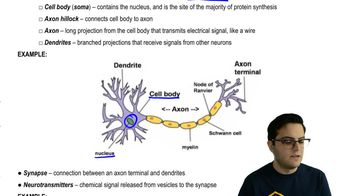
Discuss how the structure of neurons, with their long axons and dendrites, enables them to establish a network of connections for transmitting signals efficiently across the brain and to other parts of the body.
Analyze how the thin, flat structure of simple squamous epithelium cells in the lungs maximizes their efficiency in facilitating the diffusion of gases (oxygen and carbon dioxide) between the air in the alveoli and the blood in capillaries.
Explore how the dense, rigid structure of bone in the skull protects the brain from injury and supports the facial structure, while also housing cavities for the eyes, ears, and nasal passages.

Verified video answer for a similar problem:

This video solution was recommended by our tutors as helpful for the problem above.
Video duration:
2m
Was this helpful?

Key Concepts

Here are the essential concepts you must grasp in order to answer the question correctly.

Stratified Squamous Epithelium

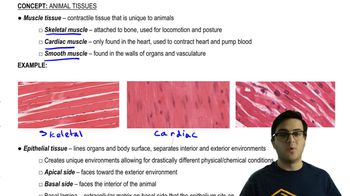
Stratified squamous epithelium consists of multiple layers of cells, with the outermost layer being flat and scale-like. This structure provides a robust barrier against physical and chemical damage, making it well-suited for areas like the skin, where protection from abrasion and pathogens is essential. The multiple layers also allow for regeneration, as the outer cells can be shed and replaced without compromising the underlying layers.
Recommended video:
Guided course
03:16
Muscle and Epithelial Tissues

Neurons

Neurons are specialized cells in the brain and nervous system that transmit information through electrical and chemical signals. Their unique structure, which includes a cell body, dendrites, and an axon, facilitates rapid communication between different parts of the body. The long axons allow for the transmission of signals over distances, while dendrites receive input from other neurons, making them essential for processing and relaying information.
Recommended video:

Simple Squamous Epithelium

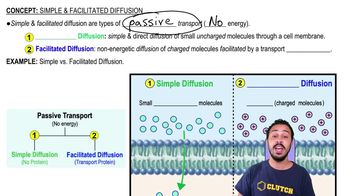
Simple squamous epithelium is a single layer of flat cells that provides a thin barrier for diffusion and filtration. This tissue is ideally suited for locations such as the lungs, where gas exchange occurs, as its thinness allows for efficient transfer of oxygen and carbon dioxide. The minimal barrier facilitates rapid diffusion, making it critical for respiratory function and other processes requiring quick exchange.
Recommended video:
Guided course
05:10
Simple and Facilitated Diffusion
Related Practice
Textbook Question

There are several key concepts introduced in this chapter: Structure correlates with function; an animal's body has a hierarchy of organization with emergent properties at each level; and complex bodies have structural adaptations that increase surface area for exchange. Label the tissue layers shown in this section of the small intestine, and describe how this diagram illustrates these three concepts.

1038
views
Textbook Question

Which of the following body systems facilitates (but doesn't regulate) the functions of the other systems? respiratory system endocrine system digestive system circulatory system

1467
views
Textbook Question

Negative-feedback mechanisms are

a. Most often involved in maintaining homeostasis.

b. Analogous to a furnace that produces heat.

c. Found only in birds and mammals.

d. All of the above.

1147
views
Textbook Question
Describe ways in which the bodies of complex animals are structured for exchanging materials with the environment. Do all animals share such features?
799
views
Textbook Question

Which of the following best illustrates homeostasis? (Explain your answer.)

a. Most adult humans are between 5 and 6 feet tall.

b. All the cells of the body are about the same size.

c. When the salt concentration of the blood goes up, the kidneys expel more salt.

d. When oxygen in the blood decreases, you feel dizzy.

1095
views
Textbook Question

The diaphragm is a large sheet of muscle that helps move air in and out of your lungs. Breathing is automatically controlled by the brain, but you can choose to hold your breath or breathe deeper. What kind of muscle do you suppose makes up the diaphragm? (Explain your answer.)

2401
views