
There are several key concepts introduced in this chapter: Structure correlates with function; an animal's body has a hierarchy of organization with emergent properties at each level; and complex bodies have structural adaptations that increase surface area for exchange. Label the tissue layers shown in this section of the small intestine, and describe how this diagram illustrates these three concepts.
Ch. 20 Unifying Concepts of Animal Structure and Function
Taylor, Simon, Dickey, Hogan10th EditionCampbell Biology: Concepts & ConnectionsISBN: 9780136538783Not the one you use?Change textbook
All textbooks
Taylor, Simon, Dickey, Hogan 10th Edition
Ch. 20 Unifying Concepts of Animal Structure and Function
Problem 4
Taylor, Simon, Dickey, Hogan 10th Edition
Ch. 20 Unifying Concepts of Animal Structure and Function
Problem 4Chapter 20, Problem 4
Negative-feedback mechanisms are
a. Most often involved in maintaining homeostasis.
b. Analogous to a furnace that produces heat.
c. Found only in birds and mammals.
d. All of the above.
Verified step by step guidance1
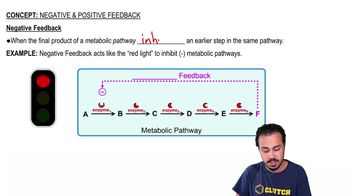
Step 1: Understand the concept of negative feedback mechanisms. Negative feedback is a regulatory process in which a system responds to a change by reversing the direction of that change, helping to maintain stability or homeostasis. For example, when body temperature rises, mechanisms are activated to cool the body down.
Step 2: Analyze option (a): 'most often involved in maintaining homeostasis.' Negative feedback mechanisms are indeed crucial for maintaining homeostasis, as they help regulate processes like temperature, blood sugar levels, and pH balance.
Step 3: Analyze option (b): 'analogous to a furnace that produces heat.' This analogy is incorrect because a furnace typically operates on positive feedback (continuing to produce heat until turned off), whereas negative feedback mechanisms work to counteract changes and stabilize conditions.
Step 4: Analyze option (c): 'found only in birds and mammals.' This statement is incorrect because negative feedback mechanisms are found in a wide variety of organisms, not just birds and mammals. For example, plants and other animals also use negative feedback to regulate internal processes.
Step 5: Analyze option (d): 'all of the above.' Since options (b) and (c) are incorrect, this option cannot be correct. The correct answer is (a), as negative feedback mechanisms are most often involved in maintaining homeostasis.

Verified video answer for a similar problem:
This video solution was recommended by our tutors as helpful for the problem above.
Video duration:
1mWas this helpful?
Key Concepts
Here are the essential concepts you must grasp in order to answer the question correctly.
Negative Feedback Mechanisms
Negative feedback mechanisms are processes that counteract changes in a system to maintain stability, or homeostasis. When a deviation from a set point occurs, these mechanisms trigger responses that reverse the change, such as the regulation of body temperature. For example, if body temperature rises, mechanisms are activated to cool the body down, ensuring it remains within a healthy range.
Recommended video:
Guided course
Negative Feedback
Homeostasis
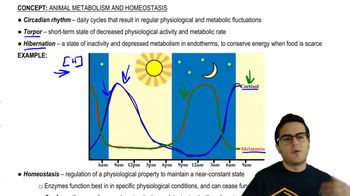
Homeostasis refers to the ability of an organism to maintain a stable internal environment despite external changes. This involves various physiological processes that regulate factors like temperature, pH, and electrolyte balance. For instance, humans maintain a core body temperature around 37°C, adjusting through sweating or shivering as needed.
Recommended video:
Guided course
Homeostasis
Examples of Negative Feedback
Common examples of negative feedback include the regulation of blood glucose levels and the control of blood pressure. In blood glucose regulation, insulin is released when levels are high, promoting glucose uptake, while glucagon is released when levels are low, stimulating glucose release. These examples illustrate how negative feedback is crucial for maintaining homeostasis across various biological systems.
Recommended video:
Guided course
Negative Feedback
Related Practice
Textbook Question
1038
views
Textbook Question
Which of the following body systems facilitates (but doesn't regulate) the functions of the other systems? respiratory system endocrine system digestive system circulatory system
1467
views
Textbook Question
Briefly explain how the structure of each of these tissues is well suited to its function: stratified squamous epithelium in the skin, neurons in the brain, simple squamous epithelium lining the lung, bone in the skull.
1648
views
Textbook Question
Describe ways in which the bodies of complex animals are structured for exchanging materials with the environment. Do all animals share such features?
799
views
Textbook Question
Which of the following best illustrates homeostasis? (Explain your answer.)
a. Most adult humans are between 5 and 6 feet tall.
b. All the cells of the body are about the same size.
c. When the salt concentration of the blood goes up, the kidneys expel more salt.
d. When oxygen in the blood decreases, you feel dizzy.
1095
views