

Pearson+ LogoPearson+ Logo
Ch. 25 Control of Body Temperature and Water Balance
Taylor - Campbell Biology: Concepts & Connections 10th Edition
Taylor, Simon, Dickey, Hogan10th EditionCampbell Biology: Concepts & ConnectionsISBN: 9780136538783Not the one you use?Change textbook
Chapter 25, Problem 6

Birds and insects excrete uric acid, whereas mammals and most amphibians excrete mainly urea. What is the chief advantage of uric acid over urea as a waste product?
a. Uric acid is a much simpler molecule.
b. It takes less energy to make uric acid.
c. Less water is required to excrete uric acid.
d. More solutes are removed excreting uric acid.

Verified step by step guidance
1
Understand the context of the problem: The question is asking about the advantages of uric acid as a waste product compared to urea. This relates to the biology of excretion and water conservation in different organisms.
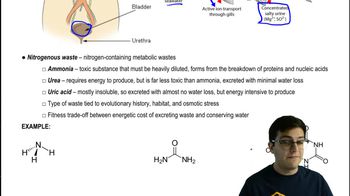
Recall the properties of uric acid: Uric acid is relatively insoluble in water and is excreted as a paste or solid, which minimizes water loss. This is particularly advantageous for organisms living in arid environments.
Compare uric acid and urea: Urea is highly soluble in water and requires a significant amount of water for excretion. Uric acid, on the other hand, requires much less water for excretion, making it more efficient for water conservation.
Analyze the options provided: Option (c) states 'Less water is required to excrete uric acid,' which aligns with the biological advantage of uric acid in conserving water. Evaluate the other options to ensure they do not match the primary advantage of uric acid.
Conclude the reasoning: The chief advantage of uric acid over urea as a waste product is its ability to conserve water during excretion, which is critical for birds and insects that often inhabit environments where water is scarce.

Verified video answer for a similar problem:

This video solution was recommended by our tutors as helpful for the problem above.
Video duration:
52s
Was this helpful?

Key Concepts

Here are the essential concepts you must grasp in order to answer the question correctly.

Nitrogenous Waste Products

Nitrogenous waste products are the byproducts of protein metabolism that organisms must eliminate. The primary types include urea, uric acid, and ammonia. Urea is soluble in water and is excreted by mammals, while uric acid is less soluble and is excreted by birds and insects. Understanding these differences is crucial for grasping how various organisms adapt their waste excretion to their environments.
Recommended video:
Guided course
07:16
Osmoregulation and Nitrogenous Waste

Water Conservation

Water conservation is a critical physiological process, especially for terrestrial organisms. Uric acid is excreted as a paste with minimal water loss, making it advantageous for animals in arid environments. This adaptation allows species like birds and insects to thrive in habitats where water is scarce, highlighting the evolutionary significance of waste product composition.
Recommended video:
Guided course
03:56
Conservation Biology and Biodiversity

Energy Cost of Excretion

The energy cost of excretion refers to the metabolic energy required to produce and eliminate waste products. Uric acid synthesis is energetically more expensive than urea, but the trade-off is beneficial in terms of water conservation. Understanding this balance helps explain why different organisms have evolved to excrete different nitrogenous wastes based on their ecological niches.
Recommended video:
Guided course
04:03
Filtration, Reabsorption, and Excretion
Related Practice
Textbook Question

Which of the following is not an adaptation for reducing the rate of heat loss to the environment?

a. Feathers or fur

b. Increasing blood flow to surface blood vessels

c. Huddling behavior of penguins

d. Countercurrent heat exchange

1020
views
Textbook Question

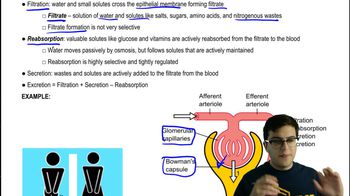
In each nephron of the kidney, the glomerulus and Bowman's capsule

a. Filter the blood and capture the filtrate.

b. Reabsorb water into the blood.

c. Break down harmful toxins and poisons.

d. Refine and concentrate the urine for excretion.

1531
views
Textbook Question

As filtrate passes through the loop of Henle, salt is reabsorbed and concentrated in the interstitial fluid of the medulla. This high solute concentration in the medulla enables nephrons to

a. Excrete the maximum amount of salt.

b. Neutralize toxins that might be found in the kidney.

c. Excrete a large amount of water.

d. Reabsorb water from the filtrate very efficiently.

2322
views
Textbook Question

A freshwater fish would be expected to

a. Pump salt out through its gills.

b. Produce copious quantities of dilute urine.

c. Have scales and a covering of mucus that reduce water loss to the environment.

d. Do all of the above.

1401
views
Textbook Question

Match each of the following components of blood (on the left) with what happens to it as the blood is processed by the kidney (on the right). Note that each lettered choice may be used more than once.


8. Water

9. Glucose

10. Plasma protein

11. Toxins or drugs

12. Red blood cell

13. Urea


a. passes into filtrate; almost all excreted in urine

b. remains in blood

c. passes into filtrate; mostly reabsorbed

d. secreted and excreted

1240
views
Textbook Question

You are in a room of empty chairs. As the chairs fill with people, you become hotter and hotter. A ceiling fan is turned on, and you feel cooler. You gained heat by _________ and lost heat to the environment by _________ .

a. Conduction … convection

b. Radiation … convection

c. Radiation … conduction

d. Convection … radiation

758
views