Pearson+ LogoPearson+ Logo
Ch. 25 Control of Body Temperature and Water Balance
Taylor - Campbell Biology: Concepts & Connections 10th Edition
Taylor, Simon, Dickey, Hogan10th EditionCampbell Biology: Concepts & ConnectionsISBN: 9780136538783Not the one you use?Change textbook
Chapter 25, Problem 5

As filtrate passes through the loop of Henle, salt is reabsorbed and concentrated in the interstitial fluid of the medulla. This high solute concentration in the medulla enables nephrons to
a. Excrete the maximum amount of salt.
b. Neutralize toxins that might be found in the kidney.
c. Excrete a large amount of water.
d. Reabsorb water from the filtrate very efficiently.

Verified step by step guidance
1
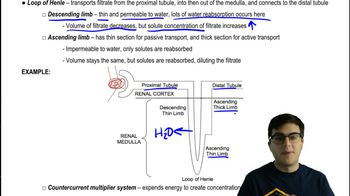
Understand the function of the loop of Henle: The loop of Henle is a structure in the nephron of the kidney that plays a critical role in concentrating urine and conserving water. It has two main segments: the descending limb and the ascending limb.
Recognize the role of the descending limb: The descending limb is permeable to water but not to salts. As filtrate moves down this limb, water is reabsorbed into the surrounding interstitial fluid due to the high solute concentration in the medulla, making the filtrate more concentrated.
Understand the role of the ascending limb: The ascending limb is impermeable to water but actively transports salts (Na⁺ and Cl⁻) out of the filtrate into the interstitial fluid of the medulla. This process increases the solute concentration in the medulla, creating a gradient that facilitates water reabsorption later in the nephron.
Connect the high solute concentration in the medulla to water reabsorption: The high solute concentration in the medulla creates an osmotic gradient that allows water to be reabsorbed efficiently from the filtrate in the collecting ducts, helping the body conserve water.
Evaluate the answer choices: Based on the function of the loop of Henle and the osmotic gradient in the medulla, the correct answer is related to the efficient reabsorption of water from the filtrate. This mechanism is essential for producing concentrated urine and maintaining water balance in the body.

Verified video answer for a similar problem:

This video solution was recommended by our tutors as helpful for the problem above.
Video duration:
3m
Was this helpful?

Key Concepts

Here are the essential concepts you must grasp in order to answer the question correctly.

Loop of Henle

The Loop of Henle is a U-shaped section of the nephron in the kidney that plays a crucial role in concentrating urine. It consists of a descending limb that is permeable to water and an ascending limb that is impermeable to water but actively transports sodium and chloride ions out into the surrounding interstitial fluid. This process creates a concentration gradient that is essential for water reabsorption later in the nephron.
Recommended video:
Guided course
06:25
Loop of Henle

Osmosis and Water Reabsorption

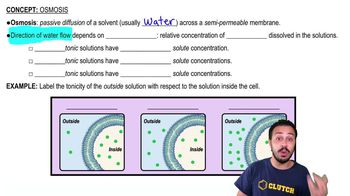
Osmosis is the movement of water across a semipermeable membrane from an area of lower solute concentration to an area of higher solute concentration. In the context of the nephron, the high solute concentration in the medulla created by the Loop of Henle facilitates the reabsorption of water from the filtrate back into the bloodstream, allowing the body to conserve water and produce concentrated urine.
Recommended video:

Countercurrent Multiplication

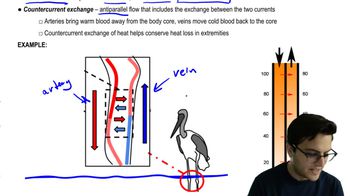
Countercurrent multiplication is a mechanism that enhances the concentration of urine by utilizing the opposing flow of fluids in the Loop of Henle. As the filtrate descends and ascends through the loop, the interaction between the descending and ascending limbs allows for the efficient reabsorption of water and salts, ultimately leading to a highly concentrated medullary interstitial fluid that promotes water reabsorption in the collecting ducts.
Recommended video:
Guided course
06:28
Countercurrent Exchange
Related Practice
Textbook Question
In this schematic of urine production in a nephron, label the four processes involved and list some of the substances that are moved in each process.

2411
views
Textbook Question

Which of the following is not an adaptation for reducing the rate of heat loss to the environment?

a. Feathers or fur

b. Increasing blood flow to surface blood vessels

c. Huddling behavior of penguins

d. Countercurrent heat exchange

1020
views
Textbook Question

In each nephron of the kidney, the glomerulus and Bowman's capsule

a. Filter the blood and capture the filtrate.

b. Reabsorb water into the blood.

c. Break down harmful toxins and poisons.

d. Refine and concentrate the urine for excretion.

1531
views
Textbook Question

Birds and insects excrete uric acid, whereas mammals and most amphibians excrete mainly urea. What is the chief advantage of uric acid over urea as a waste product?

a. Uric acid is a much simpler molecule.

b. It takes less energy to make uric acid.

c. Less water is required to excrete uric acid.

d. More solutes are removed excreting uric acid.

2313
views
Textbook Question

A freshwater fish would be expected to

a. Pump salt out through its gills.

b. Produce copious quantities of dilute urine.

c. Have scales and a covering of mucus that reduce water loss to the environment.

d. Do all of the above.

1401
views
Textbook Question

Match each of the following components of blood (on the left) with what happens to it as the blood is processed by the kidney (on the right). Note that each lettered choice may be used more than once.


8. Water

9. Glucose

10. Plasma protein

11. Toxins or drugs

12. Red blood cell

13. Urea


a. passes into filtrate; almost all excreted in urine

b. remains in blood

c. passes into filtrate; mostly reabsorbed

d. secreted and excreted

1240
views