Pearson+ LogoPearson+ Logo
Ch. 25 Control of Body Temperature and Water Balance
Taylor - Campbell Biology: Concepts & Connections 10th Edition
Taylor, Simon, Dickey, Hogan10th EditionCampbell Biology: Concepts & ConnectionsISBN: 9780136538783Not the one you use?Change textbook
Chapter 25, Problem 4

In each nephron of the kidney, the glomerulus and Bowman's capsule
a. Filter the blood and capture the filtrate.
b. Reabsorb water into the blood.
c. Break down harmful toxins and poisons.
d. Refine and concentrate the urine for excretion.

Verified step by step guidance
1
Understand the structure and function of the nephron, which is the functional unit of the kidney. The nephron is responsible for filtering blood, reabsorbing essential substances, and excreting waste products.
Focus on the glomerulus and Bowman's capsule, which are the initial components of the nephron. The glomerulus is a network of capillaries, and Bowman's capsule is a cup-shaped structure surrounding the glomerulus.
Learn the process of filtration: Blood enters the glomerulus under pressure, and small molecules like water, ions, glucose, and waste products are filtered out of the blood into Bowman's capsule. Larger molecules like proteins and blood cells remain in the bloodstream.
Clarify that the filtrate collected in Bowman's capsule is the starting point for further processing in the nephron, including reabsorption and secretion, but the glomerulus and Bowman's capsule themselves do not reabsorb water or refine urine.
Eliminate incorrect options by understanding that the glomerulus and Bowman's capsule are specifically involved in filtration, not toxin breakdown, water reabsorption, or urine concentration. This aligns with option 'a' as the correct description of their function.

Verified video answer for a similar problem:

This video solution was recommended by our tutors as helpful for the problem above.
Video duration:
1m
Was this helpful?

Key Concepts

Here are the essential concepts you must grasp in order to answer the question correctly.

Nephron Structure

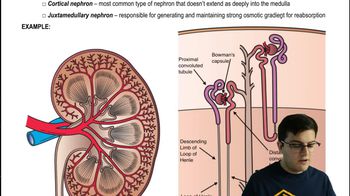
The nephron is the functional unit of the kidney, consisting of a glomerulus and Bowman's capsule, among other components. The glomerulus is a network of capillaries that filters blood, while Bowman's capsule surrounds it, collecting the filtrate. This structure is essential for the initial stage of urine formation.
Recommended video:
Guided course
02:59
Kidney and Nephron

Filtration Process

Filtration in the nephron occurs when blood enters the glomerulus, where pressure forces water, ions, and small molecules through the capillary walls into Bowman's capsule. This process separates waste products from the blood, creating a filtrate that will undergo further processing in the nephron.
Recommended video:
Guided course
04:19
1) RNA Processing

Reabsorption and Secretion

After filtration, the nephron reabsorbs essential substances like water, glucose, and ions back into the bloodstream, while secreting additional waste products into the filtrate. This process is crucial for maintaining homeostasis and ensuring that valuable nutrients are not lost in urine.
Recommended video:
Guided course
01:34
Protein Secretion
Related Practice
Textbook Question
Complete this map, which presents the three main topics of this chapter.

861
views
Textbook Question
In this schematic of urine production in a nephron, label the four processes involved and list some of the substances that are moved in each process.

2411
views
Textbook Question

Which of the following is not an adaptation for reducing the rate of heat loss to the environment?

a. Feathers or fur

b. Increasing blood flow to surface blood vessels

c. Huddling behavior of penguins

d. Countercurrent heat exchange

1020
views
Textbook Question

As filtrate passes through the loop of Henle, salt is reabsorbed and concentrated in the interstitial fluid of the medulla. This high solute concentration in the medulla enables nephrons to

a. Excrete the maximum amount of salt.

b. Neutralize toxins that might be found in the kidney.

c. Excrete a large amount of water.

d. Reabsorb water from the filtrate very efficiently.

2322
views
Textbook Question

Birds and insects excrete uric acid, whereas mammals and most amphibians excrete mainly urea. What is the chief advantage of uric acid over urea as a waste product?

a. Uric acid is a much simpler molecule.

b. It takes less energy to make uric acid.

c. Less water is required to excrete uric acid.

d. More solutes are removed excreting uric acid.

2313
views
Textbook Question

A freshwater fish would be expected to

a. Pump salt out through its gills.

b. Produce copious quantities of dilute urine.

c. Have scales and a covering of mucus that reduce water loss to the environment.

d. Do all of the above.

1401
views