Pearson+ LogoPearson+ Logo
Ch. 25 Control of Body Temperature and Water Balance
Taylor - Campbell Biology: Concepts & Connections 10th Edition
Taylor, Simon, Dickey, Hogan10th EditionCampbell Biology: Concepts & ConnectionsISBN: 9780136538783Not the one you use?Change textbook
Chapter 25, Problem 1

Complete this map, which presents the three main topics of this chapter. Flowchart illustrating osmoregulation and excretion in homeostasis, featuring animals and processes.

Verified step by step guidance
1
Identify the three main topics under Homeostasis: (a), osmoregulation, and nitrogenous wastes.
For (a), determine the type of regulation related to temperature, which involves animals being either (b) or (c).
For osmoregulation, identify the balance of (d) and (e) maintained by the human kidney.
For nitrogenous wastes, identify the forms (j), (k), and (l) and how they depend on the environment and reproduction.
Fill in the specific terms for each blank based on the context of homeostasis, osmoregulation, and nitrogenous wastes.

Verified video answer for a similar problem:

This video solution was recommended by our tutors as helpful for the problem above.
Video duration:
1m
Was this helpful?

Key Concepts

Here are the essential concepts you must grasp in order to answer the question correctly.

Homeostasis

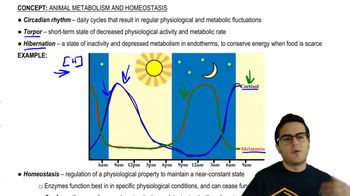
Homeostasis refers to the biological process by which living organisms maintain a stable internal environment despite external changes. This involves various physiological mechanisms that regulate factors such as temperature, pH, and ion concentrations, ensuring optimal conditions for cellular functions. For example, humans maintain a constant body temperature through thermoregulation.
Recommended video:

Osmoregulation

Osmoregulation is the process by which organisms regulate the balance of water and solutes in their bodies to maintain homeostasis. This is crucial for preventing dehydration or overhydration, which can disrupt cellular functions. In humans, the kidneys play a vital role in osmoregulation by filtering blood and adjusting the excretion of water and electrolytes.
Recommended video:
Guided course
07:16
Osmoregulation and Nitrogenous Waste

Nitrogenous Waste Excretion

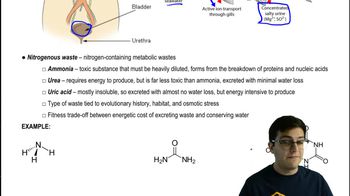
Nitrogenous waste excretion is the process of removing metabolic waste products, primarily nitrogenous compounds, from the body. These wastes, which include urea, uric acid, and ammonia, are toxic at high concentrations and must be eliminated to maintain homeostasis. The form of nitrogenous waste excreted can vary among species, influenced by factors such as habitat and water availability.
Recommended video:
Guided course
07:16
Osmoregulation and Nitrogenous Waste