Pearson+ LogoPearson+ Logo
Ch. 25 Control of Body Temperature and Water Balance
Taylor - Campbell Biology: Concepts & Connections 10th Edition
Taylor, Simon, Dickey, Hogan10th EditionCampbell Biology: Concepts & ConnectionsISBN: 9780136538783Not the one you use?Change textbook
Chapter 25, Problem 2

In this schematic of urine production in a nephron, label the four processes involved and list some of the substances that are moved in each process. Schematic of nephron showing urine production processes and labeled structures.

Verified step by step guidance
1
Identify the four main processes involved in urine production: filtration, reabsorption, secretion, and excretion.
Label the process of filtration at the glomerulus, where blood pressure forces water and solutes out of the blood and into the Bowman's capsule.
Label the process of reabsorption in the tubule, where useful substances like glucose, amino acids, and ions are reabsorbed back into the blood from the filtrate.
Label the process of secretion in the tubule, where additional waste products and excess ions are secreted from the blood into the tubule.
Label the process of excretion in the collecting duct, where the final urine is collected and transported to the bladder for elimination from the body.

Verified video answer for a similar problem:

This video solution was recommended by our tutors as helpful for the problem above.
Video duration:
1m
Was this helpful?

Key Concepts

Here are the essential concepts you must grasp in order to answer the question correctly.

Filtration

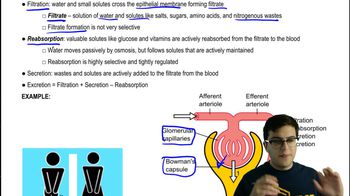
Filtration is the first step in urine production, occurring in the glomerulus of the nephron. Blood pressure forces water, ions, and small molecules from the blood into the Bowman’s capsule, forming a filtrate. Larger molecules, such as proteins and blood cells, remain in the bloodstream. This process is crucial for removing waste products while retaining essential components.
Recommended video:
Guided course
04:03
Filtration, Reabsorption, and Excretion

Reabsorption

Reabsorption takes place primarily in the renal tubules, where essential substances such as glucose, amino acids, and certain ions are selectively transported back into the bloodstream. This process ensures that valuable nutrients are not lost in urine. The reabsorption of water also occurs here, influenced by hormones like antidiuretic hormone (ADH), which helps maintain fluid balance.
Recommended video:
Guided course
04:03
Filtration, Reabsorption, and Excretion

Secretion

Secretion is the process by which additional waste products and excess ions are actively transported from the blood into the renal tubules. This occurs after filtration and reabsorption, allowing the body to eliminate substances like hydrogen ions, potassium, and certain drugs. Secretion plays a vital role in regulating blood pH and electrolyte balance, contributing to the overall homeostasis of the body.
Recommended video:
Guided course
01:34
Protein Secretion