Pearson+ LogoPearson+ Logo
Ch. 6 How Cells Harvest Chemical Energy
Taylor - Campbell Biology: Concepts & Connections 10th Edition
Taylor, Simon, Dickey, Hogan10th EditionCampbell Biology: Concepts & ConnectionsISBN: 9780136538783Not the one you use?Change textbook
Chapter 6, Problem 7

The poison cyanide binds to an electron carrier within the electron transport chain and blocks the movement of electrons. When this happens, glycolysis and the citric acid cycle soon grind to a halt as well. Why do you think these other two stages of cellular respiration stop? (Explain your answer.)
a. They run out of ATP
b. Unused O₂ interferes with cellular respiration
c. They run out of NAD+ and FAD
d. Electrons are no longer available

Verified step by step guidance
1
Step 1: Understand the role of the electron transport chain in cellular respiration. The electron transport chain is the final stage of cellular respiration, where electrons are transferred through a series of carriers to ultimately produce ATP. It also regenerates NAD+ and FAD by oxidizing NADH and FADH2, which are produced during glycolysis and the citric acid cycle.
Step 2: Recognize the importance of NAD+ and FAD in glycolysis and the citric acid cycle. These molecules act as electron carriers, accepting electrons during these processes and becoming NADH and FADH2. Without NAD+ and FAD, these stages cannot proceed because the reactions that depend on them will stop.
Step 3: Analyze the impact of cyanide on the electron transport chain. Cyanide blocks the movement of electrons by binding to an electron carrier, preventing the chain from functioning. This halts the regeneration of NAD+ and FAD, as the electron transport chain is responsible for oxidizing NADH and FADH2 back into NAD+ and FAD.
Step 4: Connect the disruption of the electron transport chain to the cessation of glycolysis and the citric acid cycle. Without NAD+ and FAD, glycolysis and the citric acid cycle cannot continue because they rely on these molecules to accept electrons during their respective reactions.
Step 5: Conclude that the correct answer is c. They run out of NAD+ and FAD. The blockage of the electron transport chain by cyanide prevents the regeneration of these essential electron carriers, causing glycolysis and the citric acid cycle to stop.

Verified video answer for a similar problem:

This video solution was recommended by our tutors as helpful for the problem above.
Video duration:
1m
Was this helpful?

Key Concepts

Here are the essential concepts you must grasp in order to answer the question correctly.

Electron Transport Chain (ETC)

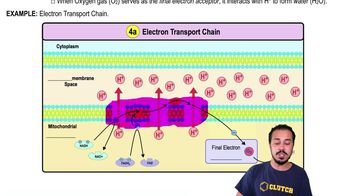
The electron transport chain is a series of protein complexes located in the inner mitochondrial membrane that facilitate the transfer of electrons derived from NADH and FADH2. This process generates a proton gradient that drives ATP synthesis through oxidative phosphorylation. When cyanide binds to an electron carrier in the ETC, it halts electron flow, disrupting ATP production and affecting the entire cellular respiration process.
Recommended video:
Guided course
07:41
Electron Transport Chain

Glycolysis and Citric Acid Cycle

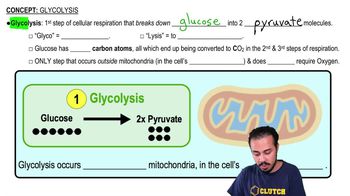
Glycolysis is the initial stage of cellular respiration that breaks down glucose into pyruvate, producing a small amount of ATP and NADH. The citric acid cycle (Krebs cycle) further processes pyruvate to generate additional NADH and FADH2, which are crucial for the ETC. Both processes rely on the availability of NAD+ and FAD, which are regenerated during electron transport; thus, their cessation leads to a halt in glycolysis and the citric acid cycle.
Recommended video:

Role of NAD+ and FAD

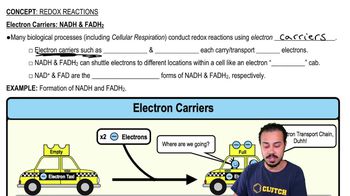
NAD+ and FAD are essential coenzymes in cellular respiration that act as electron carriers. They accept electrons during glycolysis and the citric acid cycle, becoming reduced to NADH and FADH2. When the electron transport chain is blocked, these coenzymes cannot be reoxidized, leading to a depletion of NAD+ and FAD, which ultimately stops glycolysis and the citric acid cycle from functioning.
Recommended video:
Guided course
05:22
Electron Carriers: NADH & FADH2