Textbook Question
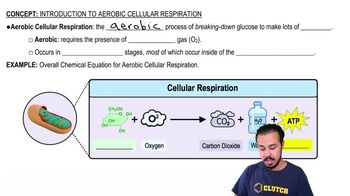
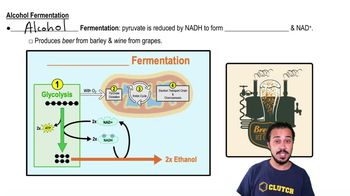
In glycolysis, ________ is oxidized and ________ is reduced.
a. NAD+ ... glucose
b. Glucose ... oxygen
c. ATP ... ADP
d. Glucose ... NAD+
3017
views



 Taylor, Simon, Dickey, Hogan 10th EditionCh. 6 How Cells Harvest Chemical EnergyProblem 6
 Verified step by step guidance
 03:39
03:39
 02:02
02:02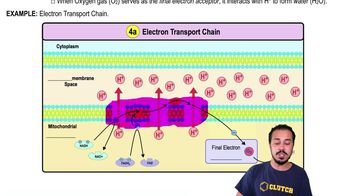 07:41
07:41In glycolysis, ________ is oxidized and ________ is reduced.
a. NAD+ ... glucose
b. Glucose ... oxygen
c. ATP ... ADP
d. Glucose ... NAD+
Most of the CO₂ from cellular respiration is released during
a. Stage 1: Glycolysis
b. Stage 2: Pyruvate oxidation
c. Stage 2: The citric acid cycle
d. Stage 3: Oxidative phosphorylation
Which of the following is the most immediate source of energy for making most of the ATP in your cells?
a. The transfer of from intermediate substrates to ADP
b. The movement of H⁺ across a membrane down its concentration gradient
c. The splitting of glucose into two molecules of pyruvate
d. Electrons moving through the electron transport chain
The poison cyanide binds to an electron carrier within the electron transport chain and blocks the movement of electrons. When this happens, glycolysis and the citric acid cycle soon grind to a halt as well. Why do you think these other two stages of cellular respiration stop? (Explain your answer.)
a. They run out of ATP
b. Unused O₂ interferes with cellular respiration
c. They run out of NAD+ and FAD
d. Electrons are no longer available
In which of the following is the first molecule becoming reduced to the second molecule?
a. Pyruvate → acetylCoA
b. Pyruvate → lactate
c. Glucose → pyruvate
d. NADH + H+ →NAD+ + 2H