Pearson+ LogoPearson+ Logo
Ch. 33 Control Systems in Plants
Taylor - Campbell Biology: Concepts & Connections 10th Edition
Taylor, Simon, Dickey, Hogan10th EditionCampbell Biology: Concepts & ConnectionsISBN: 9780136538783Not the one you use?Change textbook
Chapter 33, Problem 5

Plant hormones act by affecting the activities of:
a. Genes
b. Membranes
c. Enzymes
d. Genes, membranes, and enzymes

Verified step by step guidance
1
Understand the role of plant hormones: Plant hormones are chemical messengers that regulate various physiological processes in plants, such as growth, development, and responses to environmental stimuli.
Review how plant hormones interact with genes: Plant hormones can influence gene expression by activating or repressing specific genes, which leads to the production of proteins necessary for certain cellular functions.
Examine the effect of plant hormones on membranes: Plant hormones can alter the permeability of cell membranes, affecting the transport of ions and molecules, which is crucial for processes like nutrient uptake and signal transduction.
Explore the impact of plant hormones on enzymes: Plant hormones can regulate enzyme activity by either activating or inhibiting enzymes, which are essential for catalyzing biochemical reactions in the plant.
Conclude that plant hormones act on multiple levels: Based on the above points, plant hormones affect genes, membranes, and enzymes, demonstrating their multifaceted role in plant physiology.

Verified video answer for a similar problem:

This video solution was recommended by our tutors as helpful for the problem above.
Video duration:
2m
Was this helpful?

Key Concepts

Here are the essential concepts you must grasp in order to answer the question correctly.

Plant Hormones

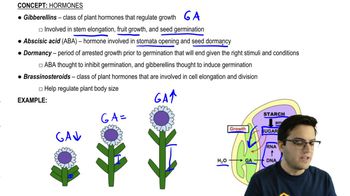
Plant hormones, or phytohormones, are chemical messengers that regulate various physiological processes in plants, including growth, development, and responses to environmental stimuli. They influence activities such as cell division, elongation, and differentiation, playing a crucial role in plant adaptation and survival.
Recommended video:
Guided course
08:18
Plant Hormones and Senescence

Gene Regulation

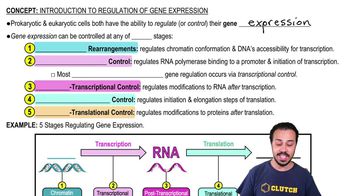
Gene regulation refers to the mechanisms that control the expression of genes, determining when and how much of a gene product is produced. In plants, hormones can activate or repress specific genes, leading to changes in growth patterns and developmental processes, such as flowering and fruit ripening.
Recommended video:
Guided course
06:40
Introduction to Regulation of Gene Expression

Enzyme Activity

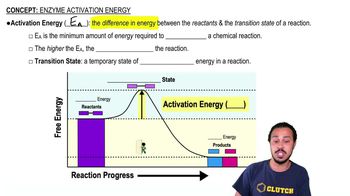
Enzymes are biological catalysts that accelerate chemical reactions in living organisms. Plant hormones can modulate enzyme activity, influencing metabolic pathways and physiological responses, such as photosynthesis and respiration, thereby affecting overall plant health and growth.
Recommended video:
Guided course
04:18
Enzyme Activation Energy
Related Practice
Textbook Question

During winter or periods of drought, which one of the following plant hormones inhibits growth and seed germination?

a. Ethylene

b. Abscisic acid

c. Gibberellin

d. Auxin

1024
views
Textbook Question

Auxin causes a shoot to bend toward the light by

a. Causing cells to shrink on the dark side of the shoot

b. Stimulating growth on the dark side of the shoot

c. Causing cells to shrink on the lighted side of the shoot

d. Stimulating growth on the lighted side of the shoot

1381
views
Textbook Question

In autumn, the amount of _________ increases and the amount of _________ decreases in fruits and leaf stalks, causing a plant to drop fruit and leaves.

a. Ethylene … auxin

b. Gibberellin … abscisic acid

c. Cytokinin … abscisic acid

d. Auxin … ethylene

1040
views
Textbook Question

Buds and sprouts often form on tree stumps. Which hormone would stimulate their formation?

a. Auxin

b. Cytokinin

c. Abscisic acid

d. Ethylene

1180
views
Textbook Question

Which of the following is a type of defense used by plants to deter herbivores?

a. Chemicals toxic to the herbivore

b. Chemicals that recruit other animals

c. Spines

d. a, b, and c

1186
views
Textbook Question

"Match each definition with the correct term.

Bending of a shoot toward light, Growth response to touch, Cycle with a period of about 24 hours Pigment that helps control flowering Relative lengths of night and day Growth response to gravity Folding of plant leaves at night

a. Phytochrome

b. Photoperiod

c. Sleep movement

d. Circadian rhythm

e. Thigmotropism

f. Phototropism

g. Gravitropism"

951
views