
Pearson+ LogoPearson+ Logo
Ch. 12 DNA Technology and Genomics
Taylor - Campbell Biology: Concepts & Connections 10th Edition
Taylor, Simon, Dickey, Hogan10th EditionCampbell Biology: Concepts & ConnectionsISBN: 9780136538783Not the one you use?Change textbook
Chapter 12, Problem 1

Imagine you have found a small quantity of DNA. Fill in the following diagram, which outlines a series of DNA technology experiments you could perform to study this DNA.
<IMAGE>
a.
b.
c.
d.
e.

Verified step by step guidance
1
Step 1: To amplify the DNA, use the Polymerase Chain Reaction (PCR). PCR is a technique that allows for the rapid and specific amplification of DNA sequences. This step corresponds to (a) in the diagram.
Step 2: Treat the DNA sample and bacterial plasmids with restriction enzymes. Restriction enzymes cut DNA at specific sequences, creating fragments with sticky or blunt ends. This step corresponds to (b) in the diagram.
Step 3: Sort the DNA fragments by size using gel electrophoresis. Gel electrophoresis separates DNA fragments based on their size by applying an electric field to a gel matrix. Smaller fragments move faster through the gel. This step corresponds to (c) in the diagram.
Step 4: Add a DNA probe to highlight a particular DNA sequence. A DNA probe is a labeled single-stranded DNA molecule that binds to its complementary sequence, allowing for visualization of specific DNA fragments. This step corresponds to (d) in the diagram.
Step 5: Insert recombinant plasmids into bacteria and allow them to replicate via bacterial transformation. Bacteria will copy the recombinant plasmids as they divide, creating multiple copies of the DNA. This step corresponds to (e) in the diagram.

Verified video answer for a similar problem:

This video solution was recommended by our tutors as helpful for the problem above.
Video duration:
1m
Was this helpful?

Key Concepts

Here are the essential concepts you must grasp in order to answer the question correctly.

DNA Extraction

DNA extraction is the process of isolating DNA from cells or tissues. This is a crucial first step in any DNA analysis, as it allows researchers to obtain a pure sample for further experimentation. Techniques such as using detergents to break down cell membranes and alcohol to precipitate DNA are commonly employed in this process.
Recommended video:
Guided course
04:01
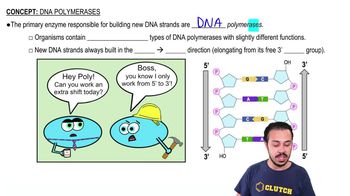
DNA Polymerases

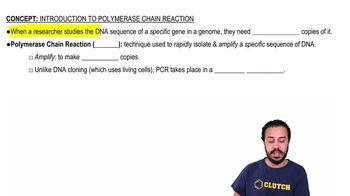
Polymerase Chain Reaction (PCR)

Polymerase Chain Reaction (PCR) is a technique used to amplify specific segments of DNA, making millions of copies of a particular sequence. This is essential when working with small quantities of DNA, as it allows for sufficient material to conduct various analyses. PCR involves repeated cycles of denaturation, annealing, and extension, utilizing DNA polymerase enzymes.
Recommended video:
Guided course
01:31
Introduction to Polymerase Chain Reaction

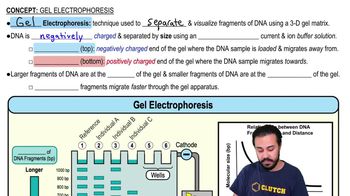
Gel Electrophoresis

Gel electrophoresis is a method used to separate DNA fragments based on their size. By applying an electric current to a gel matrix, smaller fragments move faster than larger ones, allowing for visualization and analysis of the DNA. This technique is often used after PCR to assess the success of amplification and to analyze genetic variations.
Recommended video:
Guided course
07:58
Gel Electrophoresis