Pearson+ LogoPearson+ Logo
Ch. 12 DNA Technology and Genomics
Taylor - Campbell Biology: Concepts & Connections 10th Edition
Taylor, Simon, Dickey, Hogan10th EditionCampbell Biology: Concepts & ConnectionsISBN: 9780136538783Not the one you use?Change textbook
Chapter 12, Problem 4

A paleontologist has recovered a tiny bit of organic material from the 400-year-old preserved skin of an extinct dodo. She would like to compare DNA from the sample with DNA from living birds. Which of the following would be most useful for increasing the amount of DNA available for testing?
a. Restriction fragment analysis
b. Polymerase chain reaction
c. Molecular probe analysis
d. Electrophoresis

Verified step by step guidance
1
Understand the problem: The paleontologist needs to increase the amount of DNA from a small sample to compare it with DNA from living birds. This requires a method that amplifies DNA efficiently.
Review the options: Analyze each method provided in the question to determine which one is most suitable for amplifying DNA.
Option a: Restriction fragment analysis is used to cut DNA into smaller fragments using restriction enzymes, but it does not amplify DNA. This method is not suitable for increasing DNA quantity.
Option b: Polymerase chain reaction (PCR) is a technique specifically designed to amplify DNA. It uses primers, DNA polymerase, and thermal cycling to create millions of copies of a specific DNA sequence, making it ideal for this purpose.
Option c and d: Molecular probe analysis and electrophoresis are used for identifying or separating DNA fragments, but they do not increase the amount of DNA. Therefore, they are not suitable for this task. Based on this analysis, the most useful method is polymerase chain reaction (PCR).

Verified video answer for a similar problem:

This video solution was recommended by our tutors as helpful for the problem above.
Video duration:
1m
Was this helpful?

Key Concepts

Here are the essential concepts you must grasp in order to answer the question correctly.

Polymerase Chain Reaction (PCR)

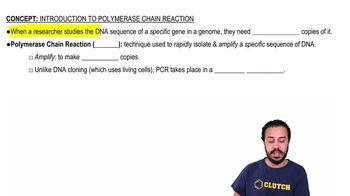
Polymerase Chain Reaction (PCR) is a molecular biology technique used to amplify specific DNA sequences, making millions of copies from a small sample. This is particularly useful when working with degraded or limited DNA, such as that from ancient or preserved specimens. By using primers that target specific regions of the DNA, PCR allows researchers to generate sufficient quantities for further analysis.
Recommended video:
Guided course
01:31
Introduction to Polymerase Chain Reaction

DNA Analysis Techniques

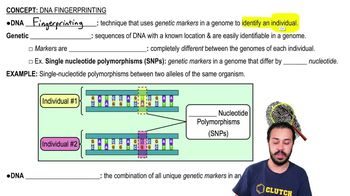
Various DNA analysis techniques, such as restriction fragment analysis and electrophoresis, are used to study DNA structure and function. Restriction fragment analysis involves cutting DNA with specific enzymes to analyze the resulting fragments, while electrophoresis separates DNA fragments based on size. However, these methods do not increase the amount of DNA available, which is crucial in this context.
Recommended video:
Guided course
03:30
DNA Fingerprinting

Molecular Probes

Molecular probes are short strands of nucleic acids used to detect specific sequences of DNA or RNA. They can bind to complementary sequences, allowing researchers to identify and quantify specific genetic material. While useful for analysis, molecular probes do not amplify DNA, making them less relevant for increasing the amount of DNA from a small sample.
Recommended video:
05:13
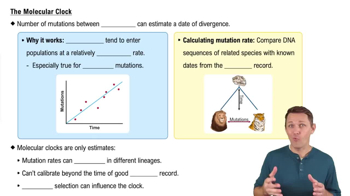
The Molecular Clock
Related Practice
Textbook Question

Imagine you have found a small quantity of DNA. Fill in the following diagram, which outlines a series of DNA technology experiments you could perform to study this DNA.

<IMAGE>

a.

b.

c.

d.

e.


793
views
Textbook Question

Which of the following would be considered a transgenic organism?

a. A bacterium that has received genes via conjugation

b. A human given a corrected human blood-clotting gene

c. A fern grown in cell culture from a single fern root cell

d. A rat with rabbit hemoglobin genes

1452
views
Textbook Question

The DNA profiles used as evidence in a murder trial look something like supermarket bar codes. The pattern of bars in a DNA profile shows

a. The order of bases in a particular gene.

b. The presence of various-sized fragments of DNA.

c. The presence of dominant or recessive alleles for particular traits.

d. The order of genes along particular chromosomes.

1157
views
Textbook Question

How many genes are there in a human sperm cell?

a. 23

b. 46

c. About 21,000

d. about 3 billion

1793
views
Textbook Question

When a typical restriction enzyme cuts a DNA molecule, the cuts are uneven, giving the DNA fragments single-stranded ends. These ends are useful in recombinant DNA work because

a. They enable a cell to recognize fragments produced by the enzyme.

b. They serve as starting points for DNA replication.

c. The fragments will bond to other fragments with complementary ends.

d. They enable researchers to use the fragments as molecular probes.

1563
views
Textbook Question
Why does DNA profiling rely on comparing specific genetic markers rather than the entire genome?
1205
views