Pearson+ LogoPearson+ Logo
Ch. 11 How Genes Are Controlled
Taylor - Campbell Biology: Concepts & Connections 10th Edition
Taylor, Simon, Dickey, Hogan10th EditionCampbell Biology: Concepts & ConnectionsISBN: 9780136538783Not the one you use?Change textbook
Chapter 11, Problem 3

A homeotic gene does which of the following?
a. It serves as the ultimate control for prokaryotic operons.
b. It regulates the expression of groups of other genes during development.
c. It represses the histone proteins in eukaryotic chromosomes.
d. It helps splice mRNA after transcription.

Verified step by step guidance
1
Understand the concept of homeotic genes: Homeotic genes are a group of regulatory genes that control the development of anatomical structures in organisms. They are crucial in determining the body plan and the identity of body segments during embryonic development.
Eliminate option (a): Homeotic genes are not involved in the control of prokaryotic operons. Prokaryotic operons are regulated by mechanisms like repressors and activators, not homeotic genes.
Eliminate option (c): Homeotic genes do not repress histone proteins. Histone proteins are involved in DNA packaging in eukaryotic chromosomes, and their regulation is managed by other mechanisms, such as histone modification enzymes.
Eliminate option (d): Homeotic genes do not play a role in splicing mRNA after transcription. mRNA splicing is carried out by the spliceosome, a complex of proteins and RNA, and is unrelated to homeotic genes.
Select option (b): Homeotic genes regulate the expression of groups of other genes during development. They act as master regulators, turning on or off specific genes to ensure proper development of body structures in the correct locations.

Verified video answer for a similar problem:

This video solution was recommended by our tutors as helpful for the problem above.
Video duration:
1m
Was this helpful?

Key Concepts

Here are the essential concepts you must grasp in order to answer the question correctly.

Homeotic Genes

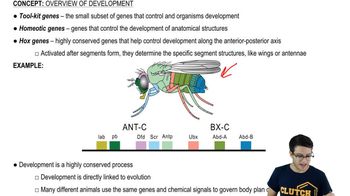
Homeotic genes are a group of regulatory genes that control the development of anatomical structures in various organisms. They play a crucial role in determining the identity of body parts during embryonic development by regulating the expression of other genes. Mutations in these genes can lead to significant developmental abnormalities, illustrating their importance in the proper formation of an organism.
Recommended video:
Guided course
05:02
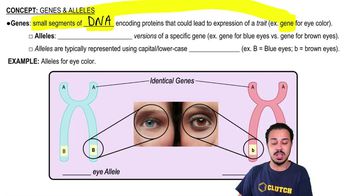
Genes & Alleles

Gene Regulation

Gene regulation refers to the mechanisms that control the expression of genes, determining when and how much of a gene product is produced. This process is essential for development, as it allows cells to respond to internal and external signals, ensuring that the right genes are expressed at the right times. In the context of homeotic genes, they regulate the expression of other genes that dictate the formation of specific structures.
Recommended video:
Guided course
06:40
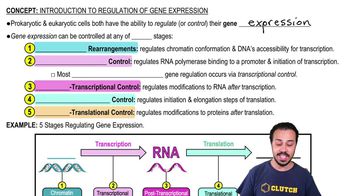
Introduction to Regulation of Gene Expression

Developmental Biology

Developmental biology is the study of the processes by which organisms grow and develop. It encompasses the genetic, cellular, and molecular mechanisms that lead to the formation of tissues and organs. Understanding developmental biology is crucial for comprehending how homeotic genes influence the organization and identity of body parts during the growth of an organism.
Recommended video:
Related Practice
Textbook Question

Complete the following concept map to test your knowledge of gene regulation.

<IMAGE>

a.

b.

c.

d.

e.

f.

g.

2289
views
Textbook Question

Which of the following methods of gene regulation do eukaryotes and prokaryotes have in common?

a. Elaborate packing of DNA in chromosomes

b. Activator and repressor proteins, which attach to DNA

c. The addition of a cap and tail to mRNA after transcription

d. Lac and trp operons

1363
views
Textbook Question

Which of the following is a valid difference between embryonic stem cells and the stem cells found in adult tissues?

a. In laboratory culture, only adult stem cells are immortal.

b. In nature, only embryonic stem cells give rise to all the different types of cells in the organism.

c. Only adult stem cells can differentiate in culture.

d. Embryonic stem cells are generally more difficult to grow in culture than adult stem cells.

1520
views
Textbook Question

The control of gene expression is more complex in multicellular eukaryotes than in prokaryotes because __________. (Explain your answer.)

a. Eukaryotic cells are much smaller

b. In a multicellular eukaryote, different cells are specialized for different functions

c. Prokaryotes are restricted to stable environments

d. Eukaryotes have fewer genes, so each gene must do several jobs

951
views
Textbook Question

Your bone cells, muscle cells, and skin cells look different because

a. Each cell contains different kinds of genes.

b. They are present in different organs.

c. Different genes are active in each kind of cell.

d. They contain different numbers of genes.

1769
views