Pearson+ LogoPearson+ Logo
Ch. 11 How Genes Are Controlled
Taylor - Campbell Biology: Concepts & Connections 10th Edition
Taylor, Simon, Dickey, Hogan10th EditionCampbell Biology: Concepts & ConnectionsISBN: 9780136538783Not the one you use?Change textbook
Chapter 11, Problem 2

Which of the following methods of gene regulation do eukaryotes and prokaryotes have in common?
a. Elaborate packing of DNA in chromosomes
b. Activator and repressor proteins, which attach to DNA
c. The addition of a cap and tail to mRNA after transcription
d. Lac and trp operons

Verified step by step guidance
1
Understand that the question is asking about similarities in gene regulation between eukaryotes and prokaryotes. This means we need to identify a regulatory mechanism that is shared by both types of organisms.
Analyze each option: Option (a) refers to the elaborate packing of DNA in chromosomes, which is specific to eukaryotes due to their chromatin structure and histone proteins. Prokaryotes do not have this level of DNA packaging.
Option (b) mentions activator and repressor proteins, which are regulatory proteins that bind to DNA to either promote or inhibit transcription. Both eukaryotes and prokaryotes use these proteins in gene regulation, making this a shared mechanism.
Option (c) involves the addition of a cap and tail to mRNA after transcription, which is a process unique to eukaryotes. Prokaryotes do not modify their mRNA in this way.
Option (d) refers to lac and trp operons, which are specific examples of gene regulation in prokaryotes. Eukaryotes do not use operons for gene regulation. Therefore, the correct answer is option (b), as it is the only mechanism shared by both eukaryotes and prokaryotes.

Verified video answer for a similar problem:

This video solution was recommended by our tutors as helpful for the problem above.
Video duration:
2m
Was this helpful?

Key Concepts

Here are the essential concepts you must grasp in order to answer the question correctly.

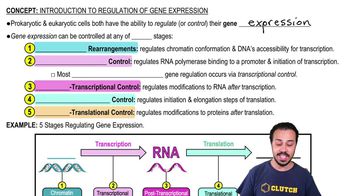
Gene Regulation

Gene regulation refers to the mechanisms that control the expression of genes, determining when and how much of a gene product is made. In both eukaryotes and prokaryotes, gene regulation is essential for responding to environmental changes and maintaining cellular functions. This process can involve various elements, including transcription factors, enhancers, and silencers, which interact with DNA to modulate gene activity.
Recommended video:
Guided course
06:40
Introduction to Regulation of Gene Expression

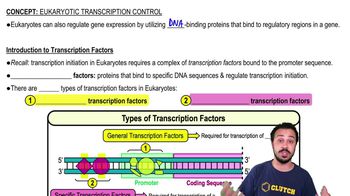
Transcription Factors

Transcription factors are proteins that bind to specific DNA sequences to regulate the transcription of genes. They can act as activators, enhancing gene expression, or repressors, inhibiting it. Both eukaryotes and prokaryotes utilize these proteins to respond to internal and external signals, making them a common feature in gene regulation across different organisms.
Recommended video:
Guided course
03:32
Introduction to Transcription Factors

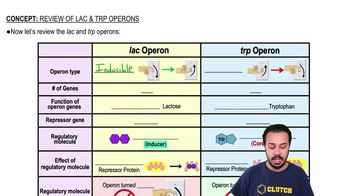
Operons

Operons are a cluster of genes under the control of a single promoter, commonly found in prokaryotes. They allow for coordinated regulation of genes that encode proteins with related functions, such as the lac and trp operons in E. coli. While eukaryotes do not have operons in the same way, they can achieve similar regulatory outcomes through complex interactions of transcription factors and regulatory elements.
Recommended video:
Guided course
06:24
Review of the Lac Operon & Trp Operon