
Pearson+ LogoPearson+ Logo
Ch. 18 The Evolution of Invertebrate Diversity
Taylor - Campbell Biology: Concepts & Connections 10th Edition
Taylor, Simon, Dickey, Hogan10th EditionCampbell Biology: Concepts & ConnectionsISBN: 9780136538783Not the one you use?Change textbook
Chapter 18, Problem 20

A marine biologist has dredged up an unknown animal from the seafloor. Describe some of the characteristics that could be used to determine the animal phylum to which the creature should be assigned.

Verified step by step guidance
1
Examine the symmetry of the animal's body. Determine if it has radial symmetry (e.g., like jellyfish), bilateral symmetry (e.g., like fish), or no symmetry (e.g., like sponges). This can help narrow down the phylum.
Inspect the presence and type of body cavity (coelom). Determine if the animal is acoelomate (no body cavity), pseudocoelomate (a body cavity not fully lined with mesoderm), or coelomate (a fully lined body cavity).
Analyze the type of digestive system. Check if the animal has a complete digestive tract (with a separate mouth and anus) or an incomplete digestive system (a single opening for ingestion and excretion).
Observe the presence and structure of specialized tissues or organs. For example, look for features like a notochord (characteristic of chordates), segmentation (e.g., in annelids or arthropods), or stinging cells (cnidocytes, characteristic of cnidarians).
Examine the animal's external and internal structures under a microscope. Look for specific features such as exoskeletons, jointed appendages, or cilia, which can provide clues about its classification into a specific phylum.

Verified video answer for a similar problem:

This video solution was recommended by our tutors as helpful for the problem above.
Video duration:
1m
Was this helpful?

Key Concepts

Here are the essential concepts you must grasp in order to answer the question correctly.

Animal Phyla Classification

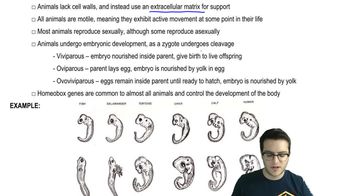
Animal phyla classification is a hierarchical system used to categorize animals based on shared characteristics and evolutionary relationships. Each phylum represents a major group of animals that share fundamental structural features, such as body symmetry, tissue organization, and developmental patterns. Understanding the classification system helps in identifying the unknown animal by comparing its traits to those of known phyla.
Recommended video:
Guided course
05:58
Overview of Animals - 1

Morphological Characteristics

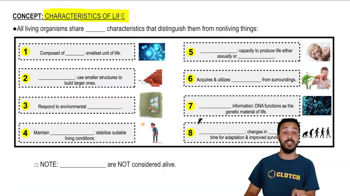
Morphological characteristics refer to the physical traits of an organism, including body shape, size, symmetry, and the presence of specialized structures. These traits are crucial for classification, as they can indicate evolutionary relationships and functional adaptations. For example, the presence of a backbone can help distinguish vertebrates from invertebrates, guiding the identification of the animal's phylum.
Recommended video:
Guided course
09:26
Characteristics of Life

Genetic and Molecular Analysis

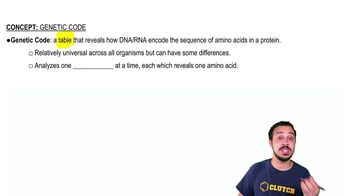
Genetic and molecular analysis involves examining the DNA and genetic material of an organism to determine its evolutionary relationships and classification. Techniques such as DNA sequencing can reveal similarities and differences at the molecular level, providing insights into the animal's lineage. This approach is increasingly important in modern taxonomy, as it can confirm or refine classifications based on morphological data alone.
Recommended video: