Pearson+ LogoPearson+ Logo
Ch. 18 The Evolution of Invertebrate Diversity
Taylor - Campbell Biology: Concepts & Connections 10th Edition
Taylor, Simon, Dickey, Hogan10th EditionCampbell Biology: Concepts & ConnectionsISBN: 9780136538783Not the one you use?Change textbook
Chapter 18, Problem 17

Compare the structure of a planarian (a flatworm) and an earthworm with regard to the following: digestive tract, body cavity, and segmentation.

Verified step by step guidance
1
Identify the type of digestive tract in both the planarian and the earthworm. Planarians have a simple digestive system with a single opening that serves as both mouth and anus, known as a gastrovascular cavity. Earthworms, on the other hand, have a more complex digestive tract that is tube-like and extends from the mouth to the anus, allowing for a more efficient digestion process.
Examine the body cavity structure of both organisms. Planarians do not have a true body cavity (coelom) but rather a solid body filled with mesenchyme. Earthworms possess a true body cavity, which is a fluid-filled space called a coelom that is lined with tissue derived from mesoderm.
Discuss the segmentation of both organisms. Planarians do not exhibit segmentation; their bodies are more or less uniform along their length. In contrast, earthworms show clear segmentation with their bodies divided into ring-like segments called annuli, which are externally visible and play a role in movement and flexibility.
Compare how these structural differences affect the biological functions of each organism. For example, the segmented body of the earthworm allows for more efficient movement through soil and aids in the circulation of fluids within their coelom, enhancing nutrient transport and waste removal.
Conclude by summarizing the key differences in the digestive tract, body cavity, and segmentation between planarians and earthworms, and how these differences reflect their adaptation to their respective environments.

Verified video answer for a similar problem:

This video solution was recommended by our tutors as helpful for the problem above.
Video duration:
1m
Was this helpful?

Key Concepts

Here are the essential concepts you must grasp in order to answer the question correctly.

Digestive Tract

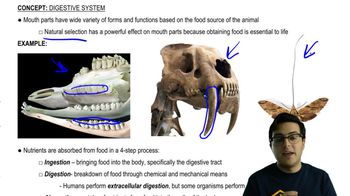
The digestive tract refers to the system of organs responsible for processing food. In planarians, the digestive system is incomplete, featuring a single opening that serves as both mouth and anus, with a branched gastrovascular cavity for nutrient distribution. In contrast, earthworms possess a complete digestive tract with a distinct mouth and anus, allowing for a more efficient processing of food through specialized regions like the crop and gizzard.
Recommended video:
Guided course
05:11
Digestion and Digestive Tracts

Body Cavity

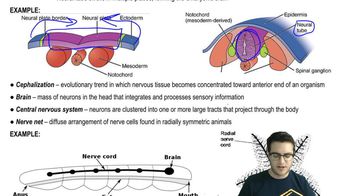
The body cavity, or coelom, is a fluid-filled space within the body that houses internal organs. Planarians are acoelomate, meaning they lack a true body cavity, with their organs embedded in a solid mass of tissue. Earthworms, however, are coelomates, possessing a true coelom that provides a more complex structure for organ development and function, allowing for greater mobility and organ differentiation.
Recommended video:

Segmentation

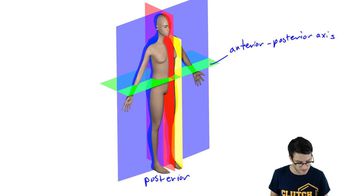
Segmentation refers to the division of the body into repetitive segments. Planarians exhibit a non-segmented body structure, which is characteristic of flatworms, allowing for a more flattened morphology. In contrast, earthworms are segmented, with their bodies divided into numerous segments (metameres) that facilitate movement and the specialization of body functions, contributing to their adaptability in various environments.
Recommended video:
Guided course
04:57
Overview of Animals - 5
Related Practice
Textbook Question

Which of the following animal groups does not have tissues derived from mesoderm?

a. Annelids

b. Echinoderms

c. Cnidarians

d. Flatworms

1396
views
Textbook Question

Molecular comparisons place nematodes and arthropods in clade Ecdysozoa. What characteristic do they share that is the basis for the name Ecdysozoa?

a. A complete digestive tract

b. Body segmentation

c. Molting of an exoskeleton

d. Bilateral symmetry

844
views
Textbook Question

Match each description on the left with the corresponding term on the right Closest relatives of chordates

a. annelids

b. nematodes

c. sponges

d. arthropods

e. flatworms

f. cnidarians

g. molluscs

h. echinoderms

i. chordates


974
views
Textbook Question
One of the key characteristics of arthropods is their jointed appendages. Describe four functions of these appendages in four different arthropods.
1277
views
Textbook Question

A marine biologist has dredged up an unknown animal from the seafloor. Describe some of the characteristics that could be used to determine the animal phylum to which the creature should be assigned.

908
views
Textbook Question

In one of the experiments described in Module 18.13, researchers tested the hypothesis that the highly successful arthropod body plan resulted from new genes that originated in the arthropod lineage. Draw a diagram showing the evolutionary relationship between arthropods and velvet worms and use it to explain why velvet worms were a good choice to test this hypothesis. What results would have supported the hypothesis?

802
views