Pearson+ LogoPearson+ Logo
Ch. 16 Microbial Life: Prokaryotes and Protists
Taylor - Campbell Biology: Concepts & Connections 10th Edition
Taylor, Simon, Dickey, Hogan10th EditionCampbell Biology: Concepts & ConnectionsISBN: 9780136538783Not the one you use?Change textbook
Chapter 16, Problem 2

Fill in the blanks on the phylogenetic tree (on the facing page) to show current hypotheses for the origin of multicellular organisms.
Phylogenetic tree illustrating hypotheses for multicellular organism origins with blanks for labeling.

Verified step by step guidance
1
Examine the phylogenetic tree starting from the ancestral eukaryote. Note that the tree branches into two main groups: one leading to algae and land plants, and the other leading to amoebozoans and other organisms.
Identify the first blank (a) on the branch leading to red algae and green algae. This represents the common ancestor of red algae and green algae, which are both photosynthetic organisms. Label this as 'Archaeplastida'.
For the second blank (b), which is on the branch leading to land plants, identify the group that includes green algae and land plants. This group is known as 'Charophytes', which are the closest relatives of land plants.
For the third blank (c), on the branch leading to amoebozoans and nucleariids, identify the group that includes these organisms. This group is known as 'Unikonta', which includes amoebozoans and opisthokonts (fungi and animals).
For the fourth, fifth, and sixth blanks (d, e, f), identify the groups branching from nucleariids. These are fungi (d), animals (e), and choanoflagellates (f), which are the closest relatives of animals.

Verified video answer for a similar problem:

This video solution was recommended by our tutors as helpful for the problem above.
Video duration:
2m
Was this helpful?

Key Concepts

Here are the essential concepts you must grasp in order to answer the question correctly.

Phylogenetic Tree

A phylogenetic tree is a diagram that represents evolutionary relationships among various biological species based on similarities and differences in their physical or genetic characteristics. It illustrates how species are related through common ancestors, helping to visualize the evolutionary history and divergence of different groups over time.
Recommended video:
04:13
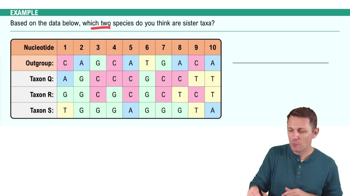
Building Phylogenetic Trees Example 2

Multicellularity

Multicellularity refers to the condition of an organism consisting of multiple cells that work together, as opposed to unicellular organisms that consist of a single cell. The evolution of multicellularity is a significant event in the history of life, allowing for greater complexity, specialization of cells, and the development of larger organisms, which can perform more complex functions.
Recommended video:
Guided course
02:09
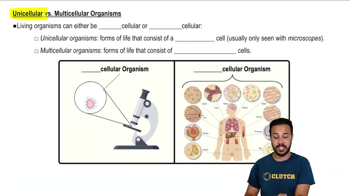
Unicellular vs. Multicellular

Eukaryotic Lineage

Eukaryotic lineage refers to the evolutionary path of organisms that possess eukaryotic cells, characterized by a defined nucleus and organelles. This lineage includes a diverse range of life forms, from single-celled organisms to complex multicellular organisms like plants and animals, and is crucial for understanding the origins and evolution of multicellular life.
Recommended video:
Guided course
02:37
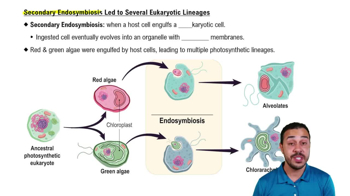
Secondary Endosymbiosis Led to Several Eukaryotic Lineages