Pearson+ LogoPearson+ Logo
Ch. 16 Microbial Life: Prokaryotes and Protists
Taylor - Campbell Biology: Concepts & Connections 10th Edition
Taylor, Simon, Dickey, Hogan10th EditionCampbell Biology: Concepts & ConnectionsISBN: 9780136538783Not the one you use?Change textbook
Chapter 16, Problem 4

A new organism has been discovered. Tests have revealed that it is unicellular, is autotrophic, and has a cell wall that contains peptidoglycan. Based on this evidence, it should be classified as a(n)
a. Alga.
b. Archaean.
c. Protist.
d. Bacterium.

Verified step by step guidance
1
Step 1: Understand the characteristics of the organism described in the problem. It is unicellular, autotrophic, and has a cell wall containing peptidoglycan.
Step 2: Recall that peptidoglycan is a structural molecule found in the cell walls of bacteria. This is a key distinguishing feature of bacteria compared to other groups.
Step 3: Analyze the other options: (a) Algae are typically eukaryotic and do not have peptidoglycan in their cell walls. (b) Archaea, while unicellular, have cell walls that lack peptidoglycan. (c) Protists are eukaryotic and do not have peptidoglycan in their cell walls.
Step 4: Compare the characteristics of the organism to the defining features of bacteria. The presence of peptidoglycan in the cell wall strongly supports classification as a bacterium.
Step 5: Conclude that the organism is most likely classified as a bacterium based on the evidence provided.

Verified video answer for a similar problem:

This video solution was recommended by our tutors as helpful for the problem above.
Video duration:
1m
Was this helpful?

Key Concepts

Here are the essential concepts you must grasp in order to answer the question correctly.

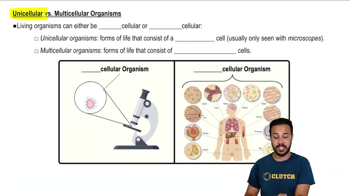
Unicellularity

Unicellularity refers to organisms that consist of a single cell. This characteristic is fundamental in classifying organisms, as it distinguishes them from multicellular organisms. Unicellular organisms can perform all necessary life functions within one cell, including metabolism, reproduction, and response to environmental stimuli.
Recommended video:
Guided course
02:09
Unicellular vs. Multicellular

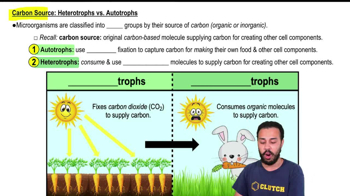
Autotrophy

Autotrophy is the ability of an organism to produce its own food from inorganic substances, typically through photosynthesis or chemosynthesis. Autotrophic organisms, such as plants and certain bacteria, convert light energy or chemical energy into organic compounds, which are essential for their growth and energy needs.
Recommended video:
Guided course
02:59
Carbon Source: Heterotrophs vs. Autotrophs

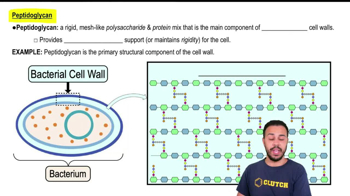
Peptidoglycan in Cell Walls

Peptidoglycan is a polymer that forms a crucial component of the cell walls in bacteria. It provides structural support and protection to the cell. The presence of peptidoglycan is a key distinguishing feature that helps classify organisms as bacteria, differentiating them from archaea and eukaryotes, which have different cell wall compositions.
Recommended video:
Guided course
01:58
Peptidoglycan