Pearson+ LogoPearson+ Logo
Ch. 16 Microbial Life: Prokaryotes and Protists
Taylor - Campbell Biology: Concepts & Connections 10th Edition
Taylor, Simon, Dickey, Hogan10th EditionCampbell Biology: Concepts & ConnectionsISBN: 9780136538783Not the one you use?Change textbook
Chapter 16, Problem 3

In terms of nutrition, autotrophs are to heterotrophs as
a. Kelp are to diatoms.
b. Archaea are to bacteria.
c. Slime molds are to algae.
d. Algae are to slime molds.

Verified step by step guidance
1
Understand the key terms: Autotrophs are organisms that produce their own food using light (photosynthesis) or chemical energy (chemosynthesis). Heterotrophs, on the other hand, obtain their energy by consuming other organisms or organic matter.
Analyze the relationship: The question asks for a comparison between autotrophs and heterotrophs. Autotrophs are producers in an ecosystem, while heterotrophs are consumers.
Evaluate the options: Look at the pairs provided in the options. For each pair, determine which organism is an autotroph and which is a heterotroph.
Option analysis: For example, algae are autotrophs because they perform photosynthesis, while slime molds are heterotrophs because they consume organic matter. This matches the relationship between autotrophs and heterotrophs.
Select the correct answer: Based on the analysis, identify the pair that correctly represents the relationship between autotrophs and heterotrophs.

Verified video answer for a similar problem:

This video solution was recommended by our tutors as helpful for the problem above.
Video duration:
1m
Was this helpful?

Key Concepts

Here are the essential concepts you must grasp in order to answer the question correctly.

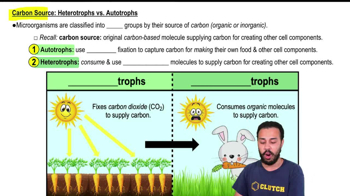
Autotrophs

Autotrophs are organisms that produce their own food using light, water, carbon dioxide, or other chemicals. They are primarily classified into photoautotrophs, which use sunlight for photosynthesis, and chemoautotrophs, which derive energy from chemical reactions. Examples include plants and certain bacteria, which form the base of food chains by converting inorganic substances into organic matter.
Recommended video:
Guided course
02:59
Carbon Source: Heterotrophs vs. Autotrophs

Heterotrophs

Heterotrophs are organisms that cannot synthesize their own food and rely on consuming other organisms or organic matter for energy and nutrients. This group includes animals, fungi, and many bacteria. Heterotrophs play a crucial role in ecosystems by breaking down organic material and recycling nutrients, thus supporting the energy flow within food webs.
Recommended video:
Guided course
02:59
Carbon Source: Heterotrophs vs. Autotrophs

Nutritional Relationships

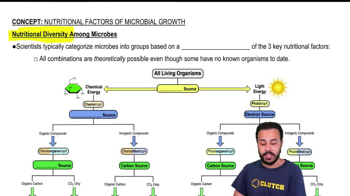
Nutritional relationships describe the interactions between different organisms based on their feeding strategies. In ecosystems, autotrophs serve as primary producers, while heterotrophs act as consumers. Understanding these relationships is essential for analyzing food webs and ecological dynamics, as they illustrate how energy and nutrients flow through different trophic levels.
Recommended video:
Guided course
05:58
Nutritional Diversity Among Microbes