
Pearson+ LogoPearson+ Logo
Ch. 16 Microbial Life: Prokaryotes and Protists
Taylor - Campbell Biology: Concepts & Connections 10th Edition
Taylor, Simon, Dickey, Hogan10th EditionCampbell Biology: Concepts & ConnectionsISBN: 9780136538783Not the one you use?Change textbook
Chapter 16, Problem 13

In a process known as 'coral bleaching,' high water temperatures cause corals to expel the dinoflagellates that normally reside within their cells. How might coral bleaching affect coral reefs?

Verified step by step guidance
1
Understand the symbiotic relationship: Corals and dinoflagellates (specifically zooxanthellae) have a mutualistic relationship. The dinoflagellates live within the coral's tissues and perform photosynthesis, providing the coral with nutrients like glucose, glycerol, and amino acids, while the coral provides the dinoflagellates with protection and access to sunlight.
Recognize the role of dinoflagellates in reef health: The nutrients produced by the dinoflagellates are essential for coral growth and the formation of calcium carbonate skeletons, which are the structural foundation of coral reefs.
Analyze the impact of bleaching: When corals expel their dinoflagellates due to stress (e.g., high water temperatures), they lose their primary source of nutrients. This weakens the corals, making them more susceptible to disease, reduced growth, and potentially death.
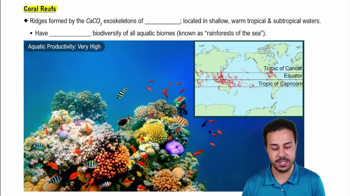
Consider the broader ecological effects: Coral reefs are biodiversity hotspots, providing habitat and food for numerous marine species. Coral bleaching can lead to the collapse of these ecosystems, affecting fish populations and other organisms that depend on the reef.
Connect to environmental implications: Coral bleaching is often linked to climate change and rising sea temperatures. The loss of coral reefs can have significant consequences for coastal protection, fisheries, and global biodiversity, emphasizing the need for conservation efforts.

Verified video answer for a similar problem:

This video solution was recommended by our tutors as helpful for the problem above.
Video duration:
1m
Was this helpful?

Key Concepts

Here are the essential concepts you must grasp in order to answer the question correctly.

Coral Symbiosis

Coral reefs are formed through a symbiotic relationship between corals and dinoflagellates, specifically zooxanthellae. These algae live within coral tissues and provide essential nutrients through photosynthesis, which supports coral growth and health. Disruption of this relationship, such as through coral bleaching, can severely impact the survival of coral species.
Recommended video:

Coral Bleaching

Coral bleaching occurs when corals experience stress, often due to elevated water temperatures, leading them to expel their symbiotic dinoflagellates. This loss of algae not only deprives corals of their primary food source but also causes them to lose their vibrant colors, turning them white. Prolonged bleaching can result in coral mortality and the degradation of reef ecosystems.
Recommended video:

Ecosystem Impact

Coral reefs are vital ecosystems that support a diverse range of marine life. The loss of coral due to bleaching can lead to decreased biodiversity, as many species rely on coral for habitat and food. Additionally, the decline of coral reefs can affect coastal protection, fisheries, and tourism, highlighting the broader ecological and economic consequences of coral bleaching.
Recommended video:
Guided course
03:35
Geographic Impact on Communities
Related Practice
Textbook Question

Chlamydomonas is a unicellular green alga. How does it differ from a photosynthetic bacterium, which is also single-celled? How does it differ from a protozoan, such as an amoeba? How does it differ from larger green algae, such as sea lettuce (Ulva)?

1569
views
Textbook Question

The bacteria that cause tetanus can be killed only by prolonged heating at temperatures considerably above boiling. This suggests that tetanus bacteria

a. Have cell walls containing peptidoglycan.

b. Secrete endotoxins.

c. Are autotrophic.

d. Produce endospores.

1583
views
Textbook Question

Which of the following experiments could test the hypothesis that bacteria cause ulcers in humans? (Assume each experiment includes a control group.) Explain what evidence would be provided by the results of the experiment.

a. Identify the microbes found in the stomachs of ulcer patients.

b. Treat a group of ulcer patients with antibiotics.

c. Place a group of ulcer patients on a strict low-acid diet.

d. Obtain stomach fluid from ulcer patents and feed it to mice.

932
views
Textbook Question

Probiotics, foods and supplements that contain living microorganisms, are thought to cure problems of the digestive tract by restoring the natural balance of its microbial community. Sales of these products total billions of dollars a year. Explore the topic of probiotics and evaluate the scientific evidence for their beneficial effects. A good starting point is the website of the U.S. Food and Drug Administration, which regulates advertising claims of health benefits of dietary supplements. U.S. Food and Drug Administration website, www.fda.gov/food/dietary-supplements.

935
views
Textbook Question
Imagine you are on a team designing a moon base that will be self-contained and self-sustaining. Once supplied with building materials, equipment, and organisms from Earth, the base will be expected to function indefinitely. One of the team members has suggested that everything sent to the base be sterilized so that no bacteria of any kind are present. Do you think this is a good idea? Predict some of the consequences of eliminating all bacteria from an environment.
1189
views
Textbook Question

The buildup of CO2 in the atmosphere resulting from the burning of fossil fuels is regarded as a major contributor to global warming. Diatoms and other microscopic algae in the oceans counter this buildup by using large quantities of atmospheric CO2 in photosynthesis, which requires small quantities of iron. Experts suspect that a shortage of iron may limit algal growth in the oceans. Some scientists have suggested that one way to reduce CO2 buildup might be to fertilize the oceans with iron. The iron would stimulate algal growth and thus the removal of more CO2 from the air. A single supertanker of iron dust, spread over a wide enough area, might reduce the atmospheric CO2 level significantly. Do you think this approach would be worth a try? Why or why not?

945
views