Pearson+ LogoPearson+ Logo
Ch. 16 Microbial Life: Prokaryotes and Protists
Taylor - Campbell Biology: Concepts & Connections 10th Edition
Taylor, Simon, Dickey, Hogan10th EditionCampbell Biology: Concepts & ConnectionsISBN: 9780136538783Not the one you use?Change textbook
Chapter 16, Problem 6

Which of the following members of the SAR supergroup is incorrectly paired with its clade?
a. Stramenopiles—brown algae
b. Alveolates—parasites such as Plasmodium
c. Alveolates—dinoflagellates
d. Rhizaria—diatoms

Verified step by step guidance
1
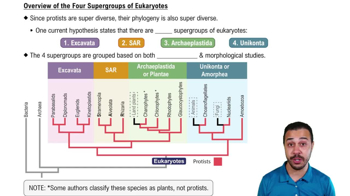
Step 1: Understand the SAR supergroup. The SAR supergroup is a major group of protists that includes three main clades: Stramenopiles, Alveolates, and Rhizaria. Each clade contains specific organisms with unique characteristics.
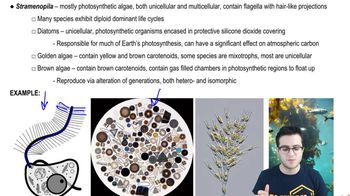
Step 2: Review the characteristics of Stramenopiles. Stramenopiles include organisms such as brown algae, diatoms, and water molds. Brown algae are a well-known member of this clade.
Step 3: Examine the Alveolates clade. Alveolates include organisms such as dinoflagellates, ciliates, and apicomplexans (e.g., Plasmodium, which causes malaria). Both dinoflagellates and Plasmodium are correctly associated with this clade.
Step 4: Investigate the Rhizaria clade. Rhizaria includes organisms such as foraminiferans, radiolarians, and cercozoans. Diatoms, however, are not part of this clade; they belong to the Stramenopiles.
Step 5: Identify the incorrect pairing. Based on the analysis, the incorrect pairing is 'Rhizaria—diatoms,' as diatoms are part of the Stramenopiles, not Rhizaria.

Verified video answer for a similar problem:

This video solution was recommended by our tutors as helpful for the problem above.
Video duration:
1m
Was this helpful?

Key Concepts

Here are the essential concepts you must grasp in order to answer the question correctly.

SAR Supergroup

The SAR supergroup is a major clade in the eukaryotic domain that includes three diverse groups: Stramenopiles, Alveolates, and Rhizaria. This classification is based on genetic and morphological data, highlighting the evolutionary relationships among these organisms. Understanding the SAR supergroup is essential for identifying the characteristics and ecological roles of its members.
Recommended video:
Guided course
03:01
Overview of the Four Supergroups of Eukaryotes

Stramenopiles

Stramenopiles are a group of protists characterized by their unique flagella, which have hair-like projections. This group includes important organisms such as brown algae, diatoms, and water molds. Recognizing the members of this clade helps in understanding their ecological significance, particularly in aquatic environments.
Recommended video:
Guided course
10:24
Stramenopila and Alveolata

Alveolates

Alveolates are a clade of protists defined by the presence of alveoli, which are membrane-bound sacs located just beneath the plasma membrane. This group includes dinoflagellates, ciliates, and apicomplexans, such as Plasmodium, the causative agent of malaria. Familiarity with alveolates is crucial for understanding their diverse life cycles and ecological roles, including their impact on human health.
Recommended video:
Guided course
10:24
Stramenopila and Alveolata