
Pearson+ LogoPearson+ Logo
Ch. 28 Nervous Systems
Taylor - Campbell Biology: Concepts & Connections 10th Edition
Taylor, Simon, Dickey, Hogan10th EditionCampbell Biology: Concepts & ConnectionsISBN: 9780136538783Not the one you use?Change textbook
Chapter 28, Problem 6

Which division of the autonomic nervous system would you expect to be activated if a person heard an intruder at the front door?
a. Parasympathetic
b. Sympathetic
c. Enteric

Verified step by step guidance
1
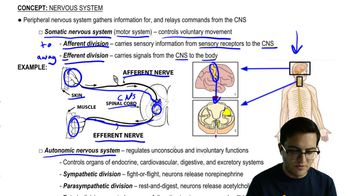
Understand the autonomic nervous system (ANS): The ANS is divided into three divisions: the sympathetic, parasympathetic, and enteric systems. Each division has specific roles in regulating involuntary physiological functions.
Review the role of the sympathetic division: The sympathetic nervous system is responsible for the 'fight or flight' response, which prepares the body to respond to perceived threats or emergencies by increasing heart rate, dilating pupils, and redirecting blood flow to muscles.
Review the role of the parasympathetic division: The parasympathetic nervous system is responsible for the 'rest and digest' state, which promotes relaxation, digestion, and energy conservation.
Review the role of the enteric division: The enteric nervous system primarily controls gastrointestinal functions and operates independently of the 'fight or flight' or 'rest and digest' responses.
Determine the correct division: Hearing an intruder at the front door would likely activate the sympathetic division, as this situation involves a potential threat that requires a 'fight or flight' response.

Verified video answer for a similar problem:

This video solution was recommended by our tutors as helpful for the problem above.
Video duration:
1m
Was this helpful?

Key Concepts

Here are the essential concepts you must grasp in order to answer the question correctly.

Autonomic Nervous System

The autonomic nervous system (ANS) is a component of the peripheral nervous system that regulates involuntary physiological functions, including heart rate, blood pressure, respiration, and digestion. It is divided into three main divisions: sympathetic, parasympathetic, and enteric, each playing distinct roles in maintaining homeostasis and responding to stressors.
Recommended video:
Guided course
06:26
Peripheral Nervous System

Sympathetic Nervous System

The sympathetic nervous system is responsible for the body's 'fight or flight' response during stressful situations. When activated, it prepares the body for rapid action by increasing heart rate, dilating airways, and redirecting blood flow to muscles, which would be crucial if a person perceives a threat, such as an intruder.
Recommended video:
Guided course
06:26
Peripheral Nervous System

Parasympathetic Nervous System

The parasympathetic nervous system promotes the 'rest and digest' state, counteracting the effects of the sympathetic nervous system. It conserves energy by slowing the heart rate, increasing intestinal and gland activity, and relaxing sphincter muscles, which is more active during calm, non-stressful situations.
Recommended video:
Guided course
06:26
Peripheral Nervous System
Related Practice
Textbook Question

Fill in the blanks to match some brain structures with their associated functions.

a. If the ___________ is severed, the right and left cerebral hemispheres cannot communicate.

b. The ___________ system helps store emotional memories.

c. Accounting for most of the weight of your brain is the highly folded ___________ ; it is the outer region of the ___________ .

d. The ___________ is responsible for hand-eye coordination.

e. The ___________ contains a cluster of neurons that function as the biological clock.

1954
views
Textbook Question
What causes a nerve signal to move from one end of a neuron along the length of the neuron to the other end? What is a nerve signal, exactly? Why can't it go backward? How is a nerve signal transmitted from one neuron to the next across a synapse? Write a short paragraph that answers these questions.
1094
views
Textbook Question

Joe accidentally touched a hot pan. His arm jerked back, and an instant later, he felt a burning pain. How would you explain the fact that his arm moved before he felt the pain?

a. His limbic system blocked the pain momentarily, but the important pain signals eventually got through.

b. His response was a spinal cord reflex that occurred before the pain signals reached the brain.

c. Motor neurons are myelinated; sensory neurons are not. The signals traveled faster to his muscles.

d. This scenario is not actually possible. The brain must register pain before a person can react.

1025
views
Textbook Question

Anesthetics block pain by blocking the transmission of nerve signals. Which of these three chemicals might work as anesthetics? (Choose all that apply and explain your selections.)

a. A chemical that prevents the opening of voltage-gated Na+ channels in membranes

b. A chemical that inhibits the enzymes that degrade neurotransmitters

c. A chemical that blocks neurotransmitter receptors

968
views
Textbook Question

A proposal to test an SSRI in a large number of individuals with depression was submitted to the FDA. Through random assignments, half of the patients would be controls, receiving nothing at all, and half the patients would receive the drug in pill form. Patients in both groups would note changes in their own mood in a daily journal. What flaw(s) do you note in this experimental design?

811
views
Textbook Question
Using microelectrodes, a researcher recorded nerve signals in four neurons in the brain of a snail, called A, B, C, and D in the table below. A, B, and C can all transmit signals to D. In three experiments, the animal was stimulated in different ways. The number of nerve signals transmitted per second by each of the cells is recorded in the table. Write a short paragraph explaining the different results of the three experiments.

1138
views