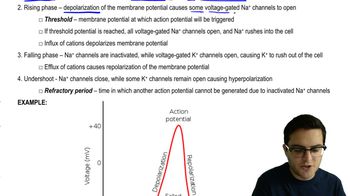
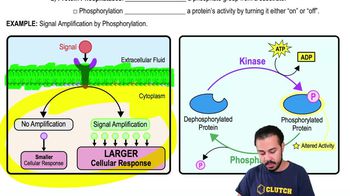
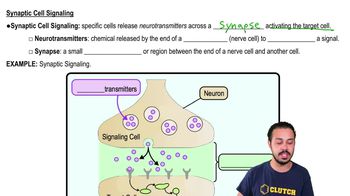
What causes a nerve signal to move from one end of a neuron along the length of the neuron to the other end? What is a nerve signal, exactly? Why can't it go backward? How is a nerve signal transmitted from one neuron to the next across a synapse? Write a short paragraph that answers these questions.
Verified step by step guidance
Verified video answer for a similar problem:
Key Concepts
Nerve Signal (Action Potential)
Propagation of Nerve Signals
Synaptic Transmission
Fill in the blanks to match some brain structures with their associated functions.
a. If the ___________ is severed, the right and left cerebral hemispheres cannot communicate.
b. The ___________ system helps store emotional memories.
c. Accounting for most of the weight of your brain is the highly folded ___________ ; it is the outer region of the ___________ .
d. The ___________ is responsible for hand-eye coordination.
e. The ___________ contains a cluster of neurons that function as the biological clock.
Joe accidentally touched a hot pan. His arm jerked back, and an instant later, he felt a burning pain. How would you explain the fact that his arm moved before he felt the pain?
a. His limbic system blocked the pain momentarily, but the important pain signals eventually got through.
b. His response was a spinal cord reflex that occurred before the pain signals reached the brain.
c. Motor neurons are myelinated; sensory neurons are not. The signals traveled faster to his muscles.
d. This scenario is not actually possible. The brain must register pain before a person can react.
Which division of the autonomic nervous system would you expect to be activated if a person heard an intruder at the front door?
a. Parasympathetic
b. Sympathetic
c. Enteric
Anesthetics block pain by blocking the transmission of nerve signals. Which of these three chemicals might work as anesthetics? (Choose all that apply and explain your selections.)
a. A chemical that prevents the opening of voltage-gated Na+ channels in membranes
b. A chemical that inhibits the enzymes that degrade neurotransmitters
c. A chemical that blocks neurotransmitter receptors