Pearson+ LogoPearson+ Logo
Ch. 28 Nervous Systems
Taylor - Campbell Biology: Concepts & Connections 10th Edition
Taylor, Simon, Dickey, Hogan10th EditionCampbell Biology: Concepts & ConnectionsISBN: 9780136538783Not the one you use?Change textbook
Chapter 28, Problem 3

Fill in the blanks to match some brain structures with their associated functions.
a. If the ___________ is severed, the right and left cerebral hemispheres cannot communicate.
b. The ___________ system helps store emotional memories.
c. Accounting for most of the weight of your brain is the highly folded ___________ ; it is the outer region of the ___________ .
d. The ___________ is responsible for hand-eye coordination.
e. The ___________ contains a cluster of neurons that function as the biological clock.

Verified step by step guidance
1
Step 1: For part (a), identify the structure that connects the right and left cerebral hemispheres. This structure is responsible for communication between the two hemispheres. Hint: It is a large bundle of nerve fibers.
Step 2: For part (b), determine the system in the brain that is involved in processing emotions and storing emotional memories. Hint: This system includes structures like the amygdala and hippocampus.
Step 3: For part (c), recognize the outermost layer of the brain that is highly folded and accounts for most of the brain's weight. Then, identify the larger brain region to which this outer layer belongs.
Step 4: For part (d), identify the brain structure responsible for coordinating motor movements, such as hand-eye coordination. Hint: This structure is located at the back of the brain.
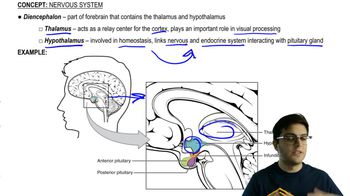
Step 5: For part (e), determine the brain region that contains a cluster of neurons functioning as the biological clock. Hint: This cluster regulates circadian rhythms and is located in the hypothalamus.

Verified video answer for a similar problem:

This video solution was recommended by our tutors as helpful for the problem above.
Video duration:
1m
Was this helpful?

Key Concepts

Here are the essential concepts you must grasp in order to answer the question correctly.

Corpus Callosum

The corpus callosum is a thick band of nerve fibers that connects the left and right cerebral hemispheres, facilitating communication between them. If this structure is severed, as in a condition known as split-brain syndrome, the two hemispheres cannot share information, leading to distinct cognitive and perceptual differences.
Recommended video:
Guided course
11:10
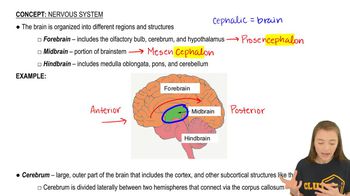
Cerebrum and Cerebral Cortex

Limbic System

The limbic system is a complex set of structures located deep within the brain, primarily involved in emotion regulation, memory formation, and motivation. Key components include the amygdala and hippocampus, which play crucial roles in processing emotional memories and forming new ones.
Recommended video:
Guided course
04:35
Limbic System

Cerebral Cortex

The cerebral cortex is the outermost layer of the brain, characterized by its highly folded structure, which increases surface area and cognitive capacity. It is responsible for many higher-order functions, including sensory perception, reasoning, and voluntary motor actions, and is divided into four lobes: frontal, parietal, temporal, and occipital.
Recommended video:
Guided course
11:10
Cerebrum and Cerebral Cortex
Related Practice
Textbook Question
Test your understanding of the nervous system by matching the following labels with their corresponding letters: CNS, effector cells, interneuron, motor neuron, PNS, sensory neuron, sensory receptor, spinal cord, synapse.

2067
views
Textbook Question
The inside of the neuron has a lower concentration of positive ions than the outside of the neuron. Is the membrane potential positive or negative?
1424
views
Textbook Question
What causes a nerve signal to move from one end of a neuron along the length of the neuron to the other end? What is a nerve signal, exactly? Why can't it go backward? How is a nerve signal transmitted from one neuron to the next across a synapse? Write a short paragraph that answers these questions.
1094
views
Textbook Question

Joe accidentally touched a hot pan. His arm jerked back, and an instant later, he felt a burning pain. How would you explain the fact that his arm moved before he felt the pain?

a. His limbic system blocked the pain momentarily, but the important pain signals eventually got through.

b. His response was a spinal cord reflex that occurred before the pain signals reached the brain.

c. Motor neurons are myelinated; sensory neurons are not. The signals traveled faster to his muscles.

d. This scenario is not actually possible. The brain must register pain before a person can react.

1025
views
Textbook Question

Which division of the autonomic nervous system would you expect to be activated if a person heard an intruder at the front door?

a. Parasympathetic

b. Sympathetic

c. Enteric

1291
views