Pearson+ LogoPearson+ Logo
Ch. 21 Nutrition and Digestion
Taylor - Campbell Biology: Concepts & Connections 10th Edition
Taylor, Simon, Dickey, Hogan10th EditionCampbell Biology: Concepts & ConnectionsISBN: 9780136538783Not the one you use?Change textbook
Chapter 21, Problem 4

The energy content of fats
a. Is released by bile salts.
b. Is, per gram, twice that of carbohydrates or proteins.
c. Cannot be dissolved in water and so cannot be absorbed.
d. Is usually healthier than the energy content of carbohydrates.

Verified step by step guidance
1
Understand the context of the question: The problem is asking about the energy content of fats compared to other macromolecules like carbohydrates and proteins. This requires knowledge of macromolecule metabolism and energy yield.
Recall the energy yield of macromolecules: Fats, carbohydrates, and proteins differ in their energy content per gram. Fats provide approximately 9 kcal per gram, while carbohydrates and proteins each provide about 4 kcal per gram. This makes fats roughly twice as energy-dense as carbohydrates or proteins.
Analyze the options: Option (a) mentions bile salts, which are involved in fat digestion but not directly related to energy content. Option (b) aligns with the fact that fats have twice the energy per gram compared to carbohydrates or proteins. Option (c) incorrectly states that fats cannot be absorbed due to their insolubility in water; fats are absorbed after being emulsified by bile salts. Option (d) makes a subjective claim about healthiness, which is unrelated to energy content.
Focus on the correct answer: Based on the comparison of energy yield per gram, the correct answer is related to the fact that fats provide twice the energy of carbohydrates or proteins.
Conclude the reasoning: The correct answer is (b), as it accurately reflects the energy content of fats compared to other macromolecules. This understanding is essential for studying metabolism and energy balance in biology.

Verified video answer for a similar problem:

This video solution was recommended by our tutors as helpful for the problem above.
Video duration:
38s
Was this helpful?

Key Concepts

Here are the essential concepts you must grasp in order to answer the question correctly.

Energy Content of Macromolecules

Fats, carbohydrates, and proteins are the three primary macromolecules that provide energy to the body. Fats contain approximately 9 calories per gram, while carbohydrates and proteins each provide about 4 calories per gram. This significant difference in energy content is crucial for understanding dietary choices and energy metabolism.
Recommended video:
Guided course
04:58
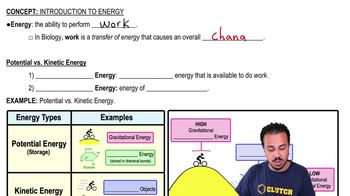
Introduction to Energy

Absorption of Fats

Fats are hydrophobic molecules, meaning they do not dissolve in water. This property affects their absorption in the digestive system, where bile salts emulsify fats, allowing them to be broken down and absorbed by intestinal cells. Understanding this process is essential for grasping how dietary fats contribute to energy intake.
Recommended video:
Guided course
19:59
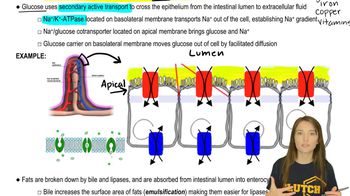
Nutrient Absorption

Health Implications of Dietary Fats vs. Carbohydrates

The health implications of consuming fats compared to carbohydrates can vary significantly based on the type of fat or carbohydrate. While some fats (like unsaturated fats) can be beneficial, others (like trans fats) can be harmful. Similarly, refined carbohydrates can lead to health issues, making it important to evaluate the quality of these macronutrients in the diet.
Recommended video:
Guided course
04:53
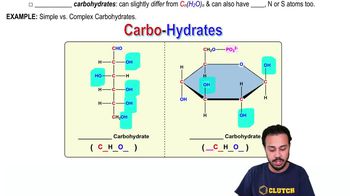
Carbohydrates
Related Practice
Textbook Question

Label the parts of the human digestive system below and indicate the functions of these organs and glands.

<Image>

3822
views
Textbook Question

Complete the following map summarizing the nutritional needs of animals that are met by a healthy diet.

1106
views
Textbook Question

Earthworms, which are substrate feeders,

a. Feed mostly on mineral substrates.

b. Filter small organisms from the soil.

c. Are bulk feeders that ingest large pieces of food.

d. Eat their way through the soil, feeding on partially decayed organic matter.

2054
views
Textbook Question

Which of the following vitamins is mismatched with the disease that results from its underconsumption?

a. Vitamin B6—Beriberi

b. Vitamin C—Scurvy

c. Vitamin A—Vision loss

d. Vitamin D—Rickets

871
views
Textbook Question

Which of the following statements is false?

a. A healthy human has enough stored fat to supply calories for several weeks.

b. An increase in leptin levels leads to an increase in appetite and weight gain.

c. The interconversion of glucose and glycogen takes place in the liver.

d. After glycogen stores are filled, excessive calories are stored as fat, regardless of their original food source.

993
views
Textbook Question

Why is it necessary for healthy vegetarians to combine different plant foods or eat some eggs or milk products?

a. To make sure they obtain sufficient calories

b. To provide sufficient vitamins

c. To make sure they ingest all essential fatty acids

d. To provide all essential amino acids for protein synthesis

1285
views