Pearson+ LogoPearson+ Logo
Ch. 8 The Cellular Basis of Reproduction and Inheritance
Taylor - Campbell Biology: Concepts & Connections 10th Edition
Taylor, Simon, Dickey, Hogan10th EditionCampbell Biology: Concepts & ConnectionsISBN: 9780136538783Not the one you use?Change textbook
Chapter 8, Problem 1

Complete the following table to compare mitosis and meiosis.

Verified step by step guidance
1
Step 1: Begin by understanding the key differences between mitosis and meiosis. Mitosis is a process of cell division that results in two genetically identical daughter cells, while meiosis is a process that produces four genetically diverse daughter cells for sexual reproduction.
Step 2: Fill in the 'Number of chromosomal duplications' row. Both mitosis and meiosis involve one round of DNA replication during the S phase of the cell cycle, prior to the start of division.
Step 3: Fill in the 'Number of cell divisions' row. Mitosis involves one cell division, while meiosis involves two consecutive cell divisions: meiosis I and meiosis II.
Step 4: Fill in the 'Number of daughter cells produced' row. Mitosis produces two daughter cells, while meiosis produces four daughter cells.
Step 5: Continue filling the table by addressing the remaining rows: 'Number of chromosomes in the daughter cells' (diploid for mitosis, haploid for meiosis), 'How the chromosomes line up during metaphase' (single file for mitosis, homologous pairs for meiosis I), 'Genetic relationship of the daughter cells to the parent cell' (identical for mitosis, genetically diverse for meiosis), and 'Functions performed in the human body' (growth and repair for mitosis, gamete production for meiosis).

Verified video answer for a similar problem:

This video solution was recommended by our tutors as helpful for the problem above.
Video duration:
1m
Was this helpful?

Key Concepts

Here are the essential concepts you must grasp in order to answer the question correctly.

Mitosis

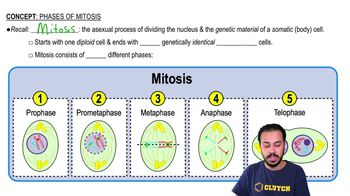
Mitosis is a type of cell division that results in two genetically identical daughter cells, each with the same number of chromosomes as the parent cell. It is essential for growth, repair, and asexual reproduction in organisms. The process includes stages such as prophase, metaphase, anaphase, and telophase, culminating in cytokinesis.
Recommended video:
Guided course
03:21
Phases of Mitosis

Meiosis

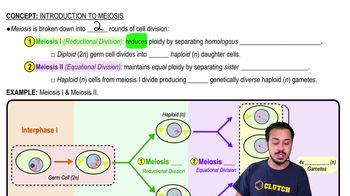
Meiosis is a specialized form of cell division that reduces the chromosome number by half, resulting in four genetically diverse gametes (sperm or eggs). It consists of two rounds of division: meiosis I and meiosis II, and includes processes like crossing over and independent assortment, which enhance genetic variation in sexually reproducing organisms.
Recommended video:
Guided course
04:49
Meiosis I & Meiosis II

Chromosome Number

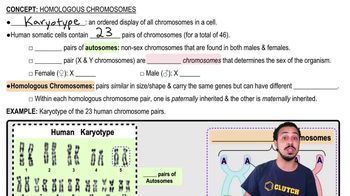
Chromosome number refers to the total count of chromosomes in a cell, which varies among species. In humans, somatic cells have 46 chromosomes (diploid), while gametes have 23 chromosomes (haploid). Understanding the difference in chromosome number between mitosis and meiosis is crucial for grasping how genetic information is passed on during reproduction.
Recommended video:
Guided course
08:09
Homologous Chromosomes