Pearson+ LogoPearson+ Logo
Ch. 8 The Cellular Basis of Reproduction and Inheritance
Taylor - Campbell Biology: Concepts & Connections 10th Edition
Taylor, Simon, Dickey, Hogan10th EditionCampbell Biology: Concepts & ConnectionsISBN: 9780136538783Not the one you use?Change textbook
Chapter 8, Problem 4

It is difficult to observe individual chromosomes during interphase because
a. The DNA has not been replicated yet
b. They are in the form of long, thin strands
c. They leave the nucleus and are dispersed to other parts of the cell
d. Homologous chromosomes do not pair up until division starts

Verified step by step guidance
1
Understand the context of the question: Interphase is a stage in the cell cycle where the cell prepares for division. During this phase, the DNA is actively being used for transcription and replication, and the chromosomes are not condensed into visible structures.
Recall the structure of chromosomes during interphase: Chromosomes exist as chromatin, which is a complex of DNA and proteins. This chromatin is in a relaxed, uncondensed state, making it difficult to observe individual chromosomes under a microscope.
Eliminate incorrect options: a) The DNA has already been replicated by the end of interphase, so this is not the reason. c) Chromosomes do not leave the nucleus; they remain within it. d) Homologous chromosomes pairing occurs during meiosis, not interphase.
Focus on the correct explanation: During interphase, chromosomes are in the form of long, thin strands of chromatin, which are not tightly packed. This uncondensed state allows for transcription and replication but makes them difficult to distinguish individually.
Conclude that the correct answer is related to the physical state of chromosomes during interphase, which is best described by option b.

Verified video answer for a similar problem:

This video solution was recommended by our tutors as helpful for the problem above.
Video duration:
1m
Was this helpful?

Key Concepts

Here are the essential concepts you must grasp in order to answer the question correctly.

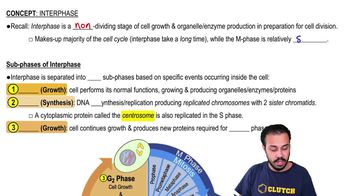
Interphase

Interphase is the phase of the cell cycle where the cell prepares for division. It consists of three stages: G1 (cell growth), S (DNA synthesis), and G2 (preparation for mitosis). During interphase, chromosomes are not yet condensed, making them difficult to observe under a microscope.
Recommended video:

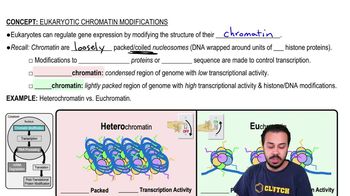
Chromatin Structure

Chromatin is the complex of DNA and proteins found in the nucleus of eukaryotic cells. During interphase, chromatin exists in a less condensed form, allowing for gene expression and DNA replication. This elongated structure makes individual chromosomes challenging to distinguish.
Recommended video:
Guided course
03:56
Eukaryotic Chromatin Modifications

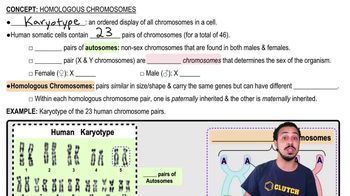
Chromosome Replication

Chromosome replication occurs during the S phase of interphase, where each chromosome is duplicated to ensure that each daughter cell receives an identical set of chromosomes. However, prior to this replication, chromosomes are not yet visible as distinct entities, contributing to the difficulty in observing them.
Recommended video:
Guided course
08:09
Homologous Chromosomes