Pearson+ LogoPearson+ Logo
Ch. 8 The Cellular Basis of Reproduction and Inheritance
Taylor - Campbell Biology: Concepts & Connections 10th Edition
Taylor, Simon, Dickey, Hogan10th EditionCampbell Biology: Concepts & ConnectionsISBN: 9780136538783Not the one you use?Change textbook
Chapter 8, Problem 2

If an intestinal cell in a grasshopper contains 24 chromosomes, then a grasshopper sperm cell contains ___________ chromosomes.
a. 6
b. 12
c. 24
d. 48

Verified step by step guidance
1
Determine the type of cell being described. An intestinal cell is a somatic (body) cell, which is diploid (2n), meaning it contains two sets of chromosomes.
Understand that sperm cells are gametes, which are haploid (n), meaning they contain only one set of chromosomes. Gametes are produced through meiosis, which reduces the chromosome number by half.
Identify the chromosome number in the somatic cell. The problem states that the intestinal cell contains 24 chromosomes, which represents the diploid (2n) number.
Calculate the haploid (n) number by dividing the diploid number by 2. Use the formula: n=2n2.
Conclude that the sperm cell, being haploid, contains half the number of chromosomes as the somatic cell. This value corresponds to one of the answer choices provided.

Verified video answer for a similar problem:

This video solution was recommended by our tutors as helpful for the problem above.
Video duration:
1m
Was this helpful?

Key Concepts

Here are the essential concepts you must grasp in order to answer the question correctly.

Chromosome Number in Organisms

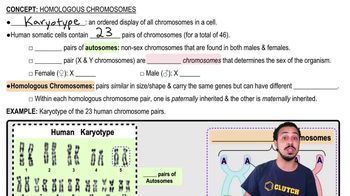
Different organisms have varying numbers of chromosomes, which are structures that carry genetic information. In diploid organisms, like grasshoppers, somatic cells (such as intestinal cells) contain two sets of chromosomes, one from each parent. This means that the total number of chromosomes in these cells is double that of the gametes, which are haploid.
Recommended video:
Guided course
08:09
Homologous Chromosomes

Diploid vs. Haploid Cells

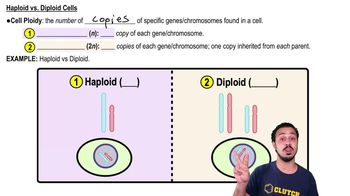
Diploid cells contain two complete sets of chromosomes, while haploid cells contain only one set. In the case of grasshoppers, the intestinal cells are diploid with 24 chromosomes, indicating they have two sets. Sperm cells, being gametes, are haploid and thus contain half the number of chromosomes found in diploid cells.
Recommended video:
Guided course
04:14
Haploid vs. Diploid Cells

Meiosis and Gamete Formation

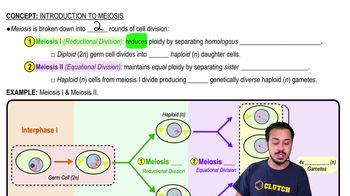
Meiosis is the process by which diploid cells divide to form haploid gametes. During this process, the chromosome number is halved, ensuring that when fertilization occurs, the resulting zygote has the correct diploid number. In grasshoppers, if the intestinal cell has 24 chromosomes, the sperm cell produced through meiosis will have 12 chromosomes.
Recommended video:
Guided course
04:49
Meiosis I & Meiosis II