Pearson+ LogoPearson+ Logo
Ch. 29 The Senses
Taylor - Campbell Biology: Concepts & Connections 10th Edition
Taylor, Simon, Dickey, Hogan10th EditionCampbell Biology: Concepts & ConnectionsISBN: 9780136538783Not the one you use?Change textbook
Chapter 29, Problem 9

Hold your right eye closed. With your left eye, look at the + in the image below. Starting from about two feet away, slowly bring your head closer while looking at the +. What happens to the dot when you get close to the image? What property of the eye's structure does this exercise demonstrate? A black dot and a plus sign on a white background for a sensory system exercise.

Verified step by step guidance
1
Step 1: Hold your right eye closed and look at the + sign with your left eye.
Step 2: Start from about two feet away from the image.
Step 3: Slowly bring your head closer to the image while keeping your left eye focused on the + sign.
Step 4: Observe what happens to the black dot as you get closer to the image.
Step 5: Understand that the black dot will disappear at a certain point, demonstrating the blind spot in your eye where the optic nerve exits the retina and lacks photoreceptors.

Verified video answer for a similar problem:

This video solution was recommended by our tutors as helpful for the problem above.
Video duration:
1m
Was this helpful?

Key Concepts

Here are the essential concepts you must grasp in order to answer the question correctly.

Visual Acuity

Visual acuity refers to the clarity or sharpness of vision, which is determined by the ability of the eye to resolve fine details. This concept is crucial for understanding how the eye perceives objects at varying distances. As you bring your head closer to the image, the visual acuity may change, affecting how the dot appears, demonstrating the eye's ability to focus.
Recommended video:
Guided course
02:52
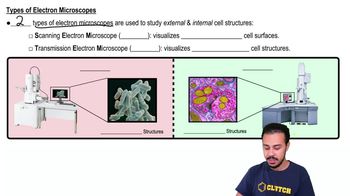
Types of Electron Microscopes

Accommodation

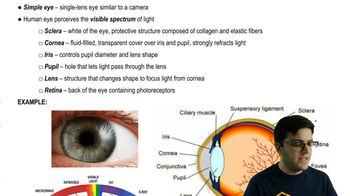
Accommodation is the process by which the eye adjusts its lens to focus on objects at different distances. When you move closer to the image, the ciliary muscles contract, changing the shape of the lens to maintain a clear image. This exercise illustrates the eye's accommodation mechanism, as the dot may appear to change or blur when the focus is adjusted.

Binocular Vision

Binocular vision is the ability to perceive a single three-dimensional image from two slightly different perspectives provided by each eye. This concept is relevant in the context of the exercise, as closing one eye alters depth perception and may affect how the dot and the plus sign are perceived. It highlights the importance of both eyes working together for optimal visual processing.
Recommended video:
Related Practice
Textbook Question
How does your brain determine the volume and pitch of sounds?
1458
views
Textbook Question

Eighty-year-old Mr. Johnson was becoming slightly deaf. To test his hearing, his doctor held a vibrating tuning fork tightly against the back of Mr. Johnson's skull. This sent vibrations through the bones of the skull, setting the fluid in the cochlea in motion. Mr. Johnson could hear the tuning fork this way, but not when it was held away from the skull a few inches from his ear. The problem was probably in the _________ . (Explain your answer.)

a. Auditory nerve leading to the brain

b. Hair cells in the cochlea

c. Bones of the middle ear

d. Fluid of the cochlea

754
views
Textbook Question
When you first sit down to read in a coffee shop, the surroundings seem very loud. Yet after a few minutes reading you realize you hardly notice the noise at all. Why is that?
771
views
Textbook Question
Construct a graph in which membrane potential is on the y axis and time is on the x axis. Then draw the action potentials that occur when a bitter flavor is absent, followed by the action potentials that result when a person tastes a bitter flavor.
872
views
Textbook Question

We know that sea turtle hatchlings use Earth's magnetic field to navigate. Do they also use light cues from the moon to get from the sand to the ocean waves? Outline an experiment to answer this question.

851
views
Textbook Question
Have you ever felt your ears ringing after listening to loud music? Can this permanently impair your hearing? Should manufacturers of music devices and producers of concerts be required to warn consumers? What effect might warnings have?
668
views