Pearson+ LogoPearson+ Logo
Ch. 19 The Evolution of Vertebrate Diversity
Taylor - Campbell Biology: Concepts & Connections 10th Edition
Taylor, Simon, Dickey, Hogan10th EditionCampbell Biology: Concepts & ConnectionsISBN: 9780136538783Not the one you use?Change textbook
Chapter 19, Problem 2

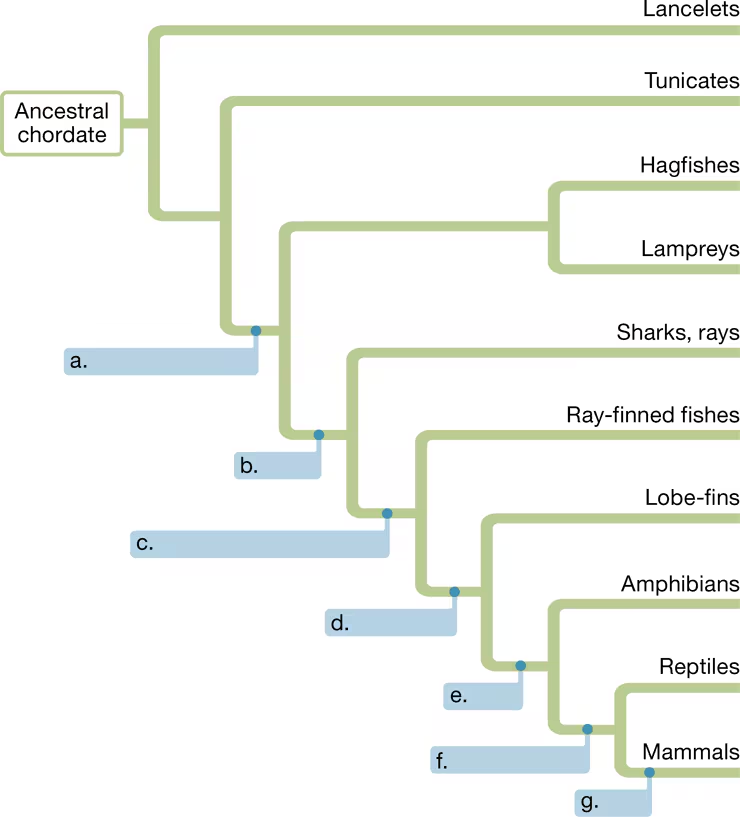
In the chordate phylogenetic tree below, fill in the shared derived character that defines each clade.
Phylogenetic tree of chordates with labels for shared derived characters at each clade.

Verified step by step guidance
1
Identify the concept of shared derived characters (synapomorphies): These are traits that are unique to a particular clade and are used to define evolutionary relationships within the phylogenetic tree.
Start at the base of the chordate phylogenetic tree. The notochord (a) is the shared derived character that defines all chordates, so it should be placed at the base of the tree.
Move up the tree to the next clade. The vertebral column (b) is the shared derived character that defines vertebrates, so it should be placed at the branch point where vertebrates diverge from other chordates.
Continue to the next clade. Jaws (c) are a shared derived character that defines gnathostomes (jawed vertebrates), so they should be placed at the branch point where jawed vertebrates diverge from jawless vertebrates.
Proceed further up the tree, adding the remaining shared derived characters (d: bony skeleton, e: four limbs, f: amniotic egg, g: hairs) at the appropriate branch points based on their evolutionary appearance. For example, four limbs (e) define tetrapods, and hairs (g) define mammals.

Verified video answer for a similar problem:

This video solution was recommended by our tutors as helpful for the problem above.
Video duration:
59s
Was this helpful?

Key Concepts

Here are the essential concepts you must grasp in order to answer the question correctly.

Notochord

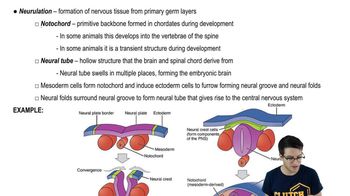
The notochord is a flexible rod-like structure that provides support and defines the primitive axis of the body in chordates. It is a key characteristic of all chordates during some stage of their development, serving as a precursor to the vertebral column in vertebrates. The presence of a notochord is essential for the development of the nervous system and the overall body plan.
Recommended video:
Guided course
06:55
Organogenesis and Neurulation

Vertebral Column

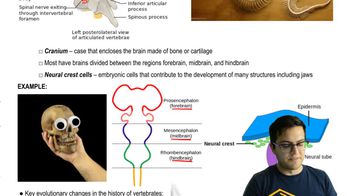
The vertebral column, or backbone, is a series of vertebrae that encase and protect the spinal cord in vertebrates. It is a defining feature of the subphylum Vertebrata, providing structural support and enabling greater mobility. The evolution of the vertebral column marks a significant advancement in the complexity and functionality of the chordate body plan.
Recommended video:

Amniotic Egg

The amniotic egg is a key evolutionary adaptation that allows for reproduction in a terrestrial environment. It features a protective shell and several membranes, including the amnion, which encases the embryo in a fluid-filled cavity. This adaptation is crucial for reptiles, birds, and mammals, as it prevents desiccation and supports the development of the embryo outside of water.
Recommended video: