Pearson+ LogoPearson+ Logo
Ch. 48 - The Immune System in Animals
Freeman - Biological Science 7th Edition
Freeman7th EditionBiological ScienceISBN: 9783584863285Not the one you use?Change textbook
Chapter 48, Problem 12

<Image>
In developed countries, an enormous change has occurred within the human body over the past century—the loss of parasitic worms. Due to improvements in sanitation, roundworms that have inhabited human intestines (such as the hookworm above) and challenged our immune system for millions of years are no longer a threat. Does the end of this long-term relationship come at a cost?
Explain how the adaptive and innate immune responses work together to defend the human body against infection by parasitic worms.

Verified step by step guidance
1
Begin by understanding the two main components of the immune system: the innate immune response and the adaptive immune response. The innate immune response is the body's first line of defense and acts quickly to recognize and respond to pathogens. It includes physical barriers like skin, as well as immune cells like macrophages and neutrophils that can engulf and destroy pathogens.
The adaptive immune response is more specific and takes longer to activate. It involves lymphocytes, such as B cells and T cells, which recognize specific antigens presented by pathogens. This response is characterized by its ability to remember past infections, providing long-term immunity.
When a parasitic worm enters the body, the innate immune system is the first to respond. Cells like eosinophils and mast cells play a crucial role in targeting parasitic worms. Eosinophils release toxic granules that can damage the worm, while mast cells release histamine, contributing to inflammation and recruiting other immune cells to the site of infection.
The adaptive immune system is activated when antigen-presenting cells, such as dendritic cells, process and present antigens from the parasitic worm to T cells. Helper T cells then stimulate B cells to produce antibodies specific to the antigens of the worm. These antibodies can neutralize the worm or mark it for destruction by other immune cells.
Together, the innate and adaptive immune responses create a coordinated defense against parasitic worms. The innate response provides immediate action, while the adaptive response offers a targeted and long-lasting defense, ensuring that the body can effectively combat and remember the parasitic threat for future encounters.

Verified video answer for a similar problem:

This video solution was recommended by our tutors as helpful for the problem above.
Video duration:
3m
Was this helpful?

Key Concepts

Here are the essential concepts you must grasp in order to answer the question correctly.

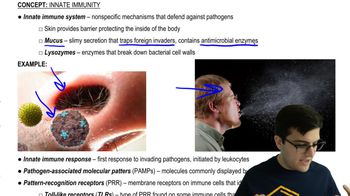
Innate Immune Response

The innate immune response is the body's first line of defense against pathogens, including parasitic worms. It is non-specific and includes physical barriers like skin, chemical barriers like stomach acid, and immune cells like macrophages and neutrophils that quickly respond to invaders. This system acts immediately to prevent the spread of infection and signals the adaptive immune system for further action.
Recommended video:
Guided course
05:20
Innate Immune Response

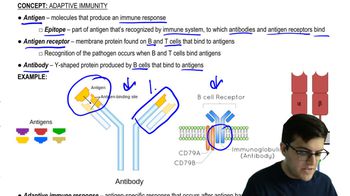
Adaptive Immune Response

The adaptive immune response is a specific defense mechanism that targets particular pathogens, including parasitic worms. It involves lymphocytes, such as B cells and T cells, which recognize antigens and produce antibodies or directly attack infected cells. This response is slower to activate but provides long-lasting protection and memory, allowing the body to respond more efficiently to future infections by the same pathogen.
Recommended video:
Guided course
05:50
Adaptive Immune Response

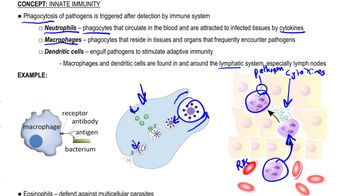
Interaction Between Innate and Adaptive Immunity

The innate and adaptive immune responses work together to protect the body from parasitic worms. The innate system initially detects and responds to the infection, providing immediate defense and signaling the adaptive system. Dendritic cells, part of the innate system, present antigens to T cells, activating the adaptive response. This collaboration ensures a comprehensive defense, with the innate system containing the infection and the adaptive system providing targeted and lasting immunity.
Recommended video:
Guided course
06:47
Innate Immune Cells
Related Practice
Textbook Question

Which of the following outcomes would be expected if somatic hypermutation did not occur?

a. The diversity of pattern-recognition receptors would be significantly lowered.

b. B and T lymphocytes would not be able to produce receptors that recognize antigens.

c. The adaptive immune response would not be activated by pathogens.

d. The secondary immune response to a repeat infection would produce the same antibodies as those made in the primary immune response.

715
views
Textbook Question

Propose a hypothesis to explain how self-reactive B cells are identified and eliminated during maturation.

614
views
Textbook Question

<Image>

In developed countries, an enormous change has occurred within the human body over the past century—the loss of parasitic worms. Due to improvements in sanitation, roundworms that have inhabited human intestines (such as the hookworm above) and challenged our immune system for millions of years are no longer a threat. Does the end of this long-term relationship come at a cost?

What is the hygiene hypothesis? What correlation does it attempt to explain?

762
views
Textbook Question

<Image>

In developed countries, an enormous change has occurred within the human body over the past century—the loss of parasitic worms. Due to improvements in sanitation, roundworms that have inhabited human intestines (such as the hookworm above) and challenged our immune system for millions of years are no longer a threat. Does the end of this long-term relationship come at a cost?

Pattern-recognition receptors have been identified that recognize worm products. Explain how these receptors are used to activate the adaptive immune response most appropriate for worm infection.

963
views
Textbook Question

<Image>

In developed countries, an enormous change has occurred within the human body over the past century—the loss of parasitic worms. Due to improvements in sanitation, roundworms that have inhabited human intestines (such as the hookworm above) and challenged our immune system for millions of years are no longer a threat. Does the end of this long-term relationship come at a cost?

Parasitic worms modulate their host's immune response by inducing the proliferation of regulatory T cells. What role do these cells play in the adaptive immune response? How could this effect on regulatory T cells be linked to the hygiene hypothesis?

733
views
Textbook Question

<Image>

In developed countries, an enormous change has occurred within the human body over the past century—the loss of parasitic worms. Due to improvements in sanitation, roundworms that have inhabited human intestines (such as the hookworm above) and challenged our immune system for millions of years are no longer a threat. Does the end of this long-term relationship come at a cost?

The roundworm Heligmosomoides polygyrus is a natural intestinal parasite of mice, and it offers an excellent model of the immunology of worm infections in humans. Scientists evaluated the impact of parasitic roundworms on immune disorders using mice prone to developing type 1 diabetes mellitus. Five-week-old mice were infected with H. polygyrus (Hp). Two weeks later, half of the mice were cured of the infection (Rx). When the mice were 40 weeks old, scientists calculated the percentage of mice that developed diabetes in both groups: those exposed to roundworms and those in uninfected control groups (** means P<0.01). What two conclusions are supported by the results shown below?

825
views